DH Debate club logo

Dalum Hjallese Debate Club

On the trail of the Danes - in Asia

10. Tarim Basin II

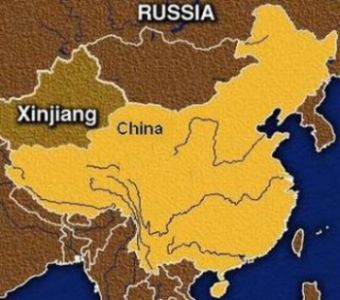
The historical area that today constitutes the Chinese province of Xinjiang consisted in ancient times of many independent kingdoms. They were founded in the distant past by Indo-European steppe nomads. Chinese historians say that around 0 AD they gained honour by attacking each other or by fighting each other. The Hou Hansu document, for example, says that "During the reign of Emperor Ai," which lasted only 7 years, "the kingdoms in the area were further fragmented, so that the 36 kingdoms were divided into 55 kingdoms". This was quite normal for Indo-European kingdoms in ancient times. The many Greek city-states and the Germanic and Celtic tribes of northern Europe waged similar wars against each other.
One might fear that the history of the Tarim Basin kingdoms is a dress rehearsal for the fate of Europe.
The kingdoms sent thousands of their young able men to Buddhist monasteries and embraced Buddhism's ideas of ultimate goodness. The kingdom of Shule became slowly and gradually infiltrated by Turkic Muslims. When Shule was conquered by the neighboring kingdom of Khotan, it brought Khotan into a long and grueling war against the Muslim Kara-Khanid Khanate, which attracted newly converted Muslims from all over Central Asia. After many years of war, Khotan fell to the Muslims, who razed the Buddhist temples to the ground, probably killing the men and fathering their own children on the fair young women.

1. The Jade Gate

One and a half thousand years after the Xiaohe people had abandoned their burial site and a thousand years after the Cherchen man and his women were laid to rest in their tomb - the Emperor of China's men appeared at the threshold of the Tarim Basin.

Far out in the Gobi Desert stand the remains of a Chinese wall, stretching from Dunhuang and 136 km. to the northwest. It was built around the year 0 AD under the Han dynasty emperors of reeds and willow twigs, laid in layers with sand in between. Here is one of the wall's watchtowers. Today it is difficult to see a landscape in reasonable proximity that would have been able to supply such a quantity of reeds and willow twigs. Photo Jiang Dong - China Daily.

The Han Dynasty emperors built a defensive wall of sand, reeds, and willows, extending from Dunhuang 136 km. to the northwest.

Access to the empire was through a gate in the wall called the "Jade Gate", built under the emperor, Wudi, in 121 BC. The gate was named after the many large caravans from Khotan that arrived in China by the route south of the Taklamakhan Desert, carrying the coveted stones.

The "Jade Gate Border Post" is built of compacted earth. It can still be seen in the desert about 80 kilometers northwest of Dunhuang. The rammed earth walls are 10 m. high and pierced by several gate openings, one of which is seen here. The square fort, where the soldiers were housed, covers more than 600 M2 in the middle of the desert. Photo Dunhuang Yumen Pass Xiaofangcheng Ruins Zhang Qi Wikipedia.

We must believe that the purpose of the wall was primarily defense, especially against attacks by the Xiongnu steppe nomads. But one can imagine that the intention was also to guide the merchant caravans on the right path, namely towards the Jade Gate and collect tolls there.

Travelers along the southern branch of the Silk Road to and from the "Western Regions", had to travel through the Jade Gate. It was the last thing they saw of Chinese territory when they set out on long caravan journeys carrying silk, among other things, to India, Parthia and perhaps the eastern provinces of the Roman Empire.

Alternative branches of the Silk Road. It has always been known that one could travel both south and north of the Taklamakhan Desert. In recent times, it has also been shown that a branch of the Silk Road turned off at Miran and went through the Qaidam Creek, further past Lake Koko Nor and down from the Tibetan Plateau along the left bank of the Yellow River. It was also possible to travel the long way north of the Tien Shan Mountains. Furthermore, as we shall see, the pilgrim Xuanzang crossed the Tien Shan Mountains. Wikimedia Commons.

But the merchants were very creative in avoiding the Jade Gate. Caravans began to prefer the northern route via Hami - and so the Jade Gate was abandoned. In recent times, it has also been shown that a branch of the Silk Road ran through the Qaidam Stream, past Koko Nor and down from the Tibetan Plateau along the upper reaches of the Yellow River towards the city of Tianshui in Gansu.

In 1907, the Hungarian-British explorer Sir Aurel Stein found bamboo pieces at the site with an inscription that named the place "Yumenguan" - which means "Jade Gate Border Post" - and in 1944 Chinese archaeologists discovered other inscriptions that confirmed this. Around 500 AD. the "Jade Gate Border Post" was abandoned.

2. The Tocharian languages

Wang Yuanlu, guardian of Dunhuang's Mogao rock temples, outside the monk's quarters opposite Cave 16. Dunhuang Mogao, June 11, 1907. Photo Aurel Stein.

In 1907, Stein arrived in Dunhuang to stock up on supplies for his survey of the Great Wall, which starts at Dunhuang and runs west through the desert.

But then, in Dunhuang, he heard from another traveler an incredible story about a Chinese Taoist priest named Wang Yuan-lu who had accidentally found an enormous amount of very old documents that had been walled up inside a cave for almost a thousand years. It was described to Stein as "several cartloads" of documents.

Pastor Wang was no ordinary man. He had selflessly and single-handedly appointed himself the protector of the amazing picture galleries and statues in the Mogao Caves near Dunhuang.

The site was in great disrepair, but there was still at least one resident Tibetan monk. The picture caves were also the center of an annual religious festival. However, many of the caves were partially filled with sand that had blown in from the desert. It was while removing sand from the corridor of a cave, now called Cave 16, that Wang discovered the hidden so-called Library Cave.

Stein was allowed to examine a selection of the documents. They turned out to be written in a variety of languages, including ancient Chinese, Tibetan, Sanskrit, Turkic runes, Sogdian and Uyghur, but - as it turned out - also in a previously unknown language, which was called Tocharian. This language has not been found outside the Tarim Basin.

Pastor Wang was in dire need of money to preserve and restore the cave paintings and statues. Eventually Stein managed to obtain 7,000 complete manuscripts and 6,000 fragments, for which he paid 130 British pounds. Although the manuscripts included many duplicates of the Diamond and Lotus Sutras. The documents filled 24 boxes, and Stein has stated that he was unable to relax as long as the boxes were within China's borders. But they all arrived at the British Museum in London in good condition after five months of sea transport.

Paul Pelliot examines manuscripts in Dunhuang in 1908. Stein was not the only one to visit the library cave. The following year, the keeper of the Magao caves, Wang Yuanlu, was visited by the Frenchman Pelliot, who managed to bring a similar amount of documents back to Paris. In addition, the Japanese Otani Kozui and the Russian Sergey Oldenburg each received a large amount of documents for a suitable payment. In this way, the Dunhuang documents were spread all over the world, and it must be said to be a good thing, otherwise the world would probably not have heard much about the Indo-European Tocharian language. Photo Charles Nouette (1869-1910) - Musee Guimet, archives photographiques, AP8186 Wikipedia.

Closer examination of the thousands of ancient documents revealed that Tocharian exists in two varieties, namely Tocharian A and Tocharian B. It was an Indo-European language with many common features and similar words with European languages.

Tocharian A was an archaic language that was used as a Buddhist liturgical language. While Tocharian B seems to have been more actively spoken throughout the area from Turpan in the east to Shule in the west, especially in Kucha.

The oldest surviving manuscripts in Tocharian B are dated to the fifth or even the end of the fourth century AD.

We recall that the Buddhist monk Faxian, who traveled along the southern route via Miran, Cherchen, Khotan, Yarkand and Shule to India, reported that "each city spoke its own barbaric language".

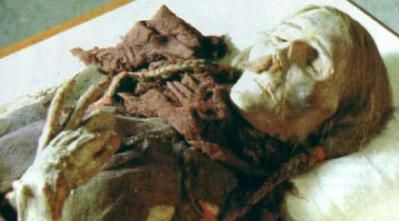
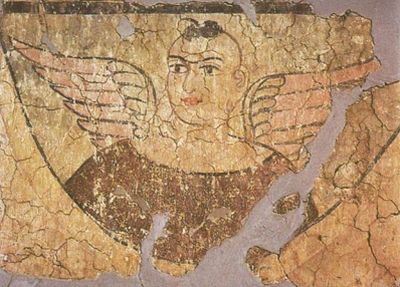
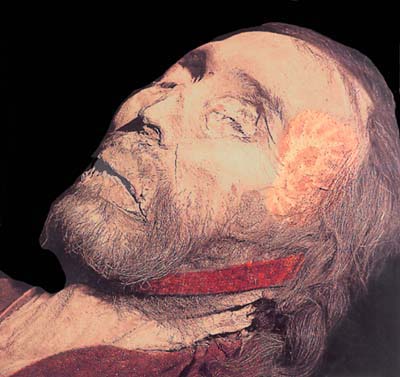
The documents, along with many cave paintings depicting people with white skin and light hair, as well as the white skin and Caucasian facial features of the ancient mummies, have led to the assumption that the indigenous people of the Tarim Basin spoke various varieties of Tocharian or similar Indo-European languages.

Archaeologists J.P. Mallory and Victor H. Mair argue that the Tarim Basin was populated by Proto-Tocharian-speaking peoples from an eastern branch of the Indo-European Afanasievo culture, who migrated south and settled in the northern and eastern parts of the basin.

2. Hou Hanshu on the Western Regions

The classical Chinese history account "Hou Hanshu" covers the history of the Han Dynasty in the first two centuries after AD 0. It was written by Fan Ye a few hundred years after the events took place, using earlier documents as sources.

First page of Hou Hanshu. Photo Fan Ye, 398-445 Southern Song Shaoxing 1131-1162 edition Wikipedia.

Fan Ye himself states that the section on the Western Regions is based on a report prepared by General Ban Yong and presented to Emperor An of Han around 125 AD.

Ban Yong was the son of General Ban Chao, who for thirty years was the leader of the Han army in the war against the Xiongnu steppe nomads.

Under Emperor Wu, 140-87 BC, the 36 kingdoms of the Western Regions came under Chinese authority with an imperial commander-in-chief, who was later replaced by a protector-general.

"During the reign of Emperor Ai, 6 BC-1 AD, the kingdoms in the region further fragmented, so that the 36 kingdoms were divided into 55 kingdoms. After Wang Mang usurped the throne in 9 AD, he demoted their kings to marquises. As a result, the kings of the western regions became angry and rebelled. They severed all ties with the Middle Kingdom and once again submitted to the Xiongnu."

However, "the Xiongnu people levied outrageously high taxes. The kingdoms were unable to meet their demands."

Because of the Xiongnu's high taxes, the kingdoms each sent representatives to the emperor's court to ask for protection. Hou Hanshu informs us: "In the middle of the Jianwu period - 25 - 55 AD, they each sent envoys to ask if they could submit to the Middle Kingdom, and to express their desire for a general to protect them." Which was rejected.

The most important cities and kingdoms in the Tarim Basin in the first three centuries. They almost all have different names in different languages and with different spellings. I have used the names that seem most common to me. Photo own work.

"In 73 AD, Emperor Ming ordered his generals to attack the Xiongnu. They captured Hami, after an absence of 65 years, and established a food production there. Khotan and the other kingdoms sent all their sons to serve the emperor."

"However, when Emperor Ming died in 75 AD, the kingdoms of Karashahr and Kucha attacked and killed the Chinese general Chen Mu and all who were with him."

"The new Emperor Zhang did not want to exhaust and destroy the kingdom for the sake of the Yi and Di peoples, and in 77 AD he withdrew the kingdom's commanders and again shut down the state's food production in Hami. However, the division commander Ban Chao remained in Khotan and made peace by reconciling all the kingdoms."

Over time, the Xiongnu weakened, sparking inter-kingdom warfare. "The king of Suoche, named Xian, destroyed several kingdoms. After Xian's death, they began to attack and fight each other. Xiao Yuan, Niya, and Ronglu" south of Niya, "and Cherchen were annexed by the Shanshan kingdom" around Lop Nor. "Khotan completely conquered Keriya and Pishan". Along the route north of the Tianshan Mountains, "Yuli, Danhuan, Guhu, and Wutanzili were destroyed by the Jushi" in Turpan. Later, these kingdoms were re-established, it is said.

"In 89 AD during the reign of Emperor He, the supreme general, Dou Xian, won a great victory over the Xiongnu. At the head of more than 2,000 cavalry, the deputy commander Yan Pan" in 90 AD "made a surprise attack on Hami, which he captured."

Carved beam from Loulan 200-300 AD "The carving is derived from leaf and flower patterns used in the Hellenistic Mediterranean, Syria, Iran and Gandhara" (British Museum announcement, 2005) Photo Wikipedia.

In 91 AD, General Ban Chao finally succeeded in pacifying the Western Regions. He established his headquarters in Kucha and stationed an additional 500 soldiers within the walls of the city of Gaochang near Near Jushi in Turpan.

In 94 AD, Ban Chao attacked again and defeated Karashahr. "After this victory, more than fifty kingdoms delivered hostages and submitted to the empire. Kingdoms as far away as the sea coasts more than 40,000 li away all offered tribute, using several successive interpreters to communicate."

"However, after the death of Emperor Xiaohe in 105 AD, the western regions rebelled again. In 107 AD, the protectors-general Ren Shang and Duan Xi and others were surrounded and attacked several times. The imperial government proclaimed that the position of protector-general should be abolished because these regions were remote, difficult, and dangerous to reach. From that point on, the western regions were therefore abandoned."

Ruins of Turpan. The city of Turpan is also called Jiaohe. Photo Colegota Wikipedia..

The Northern Xiongnu immediately took power and unified all the kingdoms again. For more than ten years, they plundered the Chinese borderlands together.

Then, in 119 AD, "the emperor sent the acting assistant, Suo Ban, with more than a thousand men to establish a garrison in Hami and pacify that kingdom. After this, the king of Turpan and the king of Cherchen came to submit".

"But a few months later, the Northern Xiongnu regained control of the King of Jushi. Together, they attacked and killed Suo Ban and others. The King of Charkhlik sent an urgent request to Cao Zong for help. Cao Zong therefore requested troops to attack the Xiongnu and avenge the betrayal of Suo Ban. He wanted to continue the advance in the western regions. But Empress Dowager Deng did not give her consent. She simply ordered the establishment of a lieutenant colonel commando in Dunhuang to protect the western regions. A camp of three hundred soldiers was re-established to keep them under control, and this then stopped their rampage".

"But the Northern Xiongnu joined Jushi" in Turpan "to jointly invade the Hexi Corridor west of the Yellow River. The imperial government was unable to prevent it. After discussions, it was decided to close the Jade Gate to prevent a disaster."

In 123 AD, the imperial secretary, Chen Zhong, presented a plan to the emperor: "Your subjects have heard that of all the devastation committed by the eight groups of southern barbarians, none is as bad as the northern savage Xiongnu."

Chen Zhong reviewed the political and military developments of the past three hundred years: "When the Han Dynasty came to power" in 206 BC " Gaozi was surrounded at Pingcheng and put in great danger, and Taizong was humiliated by submitting and paying tribute. Emperor Xiaowu was then indignant at this. He thought deeply about working out long-term strategies. He sent brave soldiers to navigate the Yellow River and cross the deserts to destroy the court of the savage Xiongnu. During this expedition, the black-haired" (Chinese) "fell north of Langwang, and fortunes were destroyed in the gorges of Mount Lu. The treasury was depleted. The shuttles and pipes of the looms became empty. Measures were taken to tax barges and carts, and even the six types of livestock", which are horses, cattle, sheep, chickens, dogs, and pigs.

Chen Zhong continued his political and military historical review: "Through these long-term strategies, however, the emperor succeeded in opening the four military districts west of the Yellow River, which cut off the southern Qiang, and gathered the 36 kingdoms in the western regions, thereby cutting off the right arm of the Xiongnu people. The king of the Xiongnu had to run far away, alone, like a frightened rat."

Then, the imperial secretary continued, "during the reigns of Emperors Xuan and Yuan," 73-33 BC, "the Empire was successfully protected from the Xiongnu. The border posts were not closed, and urgent war conscriptions were no longer made."

"A study of these historical facts shows that the Rong and Di peoples in the west and north of China can be suppressed by force, but it is difficult to civilize them."

"The western regions will eventually come to submit," predicted Secretary Chen Zhong. "They humbly look to the east and knock on our border gates until they tremble. They dislike the Xiongnu, and they admire and imitate the Han."

"Now the northern wild Xiongnu have already defeated the Jushi in Turpan. They will inevitably move south to attack Charkhlik. If we abandon the latter without helping them, all the kingdoms will follow them. If that happens, the wealth of the savage Xiongnu will increase, their boldness and strength will be multiplied, their fearsome reputation will make the southern Qiang join them."

Chen Zhong predicted: "Then the four military districts west of the Yellow River will definitely be threatened. In that case, if the area west of the Yellow River is threatened, it will be very difficult to help them. The cost of the expeditions will therefore increase a hundredfold, and there will not be enough funds to pay for them."

"In the discussions, only the extreme remoteness of the Western Regions and the many expenses involved have been taken into account. No one has taken into account the ideas of previous generations to follow their hearts and work hard."

"Moreover, the border regions are currently not very well prepared to protect and defend themselves. In the interior military districts, no military preparations have been made. Dunhuang is isolated and in danger. There is a long way to send for help and return. If we do not help them, there will be no one to support the officials and people in the interior of our kingdom."

"In the outer regions, we will be unable to show our power to the many barbarian tribes. The classics clearly forbid us from advocating the reduction of the empire."

Secretary Chen Zhong concluded: "I, your humble servant, am of the opinion that we should install a commander in Dunhuang, as they did in former times, to reinforce the military colonies in the four military districts west of the Yellow River and in this way control all the kingdoms to the west, with the intention of crushing the enemy's offensive beyond 10,000 li and terrorizing the Xiongnu."

The emperor accepted Secretary Chen Zhong's advice. "Then, in 123 AD, he gave the title of Protector of the Western Regions to Ban Yong, so that he could lead five hundred freed convicts west to the Liuzhong garrison. Ban Yong then conquered and pacified Jushi in Turpan."

The ruins of a Yangguan watchtower from the Han Dynasty in the desert west of Dunhuang.

"In 127 AD, Ban Yong once again attacked Karashahr and subdued it, and then Kucha, Kashgar, Khotan, Yarkand and other kingdoms, seventeen in all, came and submitted. After this, the Wusun and Congling in the Pamir ceased their interruption of communication to the west."

"Because Hami had from time immemorial provided fertile land bordering on the Western Regions, which the Xiongnu were able to plunder for supplies," in 131 AD "the emperor ordered the re-establishment of a state food production there" like that of the period 89-105 AD "and a commander of Hami was installed."

However, after the period 132-136 AD "the prestige of the imperial court gradually declined. The kingdoms of the western regions became arrogant and negligent. They oppressed and attacked each other again."

In 152 AD "the adjutant Wang Jing was executed in Khotan." In 153 AD "the king of the nomadic tribe Jushi again launched an attack against the garrison of the military colony of Hami."

After "The Western Regions according to the Hou Hanshu" by John E. Hill

4. Kingdoms of Tarim Basin

As early as 138 BC, the great traveler Zhang Qian passed through the cities of the Tarim Basin, but he does not tell us much about them. One of the few things that is known is that on his way out he passed the salt lake Lop Nor, which indicates that he followed the route north of the Taklamakan Desert.

King Mihirakula of the Hephthalites on a coin. The skull deformation is clearly visible. Photo Classical Numismatic Group, Inc Wikipedia.

Zhang Qian's account is known primarily from Sima Qian's history "Shiji", a text that was completed no more than forty years after Zhang Qian's return.

General Ban Chao gave a detailed account of the local conditions in each kingdom, as recounted and supplemented by his son Ban Young in the Hou Hanshu in the section on the Western Regions, which primarily deals with the first two centuries AD.

The Buddhist monk Faxian traveled through the kingdoms on the southern route on his journey to India around 400 AD. He wrote some fairly comprehensive reports of his observations.

The Buddhist monks Song Yun and Huisheng arrived in Khotan, which they called Karghalik, in 518 AD. There they met King Mihirakula of the Hephthalites, the White Huns, who ruled the area at that time. On their return journey they used the route over the Qaidam Stream, past the salt lake Koko Nor, the city of Xining and the upper reaches of the Yellow River. Unfortunately, their travelogues have been lost.

Around 630 AD, the famous Buddhist monk Xuanzang traveled along the northern route on his journey to India. However, his route was special in that he crossed the Tien Shan Mountains after Kucha to the salt lake Issyk Kul, where he met the Khan of the Western Turks on the shore of the lake. He then continued west along the route north of the Tien Shan.

Xuanzang and his companions according to the classic novel "Journey to the West" on a painting in the long corridor of the Summer Palace. Chinese storytellers have created a fantastic tale for hundreds of years about the otherworldly good Xuanzang, who is accompanied and protected by his three more down-to-earth companions, namely the Monkey King, Brother Pig, Sandy and the white horse, who time and again save their unreal master from being eaten or worse. The novel is completely adventurous fiction and has nothing to do with his actual journey. Photo shizhao Wikimedia Commons.

On his return journey from India, Xuanzang traveled south of the Taklamakhan Desert, passing through Shule, Khotan, and Dunhuang, among other places. He wrote quite detailed accounts of what he saw in Khotan.

Marco Polo visited the city between 1271 and 1275 AD. He reported "that the inhabitants all worshipped Mothamet."

5. Kingdom of Khotan

In the Hou Hanshu from around 200-300 AD, Khotan is called Yutien. It states: "The main center of the Kingdom of Yutian is the city of Xicheng". - "It controls 32,000 households, 83,000 individuals and more than 30,000 men who are able to bear arms."

However, when Aurel Stein and other explorers visited the city in the early 1900s, they observed that the region was underpopulated in relation to its agricultural potential, with the population at that time estimated at approximately 200,000, which is almost three times larger than what is stated in the Hou Hanshu.

The ruins of Rawak Stupa in the desert outside Khotan, a Buddhist site dated from the late 3rd to the 5th century AD. Photo Daggel Wikipedia.

Especially considering that since the days of the Han Dynasty the Taklamakhan Desert has swallowed up large agricultural areas - many of the ruins from ancient Khotan lie far out in the desert - it is said to cast quite serious doubt on Hou Hanshu's quantitative information.

The population must have been far larger than the 83,000 individuals reported by the ancient Chinese. This miscalculation seems to could be transferred to the figures for all the other kingdoms mentioned by Hou Hanshu, so that all Hanshu's figures regarding the number of armed men and the like are probably much too low.

The soil in Khotan is very fertile alluvial soil. But since it never rains, all agriculture is completely dependent on irrigation, as the farmers seek to exploit the meltwater rivers that flow down from the mountains before they exhaust their water in the desert sands.

Much of Khotan's wealth came from the export of jade to China. It has been proven that all the jade pieces excavated from the tomb of King Fuhao of the Shang Dynasty (1600 - 1046 BC) were from Khotan. There were more than 750 pieces.

Furthermore, it is known that Khotan was a center of silk production in the Tarim Basin.

Relief sculptures on the outer southeastern wall of the Rawak stupa courtyard in the desert outside Khotan, a Buddhist site dated from the late 3rd to the 5th century AD. Photo Aurel Stein circa 1910. Foto Aurel Stein omkring 1910.

Stein suggested that it might have been the Serindia (rather than China) of the ancient geographers, from which the West learned about the product, silk, itself.

Legend has it that at a time when the Chinese were banning the export of silkworms, mulberry trees, and the knowledge of silk production, a cunning king of Khotan asked for the hand of a Chinese princess.

Before she left for her new country, her future husband made it clear to her that if she expected to be clothed in silk, she had better provide the means for its production. She hid silkworm eggs and mulberry seeds in her headdress and took them to Khotan.

The language of the kingdom of Khotan was Khotanese, an East Iranian Indo-European language belonging to the group of languages of the Indo-European horse-riding nomads of Andronovo origin, called Saka. The royal court spoke Gandhari Prakrit, an Indo-Aryan language related to the Sanskrit Gandhari language.

Chinese annals from the about 660 - 700 e.Kr. provide a glimpse into a lost branch of history. They tell us that the people of Khotan had their own myths and chronicles. Their writing, laws, and literature were modeled after those of India.

Ashoka's visit at Ramagrama Stupa. Sanchi Stupa 1 Southern gateway. Photo Dharma from Sadao, Thailand Wikipedia.

The Tarim Basin may have been a refuge during the last glacial maximum, as the caves of southern France were in Europe. Chinese scientists believe they have traced the genes of the Xiaohe people, as preserved in the famous mummies found near Loulan, to the "Ancient North Eurasians", who hunted on the Mammoth Plain during the last glacial period.

But the Tarim Basin was populated very early by various Indo-European steppe nomads, perhaps already in connection with the exodus from the steppe at the drop in Earth's temperature 1,500-2,000 years BC.

The Chinese pilgrim Xuanzang relates that the king's great ancestor was the eldest son of Asoka-raja, who lived in Taxila. Afterwards, after being exiled from the kingdom, he went north to the Snowy Mountains. While searching for grass and water for his herds, he came to this place and built his main residence here.

The people's own myth told that they originated from the Indian city of Taxila. They were descendants of the men who blinded King Asoka's son Kunula, and therefore they had been expelled.

Figure from Khotan with distinctly Caucasian features - Tang Dynasty - Hong Kong Heritage Museum.

The Buddhist monk Faxian noted that "the king was a Westerner."

The "Hou Han Shu" records that King Xian of Suoche conquered Khotan around 25-56 AD. However, only about twenty years later, a Khotanese general named Xiu Mo raised the banner of rebellion against Suoche and proclaimed himself king of Khotan. Upon Xiu Mo's death, a son of his elder brother, Guang De, took power and then defeated Suoche. His kingdom became very prosperous after this. From Niya in the east to Shule in the west, thirteen kingdoms submitted to the king of Khotan.

Faxian visited the country between 319 and 413 AD. He reported that the inhabitants gathered to practice music. They dressed in embroidered clothes. Some, however, still wore furs. He noted that there were a large number of Buddhist monasteries in the country.

He wrote: "This country is prosperous and happy, its people are wealthy. They have all embraced the faith and find their entertainment in religious music. The monks number several thousand."

He describes a monastery that impressed him deeply with its splendor, called the King's New Monastery, which had taken eighty years and the lifetimes of three kings to build. "It is about two hundred and fifty feet high, ornately carved and overlaid with gold and silver, suitably finished with all the seven precious stones. Behind the pagoda is a Buddha hall, which is most lavishly decorated. Its beams, pillars, folding doors and windows are all gilded. In addition there are priest's chambers, also narrowly decorated." The seven precious stones to which he refers are gold, silver, lapis lazuli, crystal, ruby, emerald and coral.

Faxian, who stayed in Khotan for three months, further reports that there were fourteen large monasteries in the kingdom, not counting the small ones. He found the inhabitants generous and hospitable. "They prepare rooms for traveling monks and provide them with everything they might need for the monks, who are their guests".

Ceramic figurine from the Tang Dynasty, depicting musicians on a camel. Musicians and dancers in the Tang Dynasty very often came from the kingdoms of the Tarim Basin. In fact, throughout the Tang Dynasty, an orchestra from Kucha entertained at the imperial feasts. We even know the titles of the pieces they played. They were such as "The Jade Woman Lets the Book Go Around", "The Meeting on the Seventh Evening" "The Game of Hide and Seek". Own photo from The National Museum of Chinese History.

He describes a Buddhist festival in Khotan in which the royal court participated: "From the first day of the fourth month the main streets of the city are swept and watered, and the side streets are decorated. A large awning with all kinds of decorations is stretched over the city gate, under which the king and queen and the ladies of the court take their places. A procession takes place, led by the priests of the monastery where the king had lodged in Faxian. A kilometer or so outside the city a chariot had been prepared, more than nine meters high, resembling a movable Buddha hall. and adorned with the seven precious stones, with fluttering pennants and embroidered canopies. A Buddha figure was placed on this four-wheeled chariot with two attendant bodhisattvas and devas behind".

The ceremony continued, and when the chariots had approached a hundred paces from the city gate, the king took off his crown and put on new clothes. "He walked barefoot, holding flowers and incense in his hands, with attendants on either side, and went out of the gate," writes Faxian. "When he met the chariot, he bowed his head to the ground, scattered the flowers, and burned incense. The whole ceremony lasted for a fortnight, as each of the great monasteries had its own day for the procession and its own chariots carrying the Buddha. At the end, the king and queen returned to their palace".

On his return journey from India, another Buddhist monk named Xuanzang visited Khotan around 645 AD.

Painting on wood panel discovered by Aurel Stein in Dandan Oilik near Khotan, depicting the legend of the princess who hid silkworm eggs in her headdress to smuggle them out of China to the Kingdom of Khotan. Photo Wikipedia.

Xuanzang reports: "After moving east about 800 li, we come to the country of Kustana (Khotan). This district is a large flat area covered with sand and stone. The soil, however, is suitable for the cultivation of grain and is very productive. They make carpets of wool, fine hair cloth and silk taffeta; the soil produces much white jade and dark jade. The climate is temperate, and the common people understand courtesy and right principles; they value learning and are fond of music. They are upright in their conduct and truthful, and in these respects they differ from other Tartar tribes. Their writing resembles that of India with some slight differences. They highly value the law of Buddha."

"There are 100 monasteries here and about 5,000 monks. They study mostly the "Great Vessel" - Mahayana. "The king is a polished and learned man, brave and versed in the art of war. He is kind to virtuous people."

Head of Buddha found in Khotan 200-300 AD. Collection of Tokyo National Museum. Puchku Wikipedia.

Xuanzang also tells of the lavish celebration of the Buddha's birthday: "They make a four-wheeled chariot and erect on it a four-story building using bamboo tied together." - "They make figures of devas with gold, silver, and lapis lazuli mixed in a grand style, and with silky serpentines and canopies hung over them. On the four sides are niches with a Buddha seated in each and a Bodhisattva standing to serve him. There may be twenty chariots, all large and impressive, but each one different from the others." - "They have singers and skilled musicians; they show their devotion with flowers and incense."

"All night long they keep lamps burning, they have skillful music and offer sacrifices. This is also the practice in all the other kingdoms. The heads of the Vaisya families in them establish houses in the cities for the distribution of charity and medicine. All the poor and needy of the country, orphans, widows and childless men, the maimed and crippled, and all who are sick, go to these houses and receive every kind of help, and physicians examine their diseases. They are given the food and medicine required by their case, and are allowed to feel comfortable; and when they are better, they go of their own accord."

Xuanzang tells of the origin of the Khotan royal dynasty: "The great ancestor of the king was the eldest son of Asoka-raja, who lived in Takshasila. Afterwards, after being banished from the kingdom, he went north to the Snowy Mountains. While searching for grass and water for his flocks, he came to this place and built his main residence here."

"After a while, because he had no son, he went to pray in the temple of Vaisravana Deva. In the forehead of the god, which burst before him, a male child emerged" (like the Greek Athena emerging from the forehead of Zeus), "and the ground in front of the temple at the same time produced a wonderfully sweet-smelling liquid" (a substance like milk from a woman's breast); "taking this as nourishment for the child, it grew to maturity."

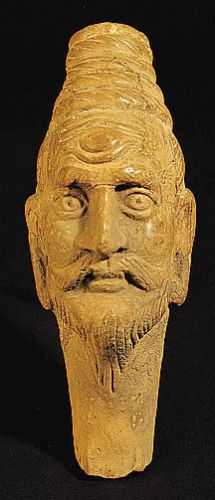
Human head with distinct Caucasian features on pottery with a cow at the bottom. Khotan Cultural Museum. Photo Zossolino Wikipedia.

"On the death of the king, he ascended the throne and established his rule in justice and brought many countries under his rule. The present king is his descendant. Since his ancestor had been nourished by an earthen breast, this family was named Kustana, meaning a descendant of the Earth."

The Kingdom of Khotan was the last kingdom in the western part of Tarim Basin to be conquered by the newly converted Turks. The Buddhist government of Khotan was destroyed by Boghra Khan around 980-1000 AD.

The Muslims had been gradually increasing their numbers in ever-larger parts of the neighboring kingdom of Suoche for a long time. Khotan conquered Suoche in 970 AD, which triggered a long war between Khotan and the Kara-khanid Caliphate.

After the conquest of Suoche, Khotan sent a dancing elephant to Song Dynasty China to win their support in the fight against the Muslims. But it was in vain. The Turkish Muslims captured Khotan around 1000 AD.

Marco Polo passed through Khotan between 1271 and 1275 AD. He wrote: "Cotan is a province lying between the northeast and the east, and is eight days' journey in length. The people are subject to the great Khan, and are all worshippers of Mahomet. There are several towns and villages in the country, but Cotan, the capital, is the most distinguished of them all, and it has given its name to the kingdom. Everything is to be had there in abundance, including an abundance of cotton, flax, hemp, wheat, wine, and the like. The people have vineyards, gardens, and estates."

"They live by trade and manufacture, and they are not soldiers.".

6. Kingdom of Kucha

Kucha is often called Qiuzi in Chinese sources. The city was an important stop on the northern route of the Silk Road.

The Indo-European language Tocharian existed in two different varieties, Tocharian A and Tocharian B, and Tocharian B is exclusively associated with Kucha.

An authentic portrait of the King and Queen of Kucha from the Kizil Caves shows an elegantly dressed royal couple and a king with red hair and fair skin like most of his subjects, clearly a person of Indo-European origin. Photo Wikimedia Commons.

Since the inhabitants thus spoke an Indo-European language with a high degree of certainty, it must be assumed that the Kucha people and their royal family descended from Indo-European horse-riding nomads of Andronovo or Afanasievo origin, who migrated from the steppe in connection with a drop in the Earth's temperature and thus precipitation over the interior of the continent around 1700 - 1000 BC.

This does not exclude that the Tarim Basin has been a refuge for an even more original population, who had withstood the last glacial maximum locally, as the Cro-Magnon people did in the caves of southern France. For example, the Xiaohe people, who lived near Loulan, cannot immediately be categorized as descendants of Indo-European horse-riding nomads.

According to the Hou Hanshu, Kucha was the largest of the "thirty-six kingdoms in the western regions" with a population of 81,317, including 21,076 men capable of bearing arms. As mentioned above, these figures should not be taken too literally. As in the case of Khotan, they are undoubtedly far too low. But Kucha was most certainly a very large kingdom.

The royal family of Kucha, which is the king, queen and young princes, all with white skin and fair hair. The kings of Kucha were of the house of Po, which means "white". Cave 17, Kizil Caves. Around 500 AD. Photo Hermitage Museum Wikipedia.

Among the monk Xuanzang's most startling observations in Kucha was the widespread practice of skull deformation: "Their custom involves pressing the heads of infants with wooden boards to flatten them." Archaeological finds from Kucha tombs confirm that this practice was not simply a traveler's exaggeration. This custom existed throughout Central Asia, and not just in Kucha, where deformed skulls appear on Kushan coin portraits.

The royal family that Xuanzang met - King Suvarnapushpa and his successor Suvarnadeva - probably had these modified skulls, although the pilgrim strangely omitted the reigning monarch from his records.

The Chinese document Jinshu mentions that Kucha during the Jin period, which is 265 - 419 AD, consisted of both an inner city and an outer city, and that the inner citadel itself was surrounded by three walls. Within this area were a thousand stupas and Buddhist monasteries. The city's perimeter was compared to the Chinese capital Chang'an. The History of the Northern Dynasties describes the city's area as a square, 5 by 6 li. The royal palace was magnificent and reportedly contained a wine cellar.

The celestial dancer Chandraprabha is a figure from Buddhist art. The painting is dated to the 5th century. It is found in cave 83 in Kizil. Photo Museum für Indiche Kunst Berlin. Wikipedia.

The Jinshu states that the people of Kucha lived by agriculture, and lists the kingdom's agricultural products: "Red millet, wheat, rice, legumes, hemp, vines, and pomegranates. Livestock included horses, cattle, sheep, and camels".

The kingdom of Kucha was rich in resources. In Bo Shan, the "White Mountain," in the Tien Shan mountain range north of Kucha, were mines for copper, iron, lead, gold, tin, coal, ammonia, copper oxide, orpiment, sulfur, and other raw materials.

Orpiment is arsenic sulfide, which was formerly used as a dye. It still has many industrial uses today.

About 52 miles (83 km) north of Kucha lay a mountain that was said to emit fire at night and smoke by day. This mountain, identified as present-day Hamama or Eshek-bashi Ola, provided enough iron to supply the entire Tarim Basin with arrowheads, swords, lances, and armor and other weapons. Which was also important for the Xiongnu nomads. This explains why they tried to maintain control of the area.

A Song Dynasty document (960 - 1279 AD) notes that ammonia could only be extracted by people with wooden soles on their shoes, as leather soles would burn. Ammonia was used in leather processing and to make lassos for the horsemen whom the Chinese feared so much.

Kucha also produced fine felt and carpets, while silk was purchased from Khotan or China. The exchange of goods was made possible by coins of copper and, we may believe, silver and gold.

The traveling Buddhist monk Xuanzang describes seeing "small bronze coins" in markets in Kucha.

A Kuchan embassy to the Southern Liang court 516-520 AD Photo Wikimedia Commons.

The document Chou shu, which is the history of the Northern Shou (557-581 AD), states: "According to the penal laws of Kucha, a murderer is executed, and a robber has one arm and one leg cut off. For military and civil administration taxes, they survey the land to determine the dues. Those who do not own fields pay in silver coins. The rules for marriage, burial, customs, and products are about the same as in Karashar. It also produces delicate felt, deerskin rugs, basins, salammonium, cosmetics, good horses, wild oxen, and the like." The oxen and deerskin rugs indicate a greater rainfall and thus a greater animal life than there is today.

"In Kucha, the ruling princes came from the house of Po", meaning "white", first mentioned in 91 AD and mentioned again in 787 AD in Chinese sources.

According to Chin Shu, Tang Dynasty c. 600 - 700, which means History of Chin, chapter 97: "The people of Kucha have a fortified city and suburbs. The walls are triple. Inside are thousands of Buddhist temples and stupas. The people are engaged in agriculture and cattle breeding."

A fair-haired Kuchan prince cuts his forehead with a knife in mourning over the death of Buddha, a type of ritual self-harm also known among the Scythians. Photo Albert Le Coq. Drawing Albert Grunwedel 1935. Wikipedia.

Kucha became a flourishing Buddhist center very early. The nation was known for its many Buddhist temples, stupas, and caves with religious paintings, including the famous Kizil Caves.

The city of Kucha was the birthplace of the famous Buddhist scholar Kumarajiva, who had translated 35 sutras, probably from Indian languages, into Chinese. Kumarajiva achieved great fame for his Buddhist academy in Chang'an, where there were daily discussions and lectures attended by hundreds of listeners.

It is said that Emperor Fu Jian of the Former Qin Dynasty in Northern China (351 - 394 AD) sent his general Lü Guang to conquer Kucha and bring Kumarajiva back to Chang'an. Emperor Fu Jian said to his general: "Send me Kumarajiva as soon as you have conquered Kucha." But Lü Guang's army was defeated in front of the capital, the general then declared his own state in 386 AD, probably on Kucha territory, and became a warlord.

The Chinese pilgrim Xuanzang had to stay in Kucha for two months around 630 AD on his way to India, as the mountain passes were blocked by snow. He wrote of this kingdom: "The soil is suitable for rice and grain - it produces grapes, pomegranates and numerous species of plums, pears, peaches and almonds - the soil is rich in minerals, which are gold, copper, iron, lead and tin. The air is soft and the manners of the people are honest. The style of writing is Indian, with some differences. They surpass other countries in their skill in playing the lute and flute. They wear ornamented garments of silk and embroidery. There are about a hundred monasteries in this country with five thousand and more disciples. These belong to the small vessel of the Sarvastivada school. Their doctrine and rules of discipline are like those of India, and those who read them use the same originals. About 40 li north of this desert city there are two monasteries close together on a hillside." That it was possible to cultivate such a water-intensive crop as rice indicates again that the rainfall was greater at that time.

Bust of a fair-haired bodhisattva from Kucha 500-600 AD. Guimet Museum. Photo Vassil Wikipedia.

Kucha's religious landscape fascinated Xuanzang:

Xuanzang relates; "Outside the western gate was a magnificent assembly square flanked by 27-meter-high Buddha statues. Here the king hosted pan-Buddhist gatherings every five years. These "unrestricted assemblies" welcomed all regardless of faith, and were financed entirely by the king.

Every year at the autumnal equinox, Kucha held processions in which devout believers carried temple icons through the streets - a practice paralleling China's Buddha's birthday celebrations.

Xuanzang relates: "There are about a hundred monasteries in this country with five thousand or more disciples. These belong to the Small Vessel, Hinayana, school of the Sarvastivadas. Their doctrine and rules of discipline are like those of India, and those who read them use the same originals - About 40 li north of this desert city, two monasteries are situated close together on a hillside - Outside the western gate of the main city, on the right and left sides of the road, are erect Buddha figures, about 27 meters high".

Very soon after Xuanzang's visit to Kucha, the king decided to support the country of Karashahr in that kingdom's rejection of the supremacy of the Tang Dynasty.

In 644 AD, the king of Karashahr entered into a marriage alliance with the Western Turks, and at the same time ended his client relationship with the Tang emperor. King Suvarnadeva of Kucha likewise ended the Tang supremacy and allied himself with Karashahr and the Western Turks..

Love poem in Tocharian found among the Dunhuang documents. According to Adams, it reads:

"A thousand years, our story will be told. I thus announce, here tofore there was no human being dearer to me than you;
likewise hereafter there will be no one dearer to you than me.
Your love, your affection, my jubilant song rises up!
Along with life itself, this should not come to an end for my whole life.
I was thinking: "I will live with one love well for the whole of my life, without any deceit"
The God of Karma alone recognized this, my thought.
Thus he provoked a quarrel; it ripped out my heart that belonged to you.
It led you afar, it tore me apart, it turned me into a part taker of all sorrows;
he took away the consolation I had in thee my life, spirit, and heart, day-by-day"

Photo Wikipedia.

Emperor Taizong responded by sending an army against Karashahr and Kucha under General Guo Xiaoke.

Tang forces attacked the kingdom of Karashahr, besieged and captured the city, deposed the king, and installed a pro-Tang member of the royal family as ruler.

However, the new king was deposed shortly afterwards by the Western Turks, and the Turks thus gained power in Karashahr.

King Suvarnadeva of Kucha died between 646 and 648, and his brother Haripushpa inherited the throne. King Haripushpa sent two tribute embassies to the Tang court, but failed to reconcile with Emperor Taizong, who had already decided to punish Kucha's pro-Turkish stance by launching an expedition against that kingdom. Perhaps he had simply become aware of Kucha's great resources.

7. Kingdom of Turpan

The Turpan royal family belonged to a tribe of Indo-European steppe nomads, whom the Chinese called the "Nearer Jushi". They were related to the "Farther Jushi", who lived on the steppe a few hundred kilometres further to the northwest.

Chinese characters do not say anything about pronunciation. Furthermore, Han Dynasty characters are different from more modern characters, and therefore there is constant disagreement about how a character should be pronounced, and even about which word it represents. The Indo-European steppe nomads who originally provided the Turpan royal family are called, for example, both, Jushi, Cheshi and Gush.

The Turpan Basin is surrounded by high mountains on all sides, and at the same time the lake with the Turkish name Aydingkol lies in the southern part of the basin 155 m. below the surface level of the World Ocean, making this depression the second deepest place on land, surpassed only by the depression around the Dead Sea between Israel and Jordan.

It goes without saying that such a depression is necessarily due to a very dry climate, where evaporation exceeds precipitation, otherwise it would be converted into a lake. The nearby Tarim Basin, on the other hand, is 600-900 meters above sea level.

The ruins of Jiaohe, which was the capital of the kingdom of Turpan ruled by "Nearer Jushi". Photo Colegota Wikipedia.

In summer, Turpan is the hottest city in all of China, and that's saying a lot.

As in the Tarim Basin, precipitation is completely negligible. Temperatures rise to over 40℃ from late April to early September. The absolute record is 49℃, which was recorded in July 2017. Turpan is protected by high mountains, so there is no significant wind. Winter is dry and sunny with January temperatures down to -10℃. It snows very rarely.

It almost sounds like Death Valley, and one has to wonder why the depression has been inhabited since the Stone Age.

The fact that farming is possible at all is due to the unique and magical Karez irrigation system. Just like in the other kingdoms in the Tarim Basin, meltwater is collected from the nearby high mountains and directed to the fields, but in Turpan the system is more advanced, as the water is directed through underground channels to avoid losses due to evaporation.

"Karez" is Turkish and means "well". According to most sources, Karaz technology was developed by the Indo-European peoples of present-day Iran very early in the first millennium BC and from there slowly spread west and east. It is said that Karez irrigation systems are used in 38 countries around the world.

A cross-section of a typical Karez water pipeline. The system is possible at the foot of mountains with high rainfall. It can be seen that the first and deepest well is dug down to the groundwater up in the mountains. This "bore" delivers the water to a horizontal, but slightly sloping channel, which carries the water to the actual open irrigation channels in the farmland. Photo Wikimedia Commons.

Excavations at Gonur Depe in Turkmenistan, the largest archaeological site of the Bactria-Margiana culture - also known as the Oxus culture - from the Bronze Age, 2300 - 1600 BC, show a very advanced control of water supply.

The "oasis theory" is a theory about how the Tarim Basin was populated. It assumes that farmers from the Oxus culture migrated to the Tarim Basin, including the Turpan Basin, bringing with them their knowledge of irrigation. The logic is that it never rains in Tarim, and people cannot survive without prior knowledge of irrigation.

The excavation and construction of Karez irrigation canals takes centuries. Even when the men of the Han Dynasty arrived in Dunhuang around 200 BC, there were Karez canals in Turpan. This depression is basically a scorching desert, and it is difficult to imagine that it could have been home to any significant settlement without advanced irrigation.

Two men bringing monetary offerings to a Buddhist monastery. Painting from a cave in Bezelik near Turpan from about 800 AD. Note the man on the right with blue eyes and red hair. The motif is a section of a larger painting showing Pranidhi scene no. 6, which Albert le Coq brought to Berlin from Bezelik near Turpan. The large painting shows the Buddha surrounded by believers. Unfortunately, this larger painting is one of those that was destroyed by British bombing during World War II. Digital Silk Road Project Digital Archive of Toyo Bunko Rare Books. Photo Wikipedia.

Professor Xie Yao Hua, Xinjiang Cultural Relics Bureau, says that the Turpan Basin was inhabited as early as the Stone Age, and how this came about.

Xie Yao Hua writes that "archaeological finds indicate that people inhabited the area as early as the Neolithic Age. Many processed stone tools have been excavated on the plateau north and west of the Yarnaiz area. These include scrapers, microliths and arrowheads. In addition, ceramic objects - typically red-painted pottery, as well as bone and bronze objects - have been discovered."

Xie Yao Hua also tells of a burial find from around 0 AD. "The ancient tombs of the Jushi aristocrats were discovered north of the Yanaiz area in August 1994. After more than three months of archaeological excavation, 27 satellite tombs with sacrificed horses and camels were found associated with Tomb No. 2, and 26 satellite tombs associated with Tomb No. 3. After careful studies and discussions, the specialists came to the conclusion that the optimal way to protect the tombs was to cover them."

Detail from Pranidhi scene no. 5. Buddhist monk of Indo-European type on the left and a nearly Mongol type on the right.
This and many other paintings were taken by Albert von Le Coq from the Bezeklik caves and brought to Berlin. They were destroyed during the British bombing of Berlin during World War II.
Photo Digital Silk Road Project Digital Archive of Toyo Bunko Rare Books - Wikipedia.

This seems to indicate that the ancient kings of Turpan had many horses and camels accompany them to the afterlife. This would imply that the kings were descendants of mounted steppe nomads, as was the case with many other kingdoms in the Tarim Basin. Many Indo-European types on the wall paintings in the Bezeklik Caves and their Indo-European language suggest that the original royal family of Turpan, the kings of Jushi, were of Indo-European origin.

Hou Hanshu tells of the king of Turpan: "The king of the Nearer Jushi in Turpan lives in the city of Jiaohe. Two rivers flow into one and surround the city, which is why it is called Jiaohe - "Confluence of Rivers". - "The king controls more than 1,500 households, more than 4,000 individuals and 2,000 men who can bear arms." We can assume that the population is underestimated, as is the case with Khotan above.

The Jushi were a warlike and self-confident people. During the Han dynasty, the Nearer Jushi in Turpan and the Farther Jushi tribes on the steppe, together with especially the northern Xiongnu, created the greatest problems for the imperial troops.

We remember the it was especialy Jushi and Xiongnu that gave the problems for the Chinese troops, as Hou Hansu tells that "after the reign of Emperor Wu" 140 - 87 BC "the kingdoms of Yuli, Danhuan, Guhu, and Wutanzili" - all along the route north of the Tien Shan Mountains "were wiped out by the Jushi. Later, these kingdoms were re-established."

Wall painting depicting a Brahmin, Bezeklik, Cave 9, probably 8th-9th century AD. Photo Ethnological Museum, Berlin Germany. Photography was allowed in the museum without restrictions. Daderot Wikipedia.

However, Jushi was gradually pressured "In the spring of the first jianchu year" - 76 AD - "Governor Duan Peng of Jiuquan won an overwhelming victory over Jushi near the city of Jiaohe".

Around 442 AD, Juqu Wuhui and Juqu Anzhou fled from Northern Liang to Gaochang in Turpan after their defeat by Northern Wei. They deposed the local governor, Kan Shuang, who fled to the Rouran Khaganate, and then established the state of "Greater Liang" in Turpan. They destroyed Jushi in 450 AD and occupied the city of Jiaohe.

In 460 AD, the Mongol Rouran invaded the area, killed Juqu Anzhou, and established the first Chinese Turpan kingdom under Kan Bozhou, who was succeeded in 477 AD by his son Yicheng.

The Jushi people disappeared from the historical arena - at least in Central Asia.

In 488 AD, the king of the Turkic Gaoju Afuzhiluo tribe took the throne in Turpan.

Buddha surrounded by bodhisattvas in Cave 45 of the Mogao Caves at Dunhuang. They all have white skin and fair hair. Photo: Chinese Internet.

In 630 AD, the king of Turpan received the Buddhist monk Xuanzang most warmly. He himself was a staunch Buddhist and discussed religious matters with Xuanzang that very night.

Xuanzang had arrived in Turpan alone, accompanied only by his old horse, which had saved him in the desert. But on his departure, the king of Turpan provided him with letters of introduction to the princes of all the kingdoms through which he would pass on his journey to India, horses, 20 servants, and gold to pay his expenses.

Some time after Xuanzang's visit, the king established relations with the Turks and blocked the caravans traveling between China and the West along the northern branch of the Silk Road. It is said that he died of fear while awaiting the emperor's army.

In 843 AD, the Uyghurs established their own kingdom in the Turpan Basin, with their capital at Qocho.

8. Kingdom of Cherchen

Shanshan was a kingdom located in the northeastern part of the Taklamakhan Desert near the large, now dried-up salt lake Lop Nor.

Archaeologist J. P. Mallory has suggested that the name Shanshan may derive from the city of Cherchen, which today has the Chinese name Qiemo.

The kingdom of Shanshan was called Kroraina in the original Indo-European language of the inhabitants, which was a variant of the Indo-European Old Indian language Gandhari Prakrit, but the Chinese called the country Loulan. Over a period of several hundred years, this kingdom probably included the cities of Niya, Cherchen, Xiao Yuan, Charkhlik, Miran, and Loulan.

A proposal for a political division of the kingdoms in the Tarim Basin before the Han Dynasty arrived in the area. The southern route of the Silk Road thus passed through three kingdoms, namely Shanshan, Khotan and Shule. But this is probably only a snapshot. The Chinese are probably right that there were basically about 35 kingdoms that waged wars against each other and entered into changing alliances. It is a picture that is typical of Indo-European civilizations. We saw it in ancient Greece, which was divided into hundreds of city-states, each of which hated its closest neighbors and did not hesitate to destroy them. We have seen it in the many ancient Germanic tribes in Northern Europe, who were happy to exterminate their closest neighbors if they could. Denmark and Sweden have waged many wars against each other for hundreds of years.

Hou Hanshu reports that around 0 AD Cherchen had 2,500 households, more than 10,000 people, and 3,000 men who could carry weapons. The region produced the substance "baicao", which is poisonous. "The inhabitants extract a substance from it that is used on arrowheads and kills it instantly". The quantitative data are most likely underestimated, as is the case with Khotan.

The Buddhist monk Faxian passed through Cherchen on his way to India around 400 AD. He wrote:

Batik textile from Niya. Marylin M. Rhie, Early Buddhist Art of China and Central Asia. Volume 1 (Handbuch der Orientalistik IV, 12) Leiden, Boston, Cologne 1999. Wikipedia..

"This country is harsh and barren. The people dress like the Chinese, except that they wear clothes made of felt and woolen cloth. The king of this country is subject to the law of the Buddha. In his kingdom there are about four thousand monks, all of whom belong to the lesser vessel (Hinayana). The common people and the priests of this and the surrounding kingdoms all follow the religious customs of India, only some more zealously than others. All the kingdoms from this country and to the west have generally the same characteristics, except that their languages ​​are different - each language uses its own dialect of the barbarian language. However, all the followers of the Buddha practice reading Indian books and conversing with each other in this language."

Faxian stayed in Cherchen for a month before continuing west, after which he came to the country of Ou-i, which cannot be identified today. But which also had four thousand Buddhist monks in several monasteries.

Buddha left with six disciples, Miran 200 - 400 AD. Nomu420 - Wikipedia.

Another Buddhist monk, Xuanzang, also traveled through Cherchen on his return journey from India in 645 AD, but does not provide much information about places on the southern route between Khotan and Dunhuang. However, he writes that when travelers leave Niya, they see "piles of animal bones like beacons" to guide travelers. These are the bones of dead pack animals from previous caravans. He continues: "When these winds increase, both people and animals become confused and forgetful. At times, sad and plaintive tones and pitiful cries are heard, so that between the sights and sounds of this desert, people become confused and do not know where they are going. Therefore, many perish on the journey."

When Marco Polo traveled through Cherchen around 1272, it was still considered a kingdom. He wrote:

Fresco from Stupa shrine M III Miran. The mural was excavated by Stein in 1914. Wikipedia.

"Charchan is a province of Greater Turkey, lying between the north-east and the east. The people worship Mahomet. There are numerous towns and villages, and the capital of the kingdom bears its name, Charchan. The province contains rivers which carry down Jasper (a kind of crystal) and Chalcedony (another kind of crystal), and these are transported for sale in Cathay, where they fetch good prices. The whole province is sandy, and the same is true all the way from Pein (probably the province of Kunar in Afghanistan), and much of the water found is bitter and bad. In some places, however, fresh and sweet water is found. When an army passes through the country, the people flee with their wives, children, and cattle to a distance of two or three days' march into the sandy wilderness; and as they know the places where water can be found, they are able to live there and keep their cattle alive, while it is impossible to find them; for the wind immediately blows the sand across their path. When one leaves Charchan and rides "...five days through the sand, where you find only bad and bitter water, then you come to a place where the water is sweet. Now I will tell you about a province called Lop, where there is a city, also called Lop, which you will reach after five days. It is located at the entrance to the great desert, and it is here that travelers rest before they go into the desert." (Marco Polo must have confused the name of the salt lake Lop Nor with the city of Dunhuang, which is located by another smaller salt lake).

The traveling company waited a year in 1273 in Dunhuang for the Great Khan's permission to travel into China itself.

9. The doom of the Indoeuropean kingdoms

What is today the Chinese province of Xinjiang consisted more than a thousand years ago of several independent kingdoms mainly populated by Indo-Europeans of Andronovo or Afanasievo origin, all of whom were devoted to Buddha.

Fragment of a wall painting depicting Indo-European young women, found in the oasis of Miran 200-300 AD. Photo Bagabondo Wikipedia.

In the Han Dynasty's war against the Xiongnu around 0 AD, the kingdoms came under Chinese rule, but when the Xiongnu weakened, they regained a form of independence.

The same pattern was repeated in the Tang Dynasty's battles against the Turks, where the city-states were once again reduced to Chinese protectorates.

These Indo-European peoples had been organized as kingdoms "always", at least for more than a thousand years, and it could not be otherwise. The Chinese generals were content to depose the rebel kings and find another candidate from the sacred royal family who was more to their liking and more cooperative.

There was a large Chinese immigration, as seen in the Astana tomb in Turpan. But apparently there were still some Jushi left even after the Uyghur invasion. They can be recognized as Indo-European types on the wall paintings in the Bezeklik caves and special names on documents found in the Astana tomb.

However, in connection with the Chinese civil war, called the An-Lushan Revolution, 755-763 AD The emperor had to withdraw his garrisons from his Western Regions, and China thereby lost control of the kingdoms in the Tarim Basin.

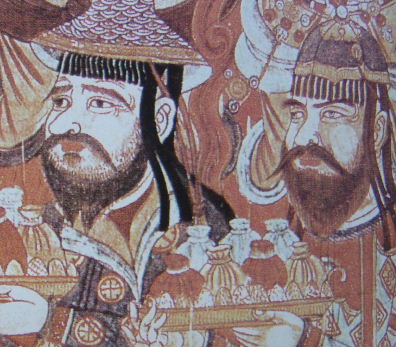
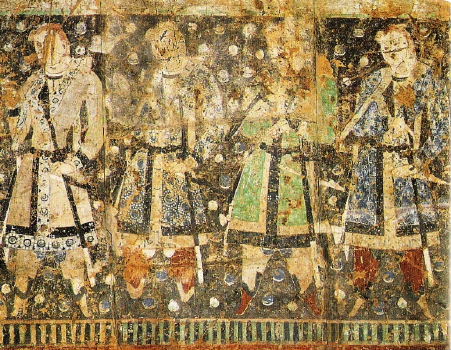
A procession of princes or donors in Bezeklik Temple 9. Who are they? They do not resemble modern Uyghurs, nor do they resemble the original Indo-European inhabitants of the Tarim Basin. They most closely resemble the well-known images of Genghis Khan. These three are just a few examples, there are many of these types in the Bezeklik murals. James A. Millward believes that they represent the original Uyghurs, who came to the Tarim Basin around 840 AD from western Mongolia. They were actually ethnic Mongols, he writes, with the characteristic broad faces and narrow, slanted eyes. Photo Millitary Wiki.

Professor James A. Millward of Georgetown University in the United States described the original Uyghurs as ethnically Mongol. He gave the images in Bezeklik at Temple 9 of the Uyghur patrons as typical examples of what the Uyghurs looked like before they began to breed with the more flirtatious and graceful Indo-European women of the Tarim Basin.

During the civil war, the emperor relied on military assistance from the Uyghur Khaganate, located in western Mongolia, to crush An Lushan's forces. However, after the victory, the emperor turned on his former allies. Under the pretext that the Uyghurs had sold poor-quality horses to the Chinese army and had sheltered Uyghurs convicted of murder, he attacked them in their homes in western Mongolia, along with his new allies, the Yenisei Kyrgyz.

This triggered the collapse of the Uyghur Khaganate and caused them to migrate into the Tarim Basin. It happened around 843 AD.

Uyghur princesses on a wall painting from the Bezeklik caves, cave 9. As can be seen, the early Uyghur women themselves were of a rather manly type. From an exhibition in the Ethnological Museum in Berlin. Photography was allowed in the museum without restrictions. Photo Daderot Wikipedia.

The Uyghurs, who were Mongols, as James A. Millward has shown, embraced Buddhism in Turpan. They established a kingdom in the eastern Tarim Basin with its capital in Turpan, which they called Qocho.

The Tarim Basin was invaded from both east and west. But initially only Islamized from the west, as the early Uyghurs were not Muslims. But from the west the area was invaded by the Turkish Karluk Kara-Khanid Khanate, and they were newly converted and very Muslim.

The English explorer, Robert Barkley Shaw, has translated excerpts from the very old Turkish document, "Tazkiratu'l-Bughra", which tells of the Muslim holy war against the "infidel" Khotan and the death of the Muslim martyr Ali Aslam.

Barkley Shaw writes: "Perhaps the most popular shrine is that of Ali Arslan, a few miles north of the town. The road leading to it is bordered on both sides by gardens belonging to the mazzar and a large resort. The high brick gateway is barred to horses and vehicles by a tree trunk, over which we climbed to find ourselves in a large enclosure with a large water tank planted with stately poplars, a usual and pleasant feature of sacred places in Chinese Turkestan."

"Behind it lay the shrine, an insignificant building, entered by an old carved and milled doorway, one of the best specimens of this form of native art that we came across in the country. An old akhun—his office is to read the Koran at the graves for the benefit of the departed—knelt and recited prayers before it, and inside the small space was filled with a large tomb covered with blue and white tiles, trophies of flags, and horns of wild sheep."

Girl from Xin Jiang with bleary eyes. She probably got her beautiful bleary eyes from her Indo-European motherly ancestor more than a thousand years ago, and her broad face from her Mongolian fatherly ancestor among the early Uyghurs. Photo China History Forum.
.

"Sultan Arslan Boghra, the hero-martyr, nicknamed the Tiger for his valor, who is here honored, fought with great valor against the Buddhist inhabitants of Khotan, who would not change their religion in favor of the principles of Islam. He was one of the earliest Mohammedan conquerors of Kashgar, and it is related by Bellew that the pagan ruler of Khotan, who led his force against the Muslims, offered a large reward to the man who could hasten the death of the Sultan. At this time the Nestorian church had its adherents throughout Asia, and history tells us that one of its priests advised the Buddhists to attack their opponents at daybreak, when they would then be absorbed in their devotions and thus be caught in their beds. The advice was followed, and in a great battle on the desert plain of Ordam-Padshah, about 50 miles south-east of Kashgar, the followers of the Prophet were completely routed, and their brave leader was killed."

"The head of Ali Arslan was carried in triumph around the walls of Kashgar, where the Muslims had retired for a time, and it is supposed to be buried in the shrine which we visited. His body, however, rests at Ordam-Padshah, and Sir Aurel Stein writes that a mound covered with poplars, from which rags flutter, is all that marks the saint's tomb, though it is a particularly sacred place and is annually visited by hundreds of pilgrims."

A cave painting from the area around Kucha

A cave painting from the vicinity of Kucha, depicting a warrior with Caucasian appearance including large eyes. Excavated at Sampula cemetery, Lop, Xinjiang Uygur Autonomous Region, 1983-84 Xinjiang Uygur Autonomous Region Museum.

Ali Arslan's memorial sites were closed by the Chinese authorities in 1997 for security reasons.

From 970 AD The Karakhanids continued to fight against Khotan until they finally succeeded in "destroying" it.

In 1006, the Muslim Kara-Khanid ruler Yusuf Kadir Khan of Kashgar finally conquered Khotan, thus ending the country's thousand-year existence as an independent kingdom.

The Karakhanid Turkish writer Mahmud al-Kashgari wrote a short poem of praise about the conquest, which, translated into English, reads:

"We came down on them like a flood wave,
We went out among their cities,
We tore down the idol temples,
We shit on the head of Buddha!"


It was not only the kingdom of Khotan that was the subject of the hatred of Muslims. They also directed their jihad against the Buddhist Uyghur Qocho kingdom, where Buddhist temples were razed to the ground, and Islam was spread by the Karakhanid ruler Sultan Satuq Bughra Khan.

Mahmud al-Kashgari considered the Uyghurs "infidels". In his "Compendium of the Turkic Dialects" from 1072 AD, he includes the Uyghurs among the infidels. It is written "just as the thorn is to be cut off at the root, so the Uyghurs are to be beaten off at the root". Kashgari considered them as unreliable and noted that the Muslim Turks used the derogatory name "Tat" for the Buddhist Uyghurs.

But in 1124 AD something happened.

A Liao army arrived in Central Asia from eastern China, and King Yelu Dashi naturally proclaimed the Western Liao, also called Kara Khitan, with its capital in Kashgar, which was the former Shule.

On the other side of the Tien Shan Mountains, they also established a capital, in Balashagun in present-day Kyrgyzstan.

The Liao also called themselves "Gur Khan", which is Turkish and means "Lords of the World". The Liao people were Buddhists and to some extent Nestorian Christians, so one must believe that the new rulers put a damper on the spread of Islam in the Tarim Basin.

Painting of Uyghur men found in the Qocho ruins. The man on the left has a crown on his head. They can be described as Mongoloid types. From the Museum Für Indiche Kunst Berlin Dahlem. Photo Gryffindor Wikipedia.

The Western Liao kingdom soon stretched from Mongolia to the Oxus River. The Muslim imams gnashed their teeth in impotent rage. It was one of the few times in history that Islam was rolled back from an area it had once conquered.

There are reports that Qi Dan imprisoned some imams in Kashgar and elsewhere, which led to unrest.

The Liao rulers gave themselves Christian names. King Yelu Dashi also bore the name David. His grandson also called himself Elijah. News of Qi Dan's victories over the Muslims reached the Crusaders in the Kingdom of Jerusalem and fueled the myth of the Christian king, Prester John, who would come from the East and defeat the Muslims forever.

In 1211 AD, a Mongol chieftain named Kuculug fled to Western Liao. He was fleeing from his mortal enemy, Djenghis Khan. Kuculug belonged to the Mongol Naiman tribe, who were Nestorian Christians. He somehow managed to put himself on the throne of his new land.

East Asia in the period immediately before the Mongol conquests. Kara Khitan is another name for the Western Liao. Photo Chinese Internet.

In 1218 AD, Genghis Khan and his Turko-Mongol army invaded Western Liao. They met little resistance and were probably welcomed as liberators by the Muslims. Kuculug fled west, but the Mongols caught up with him and killed him.

By then, Western Liao had existed for 90 years.

In the 1390s, the Chagatai ruler Khizr Khwaja launched a holy war against the Qocho kingdom in Turpan. He claimed to have converted the eastern kingdoms to Islam.

In reality, however, the conversion was more gradual. Travelers passing through the area in 1420 noted that the rich Buddhist temples still existed. Only after 1450 were a significant number of mosques reported.

Archaeologist Victor Mair writes of the late conversion to Islam in Turfan: "In the Ming annals we learn that a Buddhist from Turfan came to the Chinese capital in 1408 with his disciples".

"The records of Shah Rukh's embassy in 1420 indicate that most of the population of Turfan were polytheists (that is, Buddhists) and kept tall idols in large idol houses".

The late conversion of this oasis to Islam is for Stein an important reason why the ancient paintings have survived so well. "This allowed relics of the pre-Muhammadan civilization, including cult objects, literature, and art, to exist in this territory, relatively well preserved, within four or five centuries before our own time and on land that has been continuously inhabited. The same fact explains why a large proportion of these paintings belong to later periods." This view from Stein seems to be the likely explanation of why such a number of relics still existed.

The story of the Jataka tiger and Prince Mahasattva in Cave 428 of the Mogao Caves in Dunhuang.
This wall painting, which is composed of three long strips, tells the story of how Prince Mahasattva sacrificed his body so that the Jataka tiger could have meat to give food to her large litter of kittens.
The top strip should be read from right to left. The story begins with the three princes saying goodbye to their parents and then riding out into the world. The middle strip is the climax of the story. It should be read from left to right. The prince sees a tiger that is about to die of hunger. In great sympathy with the tiger, the prince offers his own body as food for the tiger, who then has a hearty meal for her kittens, while the prince's soul escapes. The bottom strip tells, somewhat muddled by modern cartoon standards, that the two surviving brothers ride home and tell the king and queen, what has happened. The king then orders a stupa to be built for Prince Mahasattva's gnawed bones.

This is not the only Buddhist account of the irresponsible self-sacrifice. The most famous is the story of Prince Visvantara. There was once a generous prince who owned a miraculous elephant, that had the magical property of causing rain. When the neighboring kingdom experienced a severe drought, the prince gave the elephant to them.
On the mountain Dantaloka is a stupa built by King Asoka. It was here that Prince Sudana Visvantara dwelt in solitude. It was here that the prince gave his son and daughter to a brahmin, who beat them until their blood flowed to the ground. That is why all the trees and bushes here are of a deep red color. The prince was persuaded to also give his wife away to someone who really wanted her. But it ended happily. The prince's father, the king, intervened and had everyone brought back to the kingdom, where they were welcomed by everyone and lived happily ever after. Photo Google Arts and Culture.

10. Literature

The Western Regions according to the Hou Hanshu Translated by John E. Hill
Selections from the Han Narrative Histories by Daniel C. Waugh
Western Regions Wikipedia
A Lesser Known Route: the Qinghai Route Silk Road in Rare Books
The pilgrimage of Fa Hian Internet Archieve
From the life of Hiuen'tsiang (Xuanzang) The Silk Roads
Kingdom of Khotan Wikipedia
Tang-kampagnen mod Kucha Wikipedia
Xuanzang on the Silk Road Sally Hovey Wriggins
Kucha The Forgotten Buddhist Kingdom of Silk Road Indospere
The Travels of Marco Polo - Volume 1 Gutenberg
Kizil Caves Wikipedia
The Western Regions (Hsi-Yu) under the T'ang empire and the kingdom of Tibet Three great empires.
The Glory of the Silk Road Dayton Art Institute
The City States of the Tarim Basin Zhang Guang-da
Islamicisation and Turkicisation of Xinjiang Djarmapedia

"The Silk Road Journey with Xuanzang" by Sally Hovey Wriggings - West View Press."
"Foreign Devils on the Silk Road" by Peter Hopkirk - Oxford University Press.

20250827 Passed W3C Validation