|
Home DH-Debate 13. Xiongnu and the Wusun 15. Who Were the Jaets? |
Xianbei was a group of tribes, who lived on the Eastern Steppe, roughly described in present Inner Mongolia reaching out in East and West. Here they had lived "always", or at least long before the rise of written history.
The Chinese characters for Xianbei mean literally fresh new thieves.
The best known of the Xianbei peoples were the Xianbei-Tuoba tribe. They had their name after their sacred royal lineage, Tuoba. Following modern rules of pronunciation, it must be pronounced something like "Thor-bar", and I think, it means the descendants after "Thor".
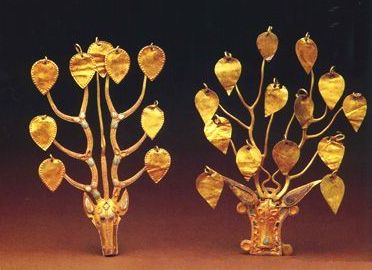
Typical Xianbei art - Inner Mongolia Autonomous Region Museum.
In China's early history all the peoples on the plains were labeled as "-rong", which means something like barbarians or natives. During the Qin dynasty (221 BC - 206 BC) and early Han Dynasty, most peoples of the steppe were categorized as
Xiongnu. Only after the collapse of the Xiongnu federation, the Xianbei tribes appeared in the history under their separate names.
In the year 48 AC, the before so mighty Xiong-Nu federation split up
into two groups, the southern and the northern Xiongnu. An officer of the Han court named Zang Gong suggested that China should take advantage of the situation, ally with Xianbei and attack Xiong-Nu; but Emperor Guang Wu-di rejected firmly further acts of war.
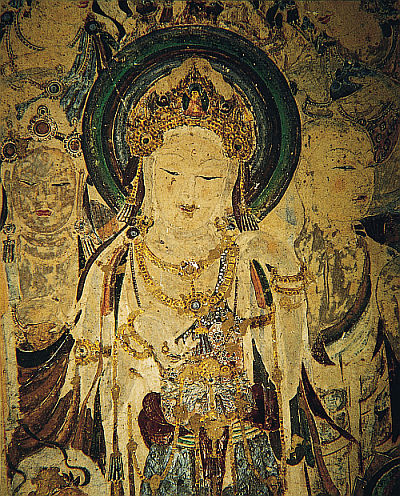
Bodisatva with blond hair and blue eyes from Dunhuang cave 57 - or is she a queen?
The Chinese characters for Xianbei literally means fresh new thieves. It can not be a name that they called themselves. At the same time, it sounds very much like "Xin bai", which means "new whites".
The Northern Wei empire was a migratory state, ruled by a branch of Xianbei people. Their sacred royal family was the Tuobas. They seem to have been the royal family superior to all others. The kings of Qi Dan, as well as Dan(g) Xiang (Tangut) claimed both that they descended from Tuoba. These kingdoms emerged several hundred years after the doom of the Northern Wei empire; here one can really talk about "The return of the king". The Tuoba royal lineage must have had a simply enormous prestige.
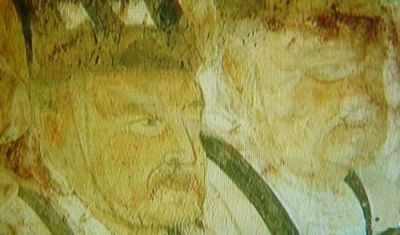
Types from Mogave Caves at Dun Huang - the Northern Wei period. Some tough men, were they kings?
Many nations' history-interested "make claim" on the Xianbei tribes. Chinese literature refers routinely to them as typical Mongolian people. Koreans have no doubt that the Xianbei was a Tungusic people like they think about themselves. Turkish history enthusiasts call them often as a "proto-Turkish", "proto" as they have a timeline problem, all without the existence of real arguments that support such claims. All parties label routinely the Xianbei's kings as khan, although this is a Turkish title, which was not invented before after several hundred years.
But there are many indications that Xianbei was a non-Mongolian Indo-European
people with white skin and often with blond or reddish hair.
The debate on Xianbei's ethnic origin is a fierce debate with political overtones that have been going on for years. The idea that possible Indo-European peoples have had their root within the borders of modern China is causing a very considerable emotional resistance.
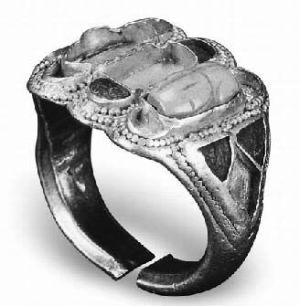
Xianbei ring.
Basically the statements about Xianbei's respectively Mongolian
or Tungusic origin are simply repeated many times, as it was a self-evident truth, but with few and insignificant real evidence. Since it seems to be politically correct in both East and West, it has gradually won an image of truth.
Supporters of Xianbei's Mongolian origin bring forward to know that the Xianbei's descendants, the Qi-Dans, mobilized their troops in military units called "Ordo". Mongolian has a word with the same significance, "Ordu", for example in "The Golden Horde" and other of Genghis Khan's armies. The word is found in Danish and English as "Horde," but they think it comes from Mongolian. Therefore, the supporters of the theory conclude, that since Xianbei's descendants used a word which the Mongols also used, they must have been of Mongolian ethnic origin.
But this evidence is worth nothing, and it proves indeed the opposite.
The Americans were the first to drill for oil offshore, they gave names to "derrick", "casing", "christmas tree" and "spot cans". Their successors the British, Norwegians and Danes simply took over the terminology, which already existed in the industry.
|
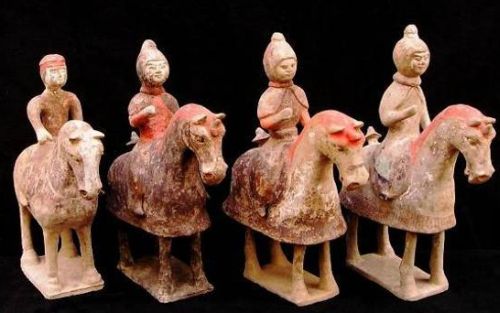
Left: Xianbei cavalry.
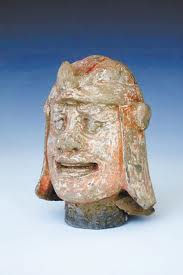
Right: Warrior figure from Northern Dynasty Tomb - Unearthed in Cixian - he looks like a Viking, who had lost his way, however, he is 500 years too early.
The Indo-Europeans were the first to develop mounted warfare on the steppe, and they developed the associated terminology. They invented the concept of "horde" originally "orde" as the name for a military formation. When the Mongols and Turks much later took possession of the steppe and picked up mounted warfare, they simply took over the terminology that already existed.
Danish is an ancient Indo-European language that still contains many words beginning with "or-", which denotes various military activities. Just try opening a Danish computer dictionary, type "or-" and see what comes up.
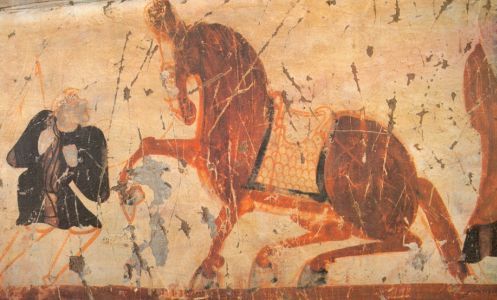
A blond steppe warrior displays his trained horse - cave painting from Dunhuang.
"Orlog" refers to naval warfare. "Orlov" is a leave from military units. An "Ordonans" is a military messenger. "Ordre" is a military command. "Orden" is the opposite of sloppiness and disorder, which typically must prevail in an army. "Orden" is also the military decoration of honour. "Orke" is to perform strenuous efforts, as it is often the case in war.
The basic word "horde" or "orde" can be recognized in modern Danish and English in that meaning of "orden" as the word for an organization, such as a knightly order, the order of the Knights Templar, the Johanitter Knights order and so on.
Such military designations are in relatively recent times replaced by terms such as "regiment", "arme" and "battalion" and therefore the meaning of horde has been degraded to describe a spontaneous, primitive and aggressive group.
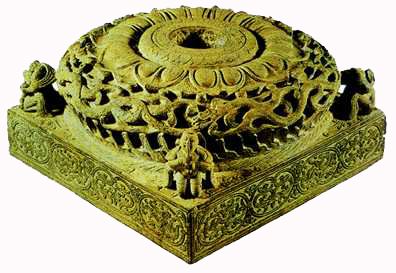
Column Foundations from the Tuoba capital Luoyang with four dwarfs
indicating each corner of the world.
Luoyang was the capital of Northern Wei, which was a Tuoba Xianbei state. Here is a pillar foundation with four dwarfs indicating each corner of the world. It brings one to think about the dwarf list in the Voelve's Divination, verses 11-13 of the Elder Edda, where the dwarves Nordri and Sudri, Austr and Vestri are named after the corners of the compass - or maybe it's the compass directions, which have been named after the dwarfs. The idea, that a dwarf should indicate a compass direction, is so unique that there must be a connection.
The arguments for Xianbei should be of Tungusic ethnic origin are equally unconvincing.
Some believe to have reconstructed a group of words from the now extinct Xianbei language, which shows that it belongs to the Tungusic language family.
Now, the fact is that everything passed on from Xianbei comes from Chinese sources, and Chinese characters say, as you well know, nothing about the pronunciation. It is hard to see how such a reconstruction has taken place. Xiabei's Tungusic origin is mentioned in many places as a matter of course, but nowhere gives any clue about the nature of such a reconstruction. It may not be something, which is particularly obvious or scientific.
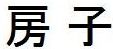
The Chinese character for house - it can be pronounced haus, hus, house, dom, casa or fangzi.
The Dunhuang documents, P. 1283 (in Tibetan) tells of the Qi Dan people's language: "In the language, they (Qi Dan) and Tuyuhun broadly could communicate with each other". So we can imagine that the two languages relate to each other such as Danish and Swedish. Tuyuhun was a branch of Murong Xianbei and Qi Dan
descended from Tuoba Xianbei. This indicates that the Xianbei tribes of the migration age, living in general in present Inner Mongolia, mainly spoke the same language. The Xianbei peoples created the Wei Dynasty and many other migratory states.
Sui and Tang Dynasty originated from Xianbei peoples, who had accepted Chinese culture. Their language, whatever it was, must necessarily have had a markedly influence on the development of the Chinese language.
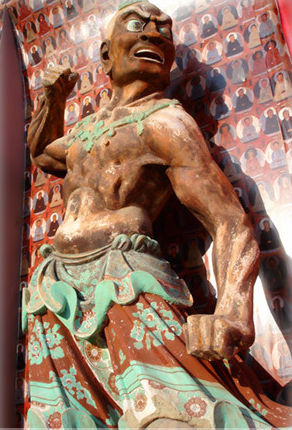
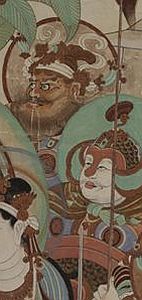
Left: A strong man with big blue eyes, big nose and in general caucasian features - Sculpture from the caves at Dunhuang.
Right: Two types from a cave painting. The man at the top left must be one of them, whom the scholar Yan Shigu had in mind when he wrote about - "These "Hu" people have green eyes, red beard, and their appearance is like bearded monkeys".
Now it is like this that there is a group of words which - in Danish and Chinese - sound similar to each others having similar meanings, even the group is not very big.
This again indicates that some of the Indo-European ancestors of modern Danes, perhaps the Aesirs, who came from Asia, had a common origin with the Xianbei tribes.
In "Han Shu", the scholar Yan Shigu (581-645) added a Comment on how the Wusun people looked like: "Wusun in the Western Areas are the same as the Rong people (old term for native tribes around China). Nowadays, these "Hu" people have green eyes, red beard, their appearance is like bearded monkeys, and they are originally of this nature." ("Hu" means caucasian features like deep-set eyes, big nose, beard etc.)
Yan Shigu worked at the court of the first Tang ruler Li Shimi. He wrote commentaries in both "Han Shu" and "Shi Ji". He lived during a very turbulent period. The dominant Xianbei State "Northern Wei" had been split into the Eastern Wei and Western Wei, who in turn evolved into the Northern Qi and Northern Zhou. The Northern Zhou
proclaimed themselves as the Sui Dynasty and claimed the power of the whole of China. The new dynasty, however, quickly perished because of the peasant revolts and civil war. However, on its ruins, Li Shimi erected the famous Tang Dynasty on the political foundation of coalitions with the tribes on the steppe, especially with many Xianbei tribes and states.
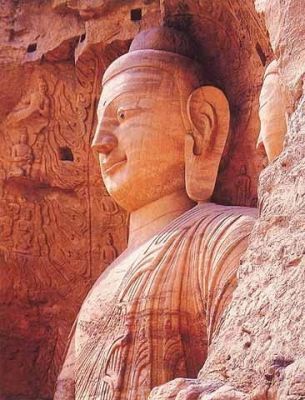
Budda of the Future from Mogave caves at Dunhuang - from the Northern Wei period - note his fair hair, white skin, big nose and eyes. He does not look like Tungusic or Mongol origin.
Yan Shigu's comment is not only a statement about the distant Wusun people, it is also a statement about the "Hu" people who surrounded him. It was undoubtedly the always rivalizing Xianbei peoples, he had in mind when he wrote: "Nowadays, these "Hu" people have green eyes, red beard, their appearance is like bearded monkeys".
The document "Zhi Zhi Tong Jian" (it means "Comprehensive Mirror
for Aid in Government) was presented to the Emperor during the Song Dynasty by Sima Guang (1019 - 1086). He had spent eighteen years composing it. Here is told a story that the Emperor of the Dynasty "Eastern Jin", Jin Ming Di (Sima Shao 323 to 326 AC)
had yellow hair and beard, because his mother was a Xianbei. Once he unannounced went out to inspect his troops. However, because of the color of his hair, his soldiers believed, he was a Xianbei and chased him as an enemy.
Folk songs from back then sounded: "Huang tou Xianbei", which means: "Xianbei have yellow head."
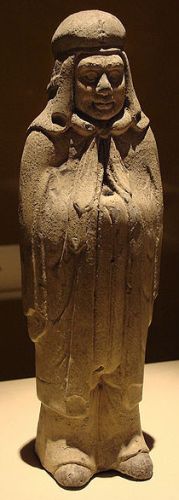
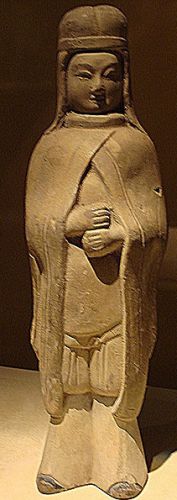
|
Left: Small figure which represents a Xianbei soldier with deep-set eyes and big nose. Treasures of ancient China Exhibition - Found in Jing County, Hebei Province, 1948.
Mid: A small figure which represents a Xianbei soldier with modern Asian features - Treasures of ancient China Exhibition - Found in Jing County, Hebei Province, 1948.
Right: Statue in Luoyang with a high sharp nose.
Among the Xianbei peoples, and also at their descendants the Qi-Dans, women were quite equal with men. They rode horses and used bow and arrow just as good as men, an old poem says. Also during the following Tang Dynasty, women could do much the same as men. However, there were severe punishments for adultery.
It is known that the Tang Dynasty had a rather full woman ideal
and that women also played polo. Only during the following ethnic Chinese Song Dynasty they developed the extremely slim ideal woman
with elegant small feet.
In Tuoba Xianbei's old capital of Luoyang are a few statues with fairly high nose bridge among the statues and figures, which have been preserved to our time. Most of the other surviving figures are either of a neutral ethnic appearance or with a modern Asian look.
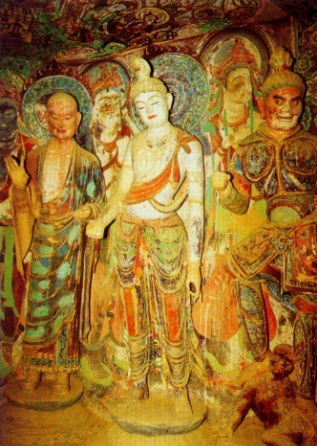
Left: A fair-haired Budda from cave no. 45 at Dunhuang- should we ques that it is a Xianbei type on is left side?
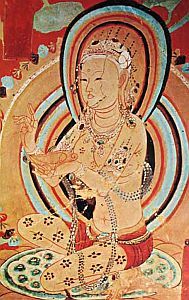
Right: A blond beauty from the Dunhuang caves - bodhisattva or dancer? Most likely dancer. - She has white skin and blond hair but modern Asian narrow eyes.
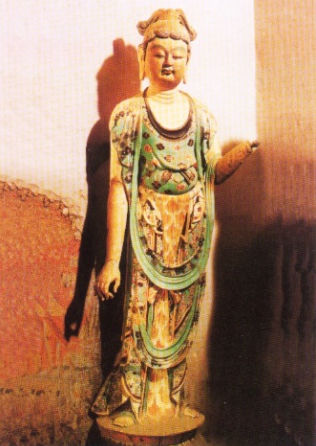
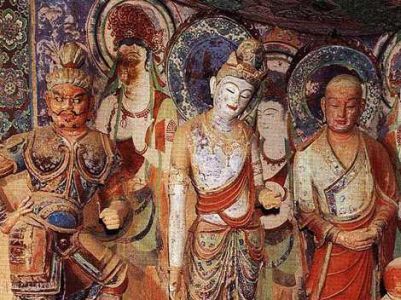
In the Dunhuang caves, the portraited characters have in general black hair. However, there are many with yellow and brown hairs especially on characters from the Wei, Sui and Tang Dynasties, who were strongly influenced by the Xianbei peoples.
It is not in question that the paint has chipped off or has become discolored thus creating hair, which is not black, as other paint nearby seem to be in good shape. However many of the
characters with blond hair have marked modern Asian facial features, narrow eyes, a low nose bridge, etc.
I think that some of the ancient artists in Dunhuang thought that yellow hair and white skin was nice, and they seemed also to like narrow eyes and small noses. So they created these really beautiful figures with both blond hair, white skin and modern Asian features.
|
Left: One more Buddha with blond hair from the Dunhuang cave no. 45.
Right: A blonde group, Budda in the middle. The person to the right of Buddha could be a Xianbei type.
"Buddha of the Future" in the cave no. 275 of Mogave at Dunhuang has a Western, almost Greek style. The statue was made during the Northern Wei dynasty shortly after the invasion from the steppe.
Generally, Xianbei seemed to have been some pretty broad types
with round or square faces. They had big eyes and beard. It seems like they often had pretty big wide noses that others might have looked down on. Some of them seemed to have had a certain "Miss Piggy" style, which often is exaggerated especially on more tough and less sympathetic figures such as soldiers, grave guardians and the likes.
However jade carvings from the very early Shang Dynasty also show persons with big eyes and wide noses, so this miss Piggy characters are possible not typical Xianbei persons only.
Maybe the character's appearance reflects the enormous political
correctness that prevailed in the Northern Wei after 494 AC and presumably also in the following Eastern Wei Dynasty.
|
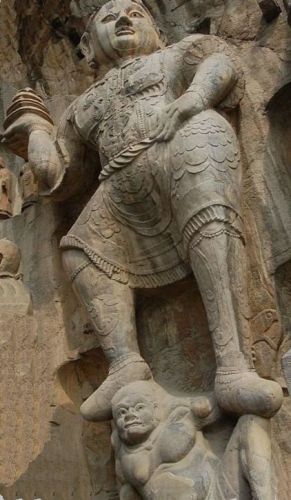
Left: The cosmic dance- Longmen at Luoyang.
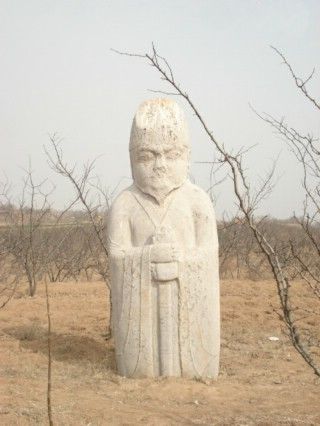
Right: A Xianbei king of the Northern Zhou. He has a very large
head with big eyes, maybe he was a child. Longquan Mountain.
Just as Dan-Xiang (Tangut), the Sogdians and of course the Indians (the God Shiwa) Xianbei Tuoba knew the cosmic dance, the god's creative destruction. It is an Indo-European ide.
The cosmic dance is also found in Buddhism, as a god, trampling
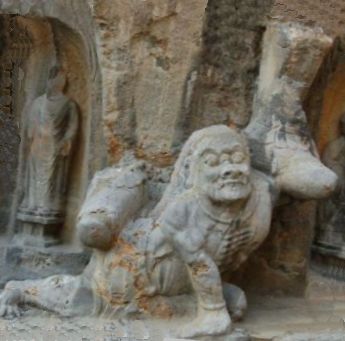
on an evil creature. The Buddhist god from Northern Wei has noble, a little narrow, eyes, which were considered beautiful, while the man, he is trampling upon, has an appearance, which can be exaggerated Xianbei traits. Also the many tomb guardians, who are somewhat unsympathetic creatures, seems to have been equipped with exaggerated Xianbei traits, like for example big eyes and wide snub nose. A sort of political correctness in the same way as when bad guys in "James Bond" movies often are exaggerated "Arian" types.
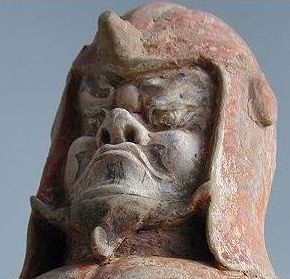
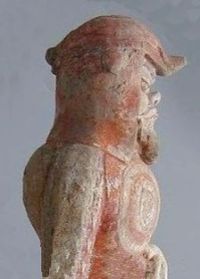
Two tomb guardian figures have a particularly frightening Miss Piggy style. Note their Scythian caps, an Indo-European trait.
|
Left: The cosmic dance - The little man whom the god is trampling on during his cosmic dance has big eyes and a broad snub nose.
Mid: Xianbei warrior en face - most likely a tomb guardian with especially frightening features.
Right: The same Xianbei warrior in profile - as I said maybe a tomb-guardian. No one can come to look like this in a natural way.
The little man whom the god is trampling on during his cosmic dance has big eyes and a broad snub nose. It must have been considered very ugly.
A Xianbei warrior has particularly pronounced and frightening Xianbei facial features. It's hard to believe that anyone really had looked like this. Maybe he is a tomb-guardian, who has the duty to frighten the evil spirits away from the tomb.
|
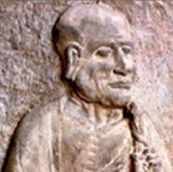
Left: A sage from the Longmen Grottoes in Luoyang. He has rather Caucasian features.
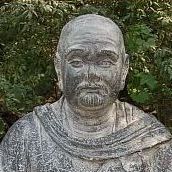
Middle: A wise man from the Longmen Grottoes in Luoyang. He has a round face and rather small eyes, shall we say he is a something in between a Caucasian type and a modern Asian type.
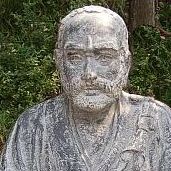
Right: A sage from the Longmen Grottoes in Luoyang. He is a Caucasian type.
The wise men from the Northern Wei look pretty ordinary, they do not have specifically modern Asian features.
A group of soldiers is mentioned being Xianbei soldiers from the Northern Zhou period. They remind most of all of a gang of henchmen send by the king of the devilish demons.
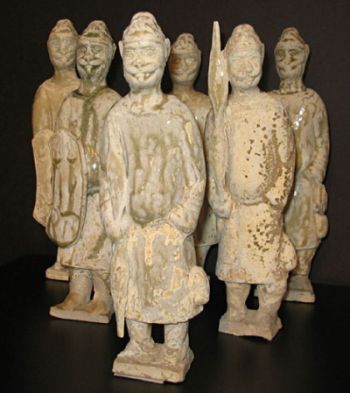
A group of soldiers mentioned to be Xianbei soldiers from the Northern Zhou period.
It brings one to remind the Taiping ruler Hong Xiuquan's revelation in his dream:
"Those who travel up to Heaven along the eastern road," which Hong did in his dream, "They see God in his majesty, still with the black dragon cape, a hat with turned up brim and golden beard," like Hong also saw him. "They see the king of the devilish demons, with square cut face and red eyes, and learns that he is really the same as the demonic devil of the eastern ocean and the devil king on Earth, known as Yan Luo. As God showed it to Moses on Mount Sinai, as he wrote the tablets of the law "with his own hands", he identifies the devil king for heaven's guest (with his own hands)." ("Gods Chinese Son," page 108)
This means that the Taiping ruler believed that God had revealed
to him that the devil king of the Eastern Ocean (the foreign devils' king) was, in fact, the same as the devil king of the Earth (the Chinese devils' king) named Yan Luo, and he had a typical square cut face and red eyes.
This indicates that Hong and most likely many other Chinese thought, that some descendants of Yuzhi and Xianbei in the western mountains and on the plains, whom the Chinese called devils, looked like the Portuguese and British, who came from the eastern ocean and was probably ruled by the same demonic king. It was probably the reason why the Europeans were called "foreign" devils because they looked like the domestic devils they already had.
Hong Xiuquan also named the Manchus as devils, and he left no doubt about how to deal with devils, namely kill them and stamp them out from the surface of the earth.
"Hou Han Shu" cites a memorandum handed to the emperor in 177 AC: "Ever since the Northern Xiongnu fled (to the west),
Xianbei had become more strong and numerous, and have taken over all land, which previously belonged to Xiongnu and claims to have 100,000 warriors - Pure metal and wrought iron has come into the hands of the rebels. Han Chinese deserters have sought refuge (at the Xianbei) and work as their advisors. Their weapons are sharper and their horses are faster than Xiongnu's."
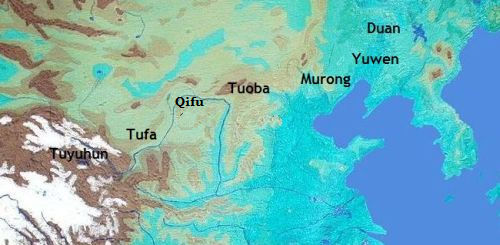
The known Xianbei peoples locations.
"Hou Han Shu" quotes further a history writer from 185 e.Kr: "The Xianbei people invade our borders so often that hardly a year pass by in peace, and it is only when the trading season comes, they come forward in humility. But when they do, they are only likely to acquire valuable Chinese goods, it is not because that they respect the Chinese power nor they are thankful for Chinese generosity. As soon as they have achieved all that they in any way can, they return to their habit of plunder and destroy."
According to "The Perilous Frontier" by Thomas Barfield in the late Han Dynasty were counted 120 small Xianbei tribes on the steppe. To comparison, on the entire steppe were reported of only ten to
twenty groups, who could be attributed to the term Xiongnu.
Xianbei was apparently more rivalizing and quarrelsome and therefore had more difficulty in joining together in larger organizations.
However, during the next some hundreds years larger and more numerous Xianbei peoples were formed. Murong Xianbei created the Yan states of North-East China, and Tuyuhun Xianbei formed a kingdom on the Tibetan plateaux. The most famous is Tuoba Xianbei who created the migration kingdom "Northern Wei."
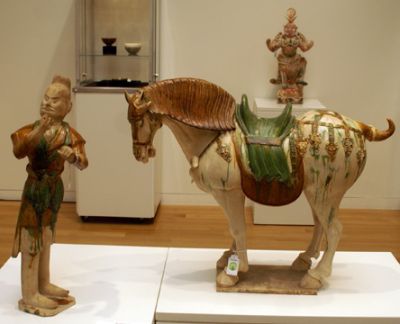
White horse and horse keeper with yellow hair - Glazed ceramics from Tang Dynasty - privately owned.
Duan Xianbei fused with Murong Xianbei in the Yan kingdom through political marriages, the king was a Murong and the Queen was from the Duan people. Yuwen lived on the plains along the Liao River;
some scholars believe they were perhaps not a Xianbei people. Qifu Xianbei created the kingdom of Western Qin in the modern province of Shaanxi. Tufa Xianbei created the Southern Liang kingdom in modern Gansu province.
In the classic novel "The Outlaws of the Marsh" the chief of the outlaws Songjiang is visited by a grim-looking man, who gave him a white horse: "My family name is Duan, my given name is Jingzhu. Because of my red hair and yellow beard, I am
called "The Golden Dog". My family is from Zhuozho Prefecture, and
I earn my daily bread by handling horses up north. - " (Page 1267)
"The Outlaws of the Marsh" is a collection of myths and legends from the Song and Yuan Dynasty, joined together in a huge classical novel by Shi Nai'an and Luo Guanzong. It was released in a fairly comprehensive form first time in 1541 AC.
The Portuguese and the Englishmen had by then not yet arrived at the coasts of China. The Portuguese landed the first time in Japan in 1542 AC, and the Englishmen came much later. But people in Eastern China could still remember the Duan Xianbei people, their horses and their golden hair.
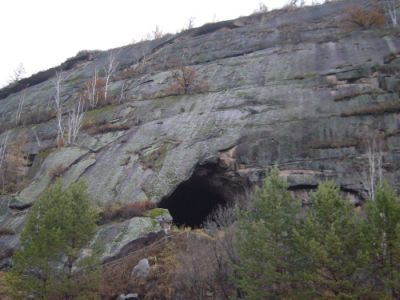
The Gaxian cave in north-astern Inner Mongolia.
The document "Wei Shu" is the story of Northern Wei, which was founded by the Tuoba Xianbei people. Here is told that in 443 AC a group of riders from a people called Wuluohou came and asked for an audience with the Emperor Tuoba Dai. They told him, they had heard about a cave, which was located in the northeastern part of the modern province of "Inner Mongolia", today called "Oroqen Autonomous Banner." The locals worshipped this cave as the Xianbei ancestral home, they said, convincing the king that the legendary cave, where all Xianbei's common ancestors in ancient times had their original home, had been found.
"Wei Shu" says further that the king sent one of his men, Li Chang, out to investigate the matter. Li Chang found that the story was true and held various ceremonies on the spot to honor Xianbei's indigenous ancestors. He did make an inscription on the rock at the cave, which described the ceremonies.
The cave and the inscriptions were explored by Professor M.I. Wenping in 1980. It has been inhabited since the Ice Age. It is today known as the Gaxian cave.
"Northern Wei" was founded by the Tuoba Xianbei people. It was the most important state in northern China in the years after the Migration Period, which in China was called the period of "Sixteen states" or the "Wu Hu" (five Hu) period.
It's called "Five Hu" because China was invaded by the five "Hu" people, who were Xiongnu, Xianbei, Jie, Di and Qiang.
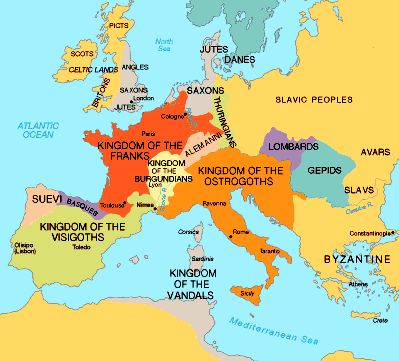
The Germanic kingdoms in the Migration Period in Europe.
The term "hu" described people with deep eye sockets, a thick beard, big nose and so on. Xiongnu was most likley the ancestor of the Turks, Xianbei is described in this article. Jie was a people few in numbers with a distinct caucasian appearance, perhaps descendants of Yuezhi. Very little is known about Di, perhaps they were related to the Xiongnu. Qiang had lived in the western mountains for millennia, maybe it was them, whom Przhevalskii met in 1876, whom he called "Tangutans", he wrote that they all were dark-haired and looked like Gypsies.
The situation of the state of Wei in Northern China was very similar to the situation of the Frankish kingdom in Europe in the years after the migration time.
During the Migration Period, the situation in Europe was chaotic. The Huns fought against the Goths and the Burgundians, the Goths fought against the Franks, the Longobards fought the Heruls and so on. Within each people's reigning royal families was also an intense rivalry for power over the newly won riches, just think of the story of the Frankish royal family, the long-haired Merovingians. After the dust from the fightings had settled, appeared the Franks under Carolus the Great as the big winners. In order to win recognition from the conquered peoples, they decided after some time to call themselves the "Holy German-Roman Empire", for the same reason they supported the Roman Catholic Christianity.
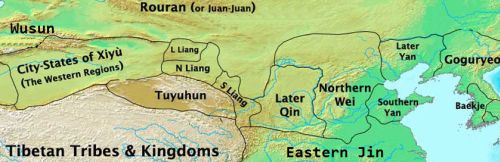
The migration kingdoms in China in the period of the sixteen kingdoms - The migration from the steppe into China began, however, fifty to a hundred years before the similar event did in Europe.
In China, the ruling Jin Dynasty likewise was overrun by barbarian peoples from the steppe, who then turned against each other in an intense fight for the newly conquered land. The Xianbei people fought against various Xiongnu (Hun) peoples, The Murong and Tuoba Xianbei fought against each other. Most Chinese migration states lived in a more or less permanent state of war with their neighbors. When the dust settled, "Northern Wei" had through many years of fighting united almost all the barbarous nations in North China. To win the conquered people's recognition they acquired Chinese culture and language, and they supported the spread of Buddhism.
All nations in North China in the Migration Period are often called something with "Former", "Later", "Northern", "Eastern" and so on. These are all call names that modern historians have given them to keep track of the so many countries, whose name were the same.
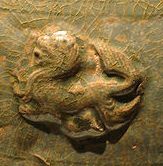
Xianbei art could be a little strange - just as they later Qi Dan's also could be.
For example, there were six different kingdoms, who called themselves "Yan". There was the original Yan that existed in ancient China, while Socrates and Plato walked around in Athens. In addition there have been forms Yan (337-370), Later Yan (384-409), Northern Yan (409-436), Southern Yan (398-410) and Western Yan (384-394).
Most Yan kingdoms were created by the Murong Xianbei people. They were short-lived and extremely unstable. For example, "Western Yan" existed only for ten years, during which time they had seven different rulers, who all suffered an unnatural death.

|
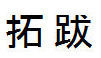
Tuoba written in Chinese characters.
In Scandinavian ears, the word Tuoba sounds very much like Thor-far. "Thor" is the Scandinavian god of thunder, and "far" is the danish word for father or decendant. Therefore, I believe that Tuoba means "the descendants after Thor."
The literal meanings of the two Chinese characters in simplified Chinese, which say Tuoba, are "extension" and "postscript" and it does not really make any sense. It is clear that these two characters have been chosen because they best describe the pronunciation of the word
regardless of their literal meaning.
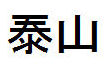
Tarzan written in Chinese characters.
If one on Google Translate is trying to translate Tarzan, the
king of the apes, from English to Chinese, you get two characters which really mean "Thai mountain", which is pronounced Taishan. (It is also a famous mountain in Shandong). If you ask then a Chinese: "What is the name of the king of the Apes?" so maybe he will reply, "hmm - yes, we can read it here, let's see - I got it - he is called Taishan."
The characters chosen to describe the sound of a foreign word are
frequently the best possible approximation and does not necessarily reproduce exactly the original pronunciation in the foreign language. So it must be that the word Tuoba represent the pronunciation of the Chinese characters, they have chosen to use, and the original pronunciation may have been slightly different.
According to the pin-yin system the Chinese word "Tuoba" is alphabetized as just "Tuoba", which pronounced, after a Scandinavian understanding of the use of sounds, will be something like toaar!-bah.
"O" is a closing sound in pin-yin, one can imagine that it is followed by a short "r". "uo" is pronounced as the vowel in the last part of the name of China - Zhong Guo. The exclamation point above shall symbolize the fourth tone, which is falling, which sounds a little like giving an order to the dog. The final "h" shall symbolize the second tone, which is rising, light and optimistic.
After the older Wade-Giles alphabetizing system Tuoba must be written "T'o-pa", but the pronunciation may, according to the nature of the case, be the same.
The name of a people or a family line is often a word, whose meaning has been lost in the mists of the past or a name of an original ancestor followed by something which means descendants, children, relatives or the like.
For example, ethnic Chinese call themselves Hua Xia, meaning descendants of Hua, the Yellow Emperor. In Scandinavian Skjoldungerne (The Shield Cubs) means the descendants of the child found lying on a shield. Gjukungerne (The Gjuk Cubs) means the descendants after Gjuki and so on.
"Father" is in Chinese called "ba pronounced somthing like ba!" (Falling tone). It is very close to the Danish "far" (father) and it may be difficult to hear the difference.
The final "-ba" in Tuoba - pronounced somthing like "bah", is with a rising tone.
But if you listen carefully, you can hear that the Danish "far" is also pronounced with a rising tone. It is only if one wants to blame the father something or warn him, that you can pronounce it with a falling tone.
In Danish it is said of a sow that gives birth, that it "farer" (present singular). It is easy to imagine that this expression previously had been valid for humans, but as time passed by it has been devalued to the animal world.
Designations for persons coming from various islands and provinces with -far have been typical for several historic peoples of Europe, the Danes, Angles and Burgundians. In Danish in a Sjaellands-, Lolands-, Langelands-, Hallands-, Blekinge- or Gullands-far designates persons originating from these islands and provinces. For example, a man from the island of Sjaelland was called a Sjaellands-far. For the Angles a Lindis-far came from Lindis and a Burgundian called himself a Burgunda-far. The meaning of this -far is close to descendants.
So a qualified guess about the meaning of "Tuoba" will be that it means the descendants from an original ancestor named "Thor".
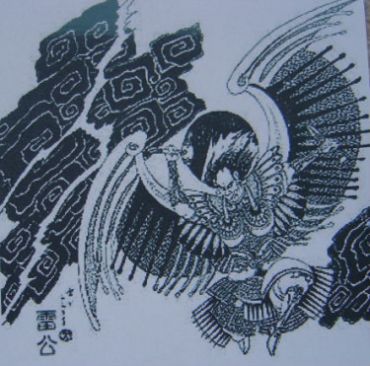
The Chinese god of thunder has a hammer with a short handle, with
which he produces the thunder - just like the Scandinavian God, Thor.
Wei Shu, the "Book of Wei", was written by Wei Shou 551 - 554 AC. Here he tells that the name "Tuoba" comes from that the Tuoba Xianbei people descended from "The Yellow Emperor", who is assumed to be the common ancestor of all Chinese.
Wei Shou lived during the Eastern Wei, who was that part of the split Northern Wei, who still held on to the hardboiled integration and adaption to Chinese culture policy, which was introduced in 494 AC. He used the Chinese royal name "Yuan", which replaced the imperial family's original name "Tuoba", including the emperors before 494 AC, and thus he creates some confusion.
He only tells about the Emperors of Eastern Wei and does not mention of the rivals in the Western Wei, who had rejected the integration policy and returned to the traditional Xianbei culture.
Not to applaud the racial policy of the state must undoubtedly have been politically incorrect, and probably harmful to health. So he could not very well write that the Xianbei people have one ancestor and the Chinese have another, it would probably have been quite dangerous. Moreover, after more than half a century's intensively integration pressure, in an era where there were only a few books, maybe many could not remember the history of their own people.
But he confirms that the name Tuoba contains a meaning of descending from an original famous ancestor.
Moreover, the writer of Wei Shu also disagrees with general Ran Min, who actually said that the Xianbei and Jie peoples were some half animal barbarians, who did not descend from the Yellow Emperor, as he did himself as a Chinese. (See elsewhere in this article)
|
|
Tuoba Xianbei people came into the history in the kingdom of "Dai". It was most likely located around the modern city of Hohhot in the modern Chinese province of "Inner Mongolia".
In 341 AC, the Tuoba king Shiyijian of Dai lost his wife, who was a sister of king Murong Huang of "Former Yan".
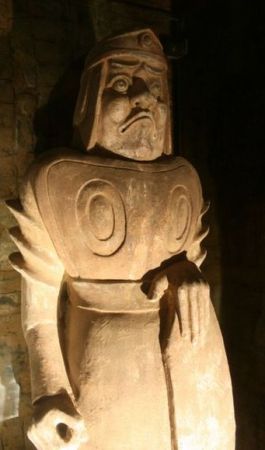
Tomb guardian from emperor Xuanwu's tomb - Northern Wei.
He asked Huang about a new wife. King Huang of Yan insisted, however, on a
large sum of money for a new princess. King Shiyijian refused to
pay and accompanied his rejection with abusive language. Then Huang sent his crown prince with an army against Dai, and King Shiyijian fled into the mountains with the whole of his people. The following year he sent his brother to Yan to ask for another wife, we don't know if he succeeded. Some months later came an envoy from the Murong kingdom to ask for a princess to the king. Kong Tuoba Shiyijian accepted the request from Yan and chose his own sister as a wife for Huang.
In 376 AC the kingdom of Dai was attacked by "Former Qin", which was founded by the "Di" people, it is said. The Tuoba people fled again into the mountains,
and during their stay there king Shiyijian died. The invaders succeeded to conquer Dai, and it ceased to exist as an independent Tuoba kingdom.
It is amusing and interesting that the Danish word for "wonderful" is "dejlig". It is pronounced something like dai-lig and means literally dai-like.
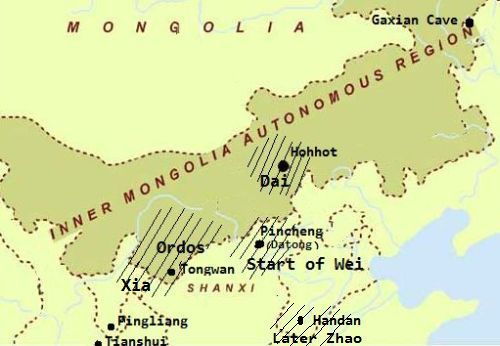
Map of Inner Mongolia, which shows Dai, Wei and later Zhao.
The new rulers left the area to the Tiefu Xiongnu people, which
was led by the kings of the "Liu" royal lineage. The Tiefu royal family had previously used their original name, "Dugu", but one of their ancestors had married a woman, whom they thought was a Han Dynasty princess, and therefore they changed their name to Liu, which was the Han emperor's family name.
The Former Qin was briefly master of the northern plain. However, they became victims of their own excessive ambitions. They set out to conquer the Chinese Jin Dynasty, which still held out in southern China. They suffered a disastrous defeat against a numerically inferior Chinese army in the Battle of Fei River in 383 AC in the far south in the modern province of Anhui.
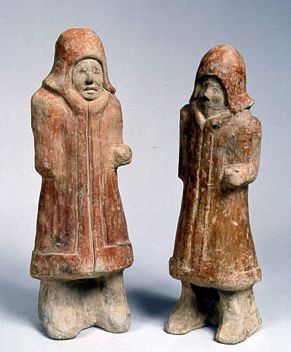
Two Xianbei figures found near Ningxia, they have a typical Xianbei dress.
"Former Qin" then disintegrated and Tuoba Gui (386-409 AC) who was a grandson of King Tuoba Shiyijian, saw the possibility of restoring the Dai kingdom in the northern part of the modern Chinese province of Shanxi. He established his capital in "Pinching", today known as Datong. The royal court resided only in the capital now and then. Most of the time they traveled around the country and took care of the kingdom's problems. Twice a year they went up the mountains to honor their ancestors.
However, after a few years, he decided to change the name of his kingdom from the original "Dai" to the more ambitious "Wei".
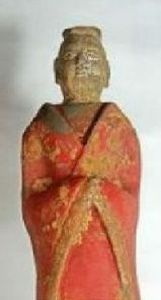
Left: "A Xianbei king or emperor.
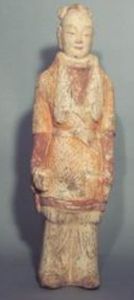
Mid: A Xianbei soldier.
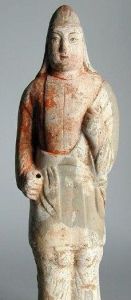
Right: A Xianbei soldier.
Already in 386 AC, the same year as the new empire was created, Tuoba Gui retook the former Dai area. King Liu Peini of the Tiefu Xiongnu surrendered. Two of his brothers, Liu Xian and Liu Kangni continued the fight against Tuoba until their death. Another branch of Tiefu Xiongnu, led by Liu Weichen, was defeated by Tuoba in 391 AC, and he was killed by his own men. However one of his sons, Liu Bobo, succeeded to escape to the Ordos area, where he 407 AC, founded a new state, which he called Xia.
The two Xianbei rulers Tuoba Gui of Wei and Murong Chui of Later Yan, united in order to attack the country "Later Zhao", which were located in the modern Hebei province around the city of Handan.
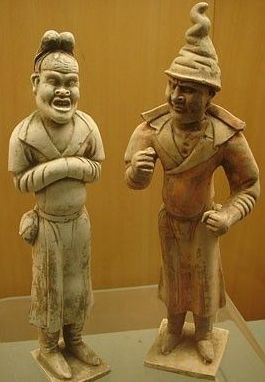
Two statuettes, which are supposed to represent foreign merchants - Tang Dynasty - Gansu Provincial Museum. The term Western merchants are often used when the findings do not have modern Asian features.
Later Zhao was originally founded by the "Jie" people. However, a Chinese-born general, Ran Min, arranged a kind of crystalnight and massacred all Jie that he could find. It is said to have been several hundred thousand. They were easily recognizable because of their typical Caucasian appearance, deep eye sockets, large nose, thick beard and so on. Some believe that they descended from Yuezhi. The Chinese character for "Jie" literally means such a thing as "castrated ram" or "animal skins." It can not be something that they called themselves.
Ran Min was an adopted son of a Jie nobleman.
Ran Min's forces had good success at the beginning of the war, but they fell into a Xianbei ambush. Wei's armored cavalry split the Chinese lines. General Ran Min was captured alive.
Before he was executed, he was asked, why he had killed the Jie rulers of the Later Zhao. He replied: "If brute barbarians like you can become emperors, why not I, a descendant of the Yellow Emperor?" (Ethnic Chinese call themselves "Hua Xia", meaning descendant of the Yellow Emperor, Huang Di.)
Ran Min's "Later Zhao" ceased to exist in 387 AC.
As a defense against the nomads to the north, the Chinese have always had their confidence in the Great Wall, gifts and bribes.
However, the Tuoba Xianbei favored mobile warfare. Emperor Tuoba Tao (408-452), explained how the Rouran nomads to the north should be fought: "The Chinese are foot soldiers, and we are soldiers on horseback. What can a herd of foals and heifers do against tigers and a wolf pack?"
"With the Rouran people, it is so that they let their animals grass in the north in the summertime when autumn comes, they move to the south, and in the winter they ravage our frontiers. We only need to attack them in the summer on their pastures. At this time their horses are useless, the stallions are busy with the young mares, and the mares are busy with their foals. If we attack them there and cut them off from their pastures and their water, we will within a few days have either overcome or annihilated them."
During Tuoba Tao's reign, Northern Wei's area was doubled, in practice, he united entire Northern China under his rule.
Sima Guang described Tuoba Tao in his "Zhi Zhi Tong Jian" ("Comprehensive Mirror for Aid in Government"):
"The Emperor of Wei was strong and brave and calm and resolute. Whether it was about to defend a town or to fight on the battlefield, he was always in the frontline. His bodyguards could suffer losses, but his expression was always the same, and therefore they were humble and impressed by him and willing to fight hard to the death. He was also modest, and he was satisfied with his clothes and his food, as long as it was sufficient."
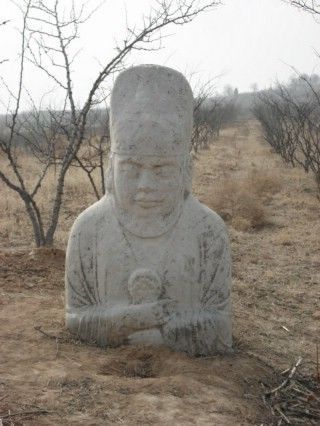
A Xianbei king of Northern Zhou - Longquan Mountain.
When his officials suggested that he should strengthen the defense of the capital and rebuild the palace, they argued with "I Ching,": "Princes and dukes must build defenses to ensure their homes and property," and with Xiao He: "An emperor may be home anywhere in his empire, but if his home is not sufficiently grand and luxurious, he cannot demonstrate his strength," he replied: "the ancient sages said, "what it depends on is flexibility, not secure defenses. Helian Bobo used boiled soil to build his city, and I destroyed his state; it was not because he was not safe enough. Right now there is no peace in the country, and we need manpower, and I despise large buildings. What Xiao Han said was not right."
He also felt that money should be spent on the state and the military and they should not be wasted. He handed out money as rewards only to those families, whose sons had died for the state or those who significantly had contributed to the nation. When he sent generals out, he always gave them instructions personally, and those, who did not follow his advice, most often did not reach their goal.
He was also good in judging his men's personalities and were able
to select generals among its soldiers, he appointed only
officials, who were qualified, not those who had good connections. He was very skilled in observation and could see, what was happening under the surface, and his advisers could not keep him from important information. He rewarded the ordinary soldiers and common people if they deserved it, and he punished men in high offices if they deserved it. He protected also not those, as he usually favored, and he often said: "I and the people obey the laws, and how dare you ignore them?"
However, he was cruel and often handed the death penalty, and he
often bitterly regretted the executions."
In 407 AC, a Tiefu Xiongnu named Liu Bobo founded the kingdom "Xia" in the modern Ning Xia area. He called it "Xia" because of the history that the Xiongnu descended from the ancient Xia Dynasty.
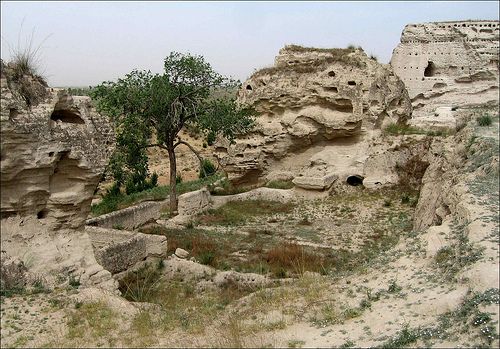
The ruins of Tongwan in Tongwanchang.
In 413 AC he decided to build a capital, which should be
absolutely impossible for the enemy to capture. He gave the responsibility for managing the construction to his evil general, Chigan Ali. The city was named "Tungwan", which means the United ten thousand, as it was Bobo's goal to rule all China's ten thousand states.
Chigan ordered that all soil that would be used for city walls, should be boiled (with rice) to make it hard and difficult to destroy. He often tested the quality of the wall, if an iron wedge were able to penetrate more than an inch into the wall, the foreman, who was responsible for this section of the wall, would be executed, and the corpse would be used as filling in the internal wall.
Liu Bobo supervised himself the manufacture of weapons and armor. He gave the order that they should be tested in such way that the arrows were shot against the armor; if the arrows could penetrate the armor, then the blacksmiths, who had produced the armor, should be beheaded; if the arrows could not penetrate the armor, then the smiths, who had produced the arrowheads should be executed. In this way, both fortifications, weapons and armor became of very high quality.
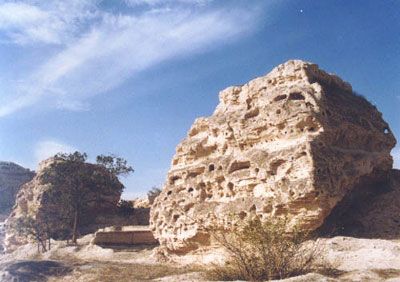
The ruins of the city Tongwan in Tongwanchang.
In 413 AC King Bobo decided to change his name from "Liu Bobo" to
"Helian Bobo". His family had before assumed the imperial family name "Liu". But Bobo meant that this were not appropriate.
A Chinese historian described Helian Bobo like this: "He was arrogant and cruel, and he treated people like weeds. Often he entered a tower with bow and arrow, and whenever he got an
impulsive suspicion, resentment or anger against someone, he would personally kill him. If someone stared at him, would he cut his eyes out. Anyone, who laughed too heartily, would have their lips cut open with a knife. Anyone, who dared to have a different opinion than he, would first get their tongue cut out, and then their head would be severed."
Helian Bobo decided in 424 AC, for reasons which have not made their way to written history, to push his eldest son, Helian Gui,
aside as a crown prince and instead appoint a second son, Helian
Lun, to succeed him. Helian Gui was a very skilled general, immediately he led his soldiers against Helian Lun, defeated him and killed him. When a third son Helian Chang heard this, he conducted a surprise attack, killed Helian Gui, took command of his troops and led them back to the capital, Tongwan. It impressed his father so much that he appointed Helian Chang to be his crown prince.
On the other hand the old man had little left for a fourth son, Helian Ding. It is said that Ding had too easy to laughter after
Bobo's taste.
Helian Bobo died in the summer of 425 AC, and his son, Helian Chang, succeeded him.
As early as 426 AC the Northern Wei attacked the Helian brothers Xia kingdom.
With fast cavalry units they rapidly penetrated deep into Xia territory, and in the same year they captured Chang'an (Xian). The young king Helian Chang, sent his brother Helian Ding off with an army of to retake the city. However, the Xia army became entangled in a kind of stationary warfare with fixed frontiers around Chang'an and got nowhere.
When the Northern Wei emperor, Tuoba Tao, learned that the Xia army was engaged around Chang'an, he ordered another Wei army under General Daxi to move quickly forward toward the Xia citadel, Tongwan, and initiate a siege. The Wei army planted the false rumor in Tongwan that they had shortage of food. This tempted Helian Chang to leave
his impregnable fortress and launch a counterattack that however, completely failed. He fled with the remnants of his army to the city Shanggui, today Tianshui, in Gansu. The Wei army then easily took his before impregnable Tongwan.
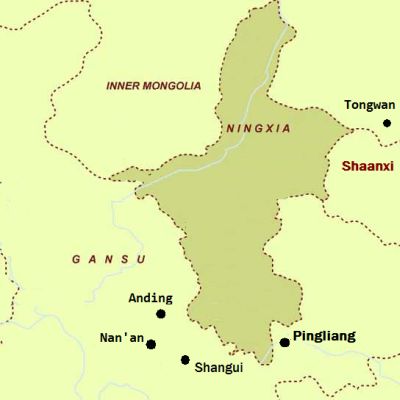
Map showing Ningxia and the southeastern Gansu.
Helian Ding succeeded in disengaging his army from the confrontation around Chang'an and joined his brother in Shanggui. In the spring 428 AC the now united Xia army pulled further back to Pingliang, also in Gansu. The Wei army was devastated by disease, which tempted the Helian brothers to take the initiative and surround the Wei army. However, during the siege, some Wei units conducted a counter attack, King Helian Chang commanded personally his men, but he fell from his horse and was taken as a prisoner.
Then his brother Helian Ding became king of Xia and the Qifu Xiongnu people. He gathered the remnants of his army and retreated to Ping Liang.
The Wei general Daxi felt humiliated that he almost had been overcome by the Xia forces. Despite the fact that he now really had a serious shortage of food supplies and also a lack of water, he pursued the enemy against Ping Liang.
A subordinate Wei officer, who was accused of negligence, deserted and told Helian Ding about the really serious situation in the Wei army. Helian Ding believed him, took the initiative, surrounded the Wei army and took their General Daxi and his entire army as prisoners.
In the town Anding and in Chang'an a few Wei units were stationed, few in numbers. When they heard, that General Daxi had surrendered with his whole army, they abandoned their posts and retreated against north. This made possible for Helian Ding to take Anding and Chang'an and the whole area back without a fight.
Helian Ding regretted that the old Helian Bobo had not appointed him his successor from the beginning, in this case Tongwan would not have been lost, he argued.
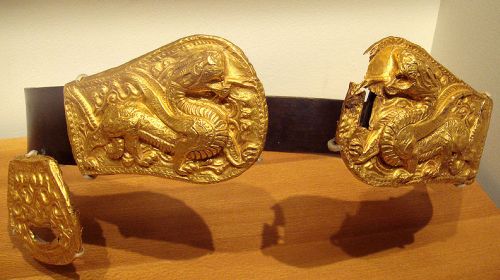
Xianbei belt buckle of gold.
Kong Helian Chang was as a prisoner brought back to Northern Wei. He was not executed, on the contrary. The emperor treated him well. The emperor gave him his sister in marriage, and appointed him Prince of Qin. Perhaps the Emperor knew that Helian Chang and his brothers all were very skillful and experienced generals, who would make good satisfaction in the Wei army.
In 431 AC the South China Liu Song Dynasty declared an offensive against their enemy and rival, the Northern Wei. Helian Ding saw the opportunity to ally himself with his enemy's enemy. Xia and Song agreed to defeat Wei and share their territory.
At the same time - in another part of Gansu, the political events developed to the detriment of Helian Ding and his Xia veterans.
The Qifu Xianbei State, "Western Qin", was hard pressed by their neighbours, who were the Xianbei Tuyuhun kingdom and the Xiongnu state, Northern Liang. Kong Qifu Mumo decided to surrender to the great power Northern Wei, provided that he got the Pingliang and Anding areas as a duchy. The areas were of course not available in the moment of the contract, but it was thought to be a matter of time. Kong Qifo Mumo and his army left his kingdom to join the Northern Wei in the fight against Xia and Helian Ding.
When these tidings came to the ears of Helian Ding, he immediately set out to sever Qifo Mumo and his army, which, however, had made a stop in the town of Nan'an, also in Gansu.
However, the Song Dynasty did not take any serious initiative in the war, and Northern Wei decided to turn against Xia and Helian
Ding first. The emperor himself led an army against Pingliang, who was defended by Ding's little brother Helian Shegan. The Emperor had the captive king, Helian Chang, trying to persuade his brother to surrender. Helian Chang's fate was an illustration of the fair conditions they could expect if they surrendered. Shegan refused to surrender.
When Helian Ding heard that Pingliang was under siege, he tried to turn around to rescue his brother, but he was prevented by a significant Wei army led by general Tuxi Bi. The Wei
general fooled Ding into believing that his army was only some small units and triggered thereby an attack from Helian Ding. In the following battle, the Xia army was badly beaten and withdrew
to the Chingdu plain near Pingliang, where they were surrounded by the Wei army. For several days they held out - without water and food. Eventually, Ding and a few men managed to fight their way out of the encirclement, but most of the army was lost, and he himself was seriously wounded. He gathered the survivors and fled to Shangui.
Around New Year 431 AC Helian Shegan and another brother Helian Duluogu had to surrender both Ping Liang and Anding.
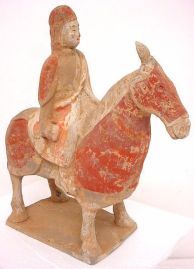
Xianbei cavalry man from Eastern Wei.
Helian Ding gathered one last army and went north to attack the little Xiongnu state "Northern Liang" in order to take its territory and thus ensure his people's survival and existence. But the Tuyuhun King, Murong Mugui, had anticipated this move and sent an army to cut off the way. Just when the Xia army was crossing a river, they were attacked by Tuyuhun, who took Helian Ding and all his men as prisoners. Mugui delivered Helian Ding to Northern Wei in 432 AC against being appointed to Prince of Xiqin and receiving other rewards.
For reasons which are not passed on to the history, Helian Chang fled from his gilded captivity in 434 AC. He was however captured by the Wei generals west of the Yellow River, who executed him. Then the Wei emperor gave up winning the loyalty of the Helian brothers, and they all were executed.
This was the end of the Xiongnu Tiefu people.
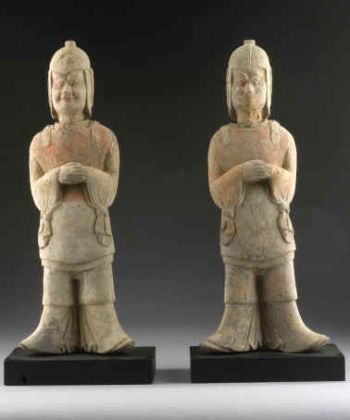
Two soldiers in typical Xianbei dress.
In the autumn of 445 AC, a Xiongnu named Gai Wu started a rebellion against Northern Wei in the previous "Former Qin" area in modern Shaanxi. Very quickly a lot of other Xiongnu and Han Chinese joined the rebellion. Gao sought and obtained the support of the Liu Song regime in South China, as he declared his loyalty as a vassal.
The local authorities failed for to quell the rebellion in the birth, and the Gai insurgency was growing still stronger, as he proclaimed himself the title of "Prince of Tiantai".
In the spring of 446 AC, the emperor Tuoba Tao personally led successful attacks on one of Gai Wu's allies, the Han insurgent, Xue Yongzong. By the news of Yongzong's defeat, Gai Wu fled into the mountains, and the emperor mercilessly punished those, who had supported the rebellion, they were all killed without mercy.
When the Wei forces took Chang'an (Xian), they found a big quantity of weapons hidden in Buddhist monasteries. The emperor, therefore, believed that the monks had collaborated with the Gao Wu rebels. Therefore, all Buddhist monks in the town were killed, the temples demolished and the Holy Scriptures burned. He subsequently issued a ban on Buddhism throughout his empire.
All the conqueror peoples of the Migrations Age in Europe as well as in Asia, established a society based on a dual system, as it is called. It was essentially a kind of apartheid system. The conquering people was an upper class that took care of the military, administration and religious affairs, while the original inhabitants were farmers, merchants and craftsmen who run the basic production.
The Franks conquered the Roman province of Gaul, including farmers
and craftsmen. The conquerors thought that it was their natural right, that they and all their descendants should enjoy the country they honestly had won by the sword. Only the French Revolution more than a thousand years after abolished their inborn nobility privileges.
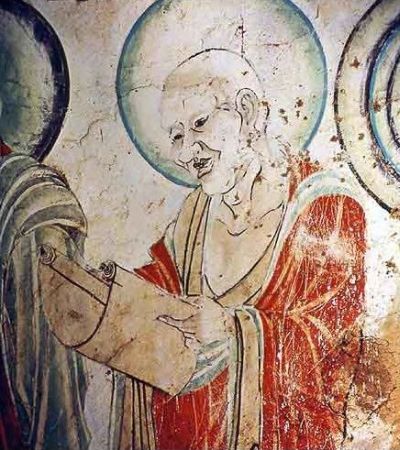
A learned man with a typical caucasian appearance - Dunhuang cave 202 from early Tang Dynasty 642 AC.
Northern Wei was also such a migratory state. The Xianbei Tuoba people were conquerors and master people, and they formed the core of the military. As Emperor Wudi Tai expressed himself: "The Chinese are foot soldiers, and we are soldiers on horseback." It was not the case that the Chinese were slaves, but they had clearly an inferior status just as the peasants had in medieval France.
But the difference between Europe and China have probably been that in Europe the common people and the masters were basically of the same race. If one did not know or were able to conclude from dress, speech and manners, one could not say, who were masters and who were the subjects.
There are stories from medieval European peasant revolts, where peasants are described as "small, black and badly armed". But, on the time of the French Revolution, there are no indications of any ethnic difference between the estates.
But in migration time North China there seemed to have been a rather visible ethnic difference between the masters and the subjects. As Ran Min said before he was executed: "If brute barbarians as you can become emperors, why not I, a descendant of the Yellow Emperor?" It is also logically included in the label "Five Hu" since the term "Hu" describes the physical appearance.
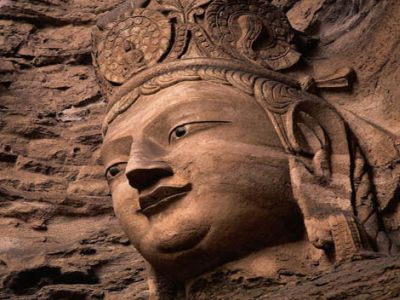
A Buddha from the Yungang Caves at Datong with a high nose bridge and narrow eyes, a compromise.
Kings and emperors were responsible for maintaining the delicate balance between the conquerors and the people. The barbarian conqueror peoples were the backbone of the states and without them, they would disintegrate. The original inhabitants of the country were the productive part of the nations, and they constituted the overwhelming majority. Any change in the balance between the country's groups could be catastrophic.
Empress Feng and her grandson Emperor Xiaowen (467-499) of Northern Wei introduced in 494 AC a dramatic integration policy. They thought it would make it easier to govern the country, but it turned out to be the end of their nation and at the very end of their people.
The emperor and his family changed their name from the original Xianbei "Tuoba" to the Chinese "Yuan".
The language at court, and any other any administrative centers were changed from Xianbei to Chinese. Officials who did not speak Chinese got a short time to learn it.
All Xianbei families were ordered to change their traditional Xianbei names into Chinese names.
All Xianbei families were called on to marry their sons and daughters to Chinese persons.
It became forbidden to wear the traditional Xianbei dress. Everybody should dress in Chinese costumes. Artistic creations should be consistent with Chinese culture.
The whole thing reminds about the Longobards, Franks and Goths in Europe. They abandoned all their own native language and took up to speak Latin, maybe they thought it was more noble. But they were not so good at it, so the resulting languages were Italian, French and Spanish; which were Latin mixed up with their native language's words and phrases.
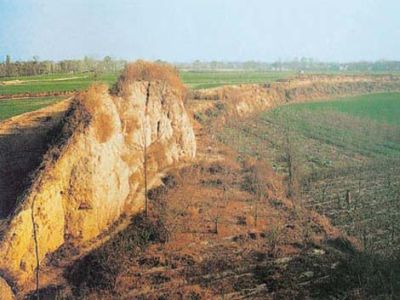
Luoyang city walls - ruins of ancient Luoyang is located in some distance from the modern city Luoyang.
The capital of the country of Wei was transferred from Pincheng to Luoyang. Originally the administrative center was located in Pincheng, which was near the front against the Rouran nomads on the steppe. After moving to Luoyang the army and indigenous Xianbei tribes and clans, which formed the core of the army, were downgraded.
Mobile warfare as the military strategy was abandoned in favor of a traditional Chinese defense based on stationary positions, gifts and bribes to selected barbarians. The military was downgraded and increasingly populated with convicts and similar.
The traditional Xianbei tribes and clans were furious. An opposition against the integration policy centered around the crown prince Yuan Xun was revealed, and he was forced to commit suicide.
In 528 AC the Northern Wei's last real emperor asked his general Erzhu Rong to march against Luoyang and rid him of his mother's (Dowager Empress Ling) Chinese advisers. However, before they arrived, the Dowager Empress got wind of the plan and she succeeded to kill the young emperor with poison.
Erzhu Rong and his Xianbei army surrounded the palace and killed the entire court together with all their family, two thousand persons, of whom most were Chinese.
Then he placed his son in law Tuoba Ziyu on the throne, while he retained the command of the military for himself and thus the real power.
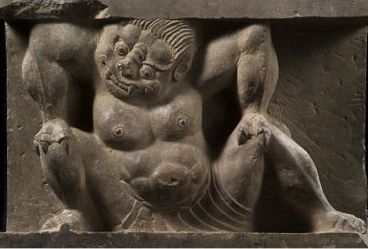
A tomb guardian or other monster from the Xianbei State of Eastern Wei - Note his disgusting big eyes.
While Erzhu Rong and the army was on an expedition in the north,
Luoyang was conquered by forces from the neighboring state of "Liang". They deposed Tuoba Ziyu and crowned their own emperor, Tuoba Hao (529 AC). Erzu Rong returned, defeated the Liang forces and reinstated his son in law as Emperor.
However, in 530 AC the young emperor killed his father in law with the royal scepter. He did not think, it was suitable for a true emperor, to be led by a man of lower rank. Erzhu Rong's nephew, Erzhu Zhao, avenged his uncle in collaboration with another general, Gao Huan, and together they set a new emperor, Tuoba Ye, on the throne.
While Erzhu Zhao was on expedition with the army to the north, one of his relatives forced the new emperor to abdicate, and he put his own candidate, Tuoba Gong, on the throne.
Meanwhile, General Gao Huan made friends with men, who hated the Erzhu clan, and in 531 AC he set his own emperor, Tuoba Lang, on the throne. However, already after a year he became unhappy with his emperor's behavior and introduced a new Tuoba Xiu, (531 AC). He gave the new emperor's his eldest daughter as a wife. However, while Gao Huan was away fighting the enemies of the Empire, Emperor Tuoba Xiu revolted against his general and
repudiated his daughter as wife. General Gao had to turn around and
insert a new emperor, Tuoba Shao, who received his repudiated oldest daughter as a wife. The former emperor escaped. However, after a short time, general Gao Huan once again had to set a new emperor on the throne, namely Tuoba Shanjian, who received another of his daughters as a wife.
In 550 AC Gao Huan's son, Gao Yang deposed the last Emperor of the Tuoba royal family and proclaimed himself as the first Emperor of Northern Qi.
It looks like the fall of the Roman Empire, just faster and more absurd.
Inner Mongolia became in the nineteenth century populated by emigrants, particularly from the Chinese central provinces Henan, Hebei and Shandong. While the American settlers went West, the Qing dynasty Chinese went North. People from Inner Mongolia, as one meet in airports and train stations look like all other Chinese.
When reading translations of classic Chinese literature, such as "Weilue" and" Hou Han Shu", it is striking that every name sounds Chinese. Xiong-Nu, Qi-Dan Dan (g)-Xiang, Xianbei and the Qiang peoples all kings and generals appear to have Chinese-sounding names. Place names and the names of the peoples in the West themselves, mentioned in the classics, also sounds Chinese.
One sits back a bit with the feeling that East Asia's and China's history might have been an entirely internal Chinese-Korean development, only affected by some frontier episodes with Turks and Mongols.
It's also what the history enthusiasts in this part of the World claim so engaged. They are passionate supporters of the philosophy of history based on the "China is an island" concept, ie that the Middle Kingdom has evolved completely independently without any significant interaction with the rest of Eurasia.
But most likely, the Chinese sounding names of the peoples in the west were names, given to them by the Chinese, and the ancient barbarian kings and generals, who had contact with China, had both their own barbarian name and a Chinese name, which the Chinese could remember and pronounce. For example, the Dan Xiang King "Weiming" had also a Chinese name "Li Yuanhao". (For deeper reflection "Wei Ming" means "mighty name" in Chinese, so it may also be a Chinese label given to him).
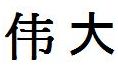
The Chinese character for very big - wei da.
Once I was in China, I wanted to buy a carved stamp as a present for my son. My son's barbaric name is "Magnus", which is derived from Latin and means "Great". I discussed with the woman in the shop, how we should express this with a Chinese character. We chose Mao Zhe Tung's epithet "Wei da", meaning "mighty big".
Now let us imagine that time has progressed for some centuries. A historian has found an old book that is stamped with Hansen's son's barbaric name. He contacts an expert who is knowledgeable in the special simplified Chinese characters from the Mao dynasty, and asks him: "Tell me, what was Hansen's son's barbaric name?" The expert looks at the Chinese characters and says: "It's easy, his name was Wei Da".
Even if one tries to find some Chinese characters, whose pronunciation matches the barbarous name as good as possible and the meaning is ignored, it can not be avoided that a later alphabetizing will sound pretty Chinese.
|
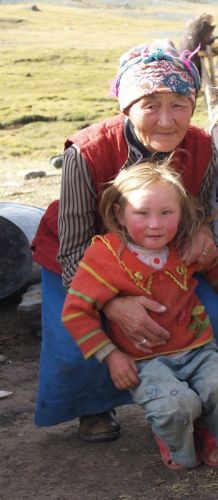
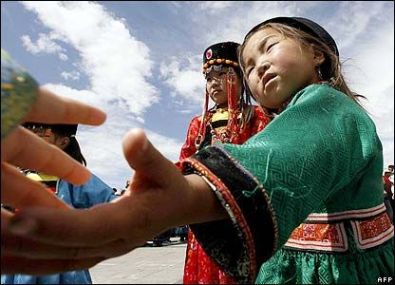
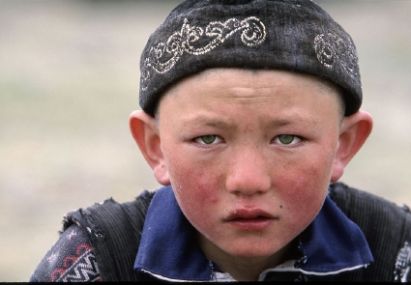
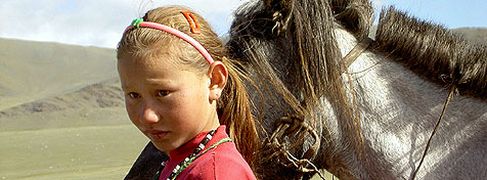
Genes for blond hair and blue eyes do still excist on the eastern steppe.
Photos found on the Internet:
Left: Blond little girl from Tuva, which is the Russian autonomous area north of Mongolia.
Mid above: Fair-haired little girl from Mongolia.
Mid below: Blonde little girl from Tuva near Mongolia.
Right: A Kirgisian boy with blue eyes.
|
Tongwancheng, the city of Southern Huns Historian, Oriental Studies - Research Group on Hungarian Ancestral History Japanese Buddhist Statuary Internet turisme i Longmen hulerne ved Luoyang. "Gods Chinese Son" af Jonathan D. Spence - Norton. A thanks to the website "China History Forum" - which unfortunately is not among us anymore - for information and inspiration. |
| To Top |
20200704

|