|
Home DH-Debate 16. A brief History of Denmark 18. The White and Superior's Great Land |
| 1. The Origin of Qi Dan | 2. The Kingdom of Liao |
| 3. Culture of Qi Dan | 4. End of Liao |
| 5. Outlaws of the Marsh | 6. Appearance of Qi Dan |
| 7. Western Liao | 8. Literature |
Danu is an ancient Indo-European word for river, which can be found in the ancient names of European rivers, such as Danubius for Danube, Danastius for Dniester, Danapris or Danaper for Dnieper, Rodanus for Rhone and many others.
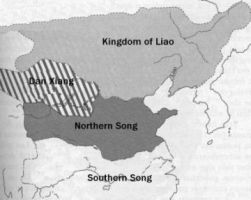
The kingdom of Liao.
A people who call themselves something with Dan thereby betrays an Indo-European origin in a near or distant past.
The Liao Kingdom that was in present-day northeast China, was called "Qi Dan" by the Chinese and "Khi-tan" by the Mongols. They claimed themselves to descend from Tuoba Xianbei and the Tuoba royal family. The Great Liao Kingdom has long since disappeared, but the name of the modern Chinese province of Liao-ning still bears testimony to them.
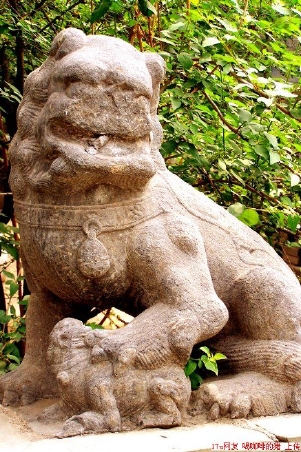
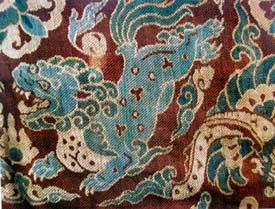
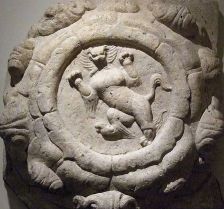
The kingdom of Liao seemed to have been as fascinated by lions as the Chinese are by dragons. It is obvious to imagine that "liao" means lion, like "loeve", "lowe", "lion", "leeuw" or "lew" do it in well-known Indo-European languages.
|
|
Left: Stone lion from the Liao Empire.
Mid: Lion on woven silk carpet from the Liao Empire.
Right: Lion on medallion from the Liao Empire.
It can also be found in the document "Hou Hanshu", from the Han Dynasty in the description of the western regions, section 19. Here is a description of the kingdom "Alan-liao": "The empire Yan-cai has changed its name to The Empire of Alan-Liao" . Which shows that the Qi Dan people shared not only language but also their fascination of lions with peoples of the Western mountains, probably the Xianbei tribes.
Qi Dan's fascination with lions can be recognized at many historical peoples, not least European ones - although no lions have lived in Western Europe in historical times. It is tempting to see a cultural connection between the Indo-European tribes around China and the early European peoples.
|
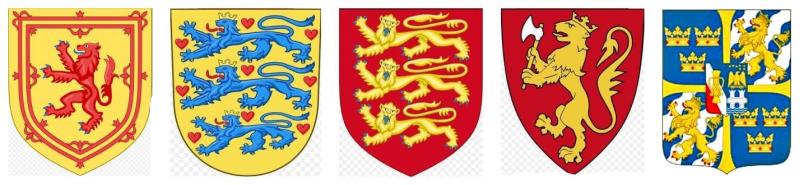
No lions have lived in Western Europe since before the last Ice Age, yet Europeans are also deeply fascinated by lions and have been since ancient times. Royal coat of arms is unthinkable without lions.
From left to right the Royal Coat of Arms for Scotland, Denmark, England, Norway and Sweden.
Westerners knew Qi Dan's country as "Cathay" or "Khitai" and this is the origin of the name China. Russians still use the word Khitai for China.
In China's very early history Qi-Dan was part of "Dong Hu", which means "Eastern Hu". As mentioned earlier, the label "Hu" indicates big noses, big eyes, eye brows, etc.
A people called Qi Dan was first mentioned in the "Wei Shu", "Book of Northern Wei Dynasty". It says: "The country Qi Dan is located East of the country Kumoxi, and they are two different people with the same ancestors". The Northern Wei Dynasty existed from the figure from fourth to the sixtht century AC. In "Wei Shu" it is noted that the Qi Dan were descendants of the Xianbei tribes.

The Chinese characters for Xianbei means fresh thieves.
In the Dunhuang documents, P. 1283 (in Tibetan) is told about the Qi Dan people's language: "In the language, they (Qi Dan) and Tuyhun could broadly communicate with each other", i.e. the languages must have been closely related to each other, such as Danish and Swedish. Tuyhun was a branch of Murong Xianbei and Qi Dan descended from Tuoba Xianbei. This indicates that the various Xianbei peoples in the migration time living in present Inner Mongolia and north China mainly spoke the same language. The Xianbei peoples created the Wei Dynasty and many other migration states. Sui and Tang Dynasty originated from Xianbei peoples, who had adopted Chinese culture.
During the Tang Dynasty Qi Dan's eight people were united under King Kuge. On behalf of the Tang Emperor, he led war against the Turks. He was granted permission to carry the family name Li and thus became related to the Tang emperors.
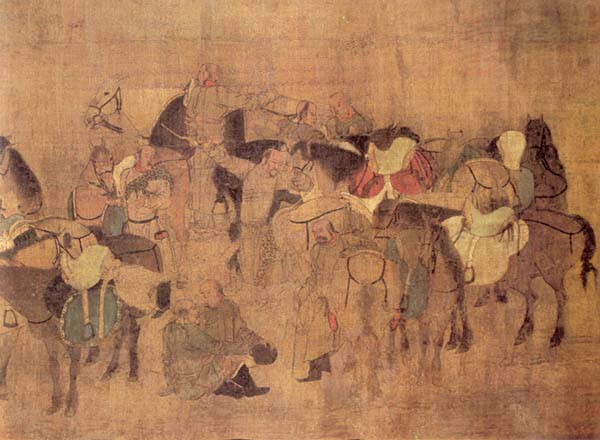
Qi Dan break up the camp. Chinese drawing, unknown origin.
In their distant past on the steppe the Qi Dan peoples worshiped the Sun, which by then many other peoples did. Their original religion also included that they sacrificed white horses and gray oxen to their gods. They became early devoted Buddhist.
Qi Dan originally consisted of eight different peoples or tribes. In the last year of the Tang Dynasty, 907 AC, they were united under King Yelu Abaoji. In 916 AC, he formed the state Qi Dan. He named themselves "Wang", which means king in Chinese. In 947 AC King Yelu Deguang renamed the country to "Liao".
Kong Abaoji established his capital, Lin-Huang (pronunciation something like Lin-Hwang) in the present Inner Mongolia.
Yuezhi also used the place-name ending -huang in Dun-huang, Guis-huang. One can believe that -huang, -hwang or -vang means pasture, as the latter does in at least one Indo-European language.
Qi Dan also occasionally referred to themselves with the sovereign title: "The Highest Peace", "Tai Ping" in Chinese. (from "Gods Chinese Son"). They have undoubtedly felt about themselves that they were a people, who was born to rule.
Immediately after the formation of the nation of Qi Dan King Abaoji started to expand his kingdom. To the north, he subdued the Turkish Uighurs, who then lived in Mongolia.
To the east Qi Dan conquered the countries of Fuyu and Bohai. They were pooled into one unit that got the name "Dong Dan," it means "East Dan". In some sources it is called the kingdom of "Dong Dan Guo" meaning East Dan Gard - indicating that the usual original realm may have been called "Dan Guo" - Since, for example, the term "East Berlin" presupposes the existence of an original "Berlin" which is not connected with the compass direction east - King Abaoji's son Yelu Bei became East Dan-gaard's first king.
Kong Yelu Abaoji introduced a civil servant system inspired by the Chinese mandarin system, pushing the nobilty aside.
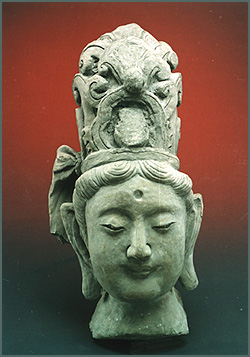
Bodisatva from the Liao period - unknown origin.
Queen Shulu brought prince Yelu Deguang to power in 926 AC. He supported a Tang general's efforts to restore the Tang Dynasty. As a reward Liao, as they now called themselves, received the nearby sixteen northeastern Chinese districts, including present Beijing.
This ekpansion led to open confrontation with Song Dynasty China.
The Song emperor personally led an army against Liao in order to win the 16 provinces provinces back. But after a few weeks of war against Qi Dan's armored cavalry the Chinese had to see themselves completely beaten, and the Emperor himself fled from the battle riding on a donkey disguised as a poor peasant.
After King Deguangs's death the usurper Yelu Lihu placed himself on the throne. Yelu Ruan took the power from the usurper, but however - he was soon murdered by a relative. His successor, Yelu Jing, balanced between the Qi Dan aristocracy and the large group of dissatisfied oppressed etnic peoples. Yelu Jing was murdered by a servant in 969 AC. General Han Derang then reigned as guardian for the Queen Dowager Cheng Tian and the minor king Yelu Longxu.
The Song rulers sent one army after another against The Liao Tartars, as they called them, but each time they were defeated. Liao's armored cavalry seemed invincible. Song was not in able to win back the disputed provinces.
After many weary battles concluded the two empires in 1004 AC a peace treaty, known as the Chan Yuan Treaty.
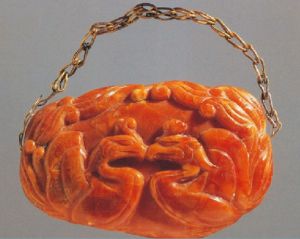
Amulet from Princess Chen's tomb of Baltic amber (!).
It determinded that the border between the two empires stretched through the present Hebei province south of Beijing. This peace lasted more than hundred years.
During Yelu Longxu's long reign experinced the Qi Dan people a steady progress. In his time many beautiful monasteries and pagodas were built, which still stands today. The Qi Dan people and the kingdom's other peoples were treated equally under the law. The slaves' conditions were improved so they became a sort of serfs.
King Yelu Zongzhen and his successor Yelu Hongjie struggled with contradictions between the Crown and the nobility and power struggles between queens and mistresses. Queen Xuan-yi was accused of witchcraft. Around 1100 AC numerous uprisings took place all over the country.
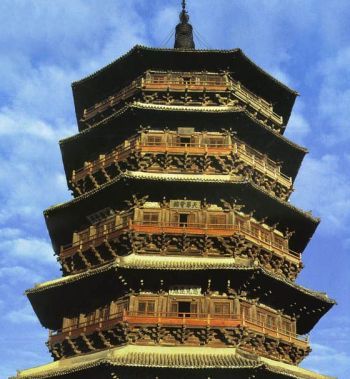
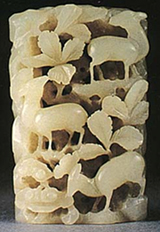
Left: The wooden pagoda at the Fogong monestary in Shanxi.
Right: Three deer who eat from a tree. Carved in Jade from the Liao dynasty. Unknown origin.
A jade figure from the Liao kingdom shows three deers eating from a tree. It brings to mind the four deer, Dain, Dvalin, Dunor and Duratro, who graze on the World Tree Ygdrasil in Scandinavian mythology. However, the Liao tree is not an ash.
By all accounts, the culture of the Qi Dan kingdom was not inferior to the Chinese Song Dynasty culture.
Already the founder of the kingdom, King Abaoji, created an academy in the capital for training of new officials. His successors established local schools and district schools all over the country.
The Qi Dan people were Buddhists and perhaps Nestorian Christians. A very large part of the beautiful and stunning pagodas and monasteries, which can be found in Northeast China have been built during the Liao period. The wooden Pagoda at the Fogong Monastery in Shanxi is built during the Qi Dan reign. It has been erected without completely without nails.
Yelu Diela, en brother of Qi Dan's first king, designed a Liao set of characters as replacement of the Chinese characters. They are still not fully understood by historians.
Qi Dan princesses and queens wrote poems. A man named Yelp Bei had a large collection of books in his Wanghaitang castle on top of Mount Xiwulu.
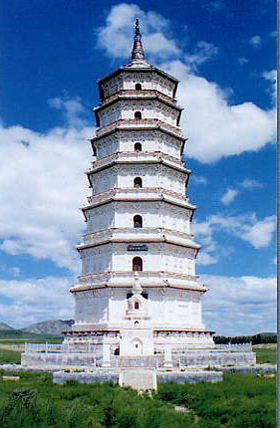
At Suoborigasumu in Balin Youqi is the ruined city of Qingzhou with the white pagoda.
In the kingdom of Liao circulated books, printed with wooden blocks. A well known Buddhist canon was called "Da Zang Jing" and its successor with more special Qi Dan content was named "Dan Zang," i.e. "Dan canon." Here we see that Qi Dan called themselves "Dan".
As an introduction to the traditional annual royal hunting the whole court followed the king to the hunting fields. This tradition was called "nabo".
In the present Inner Mongolia a Qi Dan tomb have been found belonging to the Princess of Chen, a granddaughter of King Yelu Xian. She died, 18 years old in 1018 AC of mercury poisoning. She was buried with her husband, a Qi Dan nobleman. He died at an age of 35 years.
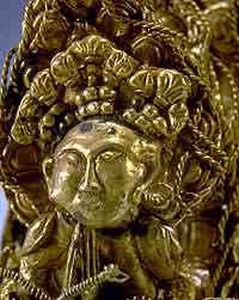
On their heads they wore crowns of gold and silver. On their faces were placed death masks of gold. Their heads rested on cushions decorated with silver and gold, and they wore necklaces of amber, pearls and jade. More than a thousand such artefacts were found in their tomb.
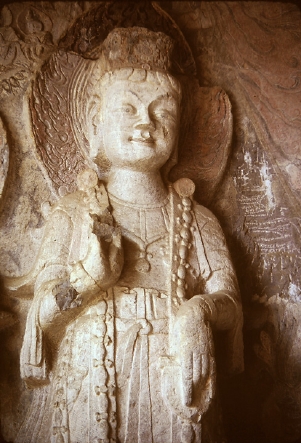
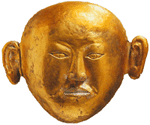
Left: Bodisatva from the kingdom of Liao - unknown origin.
Right: Death Mask of gold from the Princess of Chen's tomb.
Apparently the Qi Dan women were rather equal with men. The princess of Chen had got the harness for her horse with her in the grave and also her bow and arrow.
Some Chinese sources believed to know that Qi Dan had a strong sense of ethnic superiority over other nomadic peoples, whom they had made themselves masters of. They regarded the subordinate nomad peoples, perhaps Mongols and Turks, as something to be compared with slaves and draught animals, it is said. Others of their subjects, who were permanent residing peasants, were treated a little better. Chinese sources said that the Liao people exploited all these different etnic groups without scruples and reacted with extreme brutality on any insurgency.
To this must be said that the Chinese probably had their knowledge from the Jurchen people, the Manchus, who later conquered all of China and and established themselves as the Qing Dynasty that was in power for several hundred years. They were former subjects of and mortal enemies of Qi Dan, and maybe they were slightly biased.
Jurchen, a tribe was named that lived in the eastern part of the kingdom of Liao. The Chinese knew them as the Nutzen. They became the later Manchus. In King Yelu Hongjie's reign around 1090 AC, they were united under their leader Wanyan Aguda, and they became the strongest power within the kingdom after the Qi Dan people themselves. The new Jurchen leader refused to perform a traditional dance for King Hongjie, which should symbolize his loyalty to the kingdom of Liao. Never the less the king appointed Aguda as prince of Donghuai. But the Jurchens leader was not for sale, and they continued their rebellion.
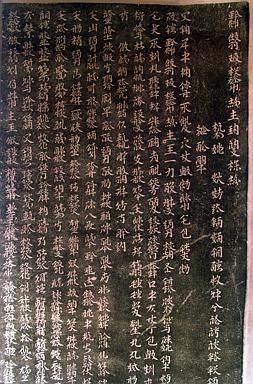
Qi Dan characters - completely different from the Chinese characters.
The Qi Dan nation's frequent name changes must reflect intenal disagreements about the leadership. Every time a new group came to power, they introduced a new name to indicate that now a new era had begun. In 947 AC King Yelu Abaoji named his kingdom "Great Liao". King Liao Yelu Longxi revived in 983 AC the name Qi Dan. In 1066 AC King Yelu Hongjie again brought the Liao name to honor and dignity. As mentioned earlier, they also sometimes called themselves for "Taiping", which means "The highest peace" in chinese.
It may have been this division, which eventually crippled their vigor and paved the way for their downfall.
Song Dynasty China made around 1120 AC an agreement with their enemy's enemy. They agreed with the Jurchens to initiate a war against the Qi Dans, attacking their common enemy from both East and West on the same time.
Before long Jurchens were in open rebellion against the kingdom of Liao, while the Song Dynasty Chinese attacked the southern borders
The Song Dynasty's armies had, as usual, little success in fighting against Liao's iron-clad cavalry. In battle after battle, they were refuted.
But however in a series of battles in present northern Jilien province the Jurchens won victory over the untill then invincible Liao cavalry. This was the beginning of the end.
King Yule Yanxi lost his temper and fled into the mountains followed only by a few family members and servants.
A new king, Yelu Chun, took over the defense of the kingdom. However he died after a few months, and his widow, Queen Xiao continued the fight. In 1122 she finally had to surrender the last city, the present Beijing, to the Jurchen rebels.
In 1125 the Jurchens captured the fugitive King Yule Yanxi in the town Yingzhou near the white pagoda, and the Liao Empire ended its excistence. Then the Qi Dan's nation had existed for 218 years.
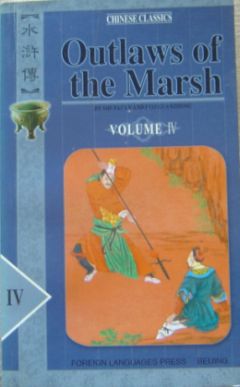
Outlaws of the Marsh.
"Outlaws of the marsh" is a classic Chinese novel. It is a collection of myths and legends from Song and Yan Dynasty, written together by Shi Nai'an and Luo Guanzong and released first time in a fairly comprehensive form in 1541 AC, many years before the first white Europeans arrived in China. The plot describes among other things the war between the Chinese and the Liao Tartars. The novel was written during the Ming Dynasty (1368 - 1644 AC), and the plot unfolds in the period around 1100 AC.
The leader of the outlaws, Song Jiang, was a historical figure, who is also mentioned in other documents from the period. Just as the famous novel "Three Kingdoms", "Outlaws of the Marsh" is built over some real historical events, but of course with many artistic additions. However, "Outlaws of the Marsh" has in general a better person portrayal and a more captivating plot. It's actually a great robber story, which completely can be compared with "Robin Hood". "Three Kingdoms" on the other hand may seem a little confusing because it mentions so many names of battles, rulers and generals. The Chinese names are in any case somewhat confusing for us, we westeners feel they all sound more or less alike.
After many brave deeds the robber chief Song Jiang and his men were granted amnesty by the emperor. They were sent to war against the Song Dynasty's enemies. The first one was the Liao Tartars, who lived in the north.
The Kingdom of Liao included, what we formerly called Manchuria, and the eastern plains, including present Beijing, where the country of Yan (Jan) had been located in China's antiquity.
They met the Tartar forces that led black flags and banners. Their general is thus described: "On a magnificant prancing horse a Tartar gneral rode forth. He was fair complected, with red lips, golden hair and green eyes, and was tall and powerful. The banner behind him read: "Aliqi, General of the grat Liao Kingdom".(Outlaws of the Marsh IV page 1762). During the fight, however, he was killed by a stone thrown in the face, and the Tartars fled.
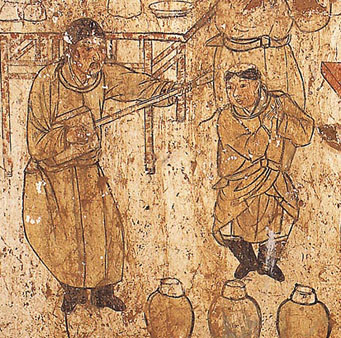
Chinese drawing of Dan Qi men - note the musician to the left, who has brown beard and hair. Dancing seems to have been very important for Qi Dan. Unknown Origin.
It is told in the novel that in the Liao kingdom men buttoned their jacket on left side, like the dancer on the picture does. Besides the musician has brown hair and beard as the the Liao men in the novel.
Then the outlaws met an army led by two royal nephews, Yel Guozhen and Yel Gubao, both immensely brave, they wore golden crowns. Also this army is beaten, and the two nephews perish. (Outlaws of the Marsh IV page 1766)
Later the outlaws met a new army led by the king's younger brother, prince Yely Dezhong. "In the distance they could see the Liao soldiers swarming towards them, like a dense dark fog, like rolling yellow sand dunes. Their black flags were rows of raven clouds, their fine steeds were charged with a lethal spirit. Their broad-brimmed hats of green felt were like lotus leaves stired by the breeze in a thousand ponds, their iron helmets were ten thousands leagues of ocean seas gleaming dully neath the winter sun. Each buttoned his tunic on the left side, wore his hair to his shoulders, and dressed in double chain mail over a thick tightly woven robe. Doughty, dark complected men, they had green eyes and brown hair." (Outlaws of the Marsh VI page 1775) It sounds like an old poem, which had been worked into the novel.
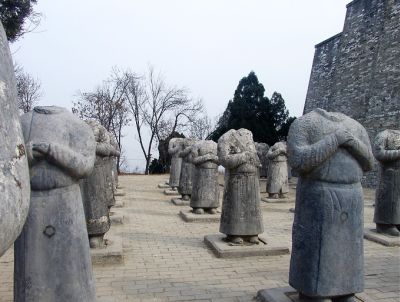
At the Tang Empress, Wu Zetian's (624-702AC) funeral attended 61 kings from the North. In memory of the event was made statues of each of the kings, which can still be seen near Xian. Unfortunately, most of them have no head anymore.
And further in the novel: "The Tartar cavalry were broad shouldered, with waist of steel and legs of iron, and they rode excellent mounts. Their bows were tipped with ram's horn, their poplar arrows had been scoured with sand. Their broad tiger skin capes contrasted with their narrow saddles of incised leather. Raised in the border region, they grew up skilled in weaponry. For generations they had been riding the most spirited horses. their infantry marched to the blare of bronze trumpets and the throb of sheepskin drums, their cavalry played flutes and fifes, as they cantered along. (Outlaws of the Marsh IV page 1776).
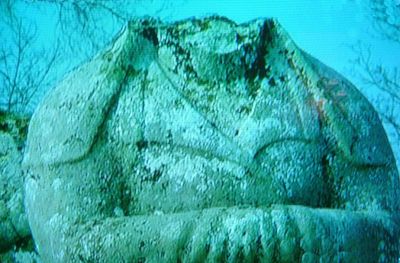
A King, who participated in Wu Zetians funeral, he buttons his jacket on left side - he must be a Qi Dan.
The King of Liao and his advisers were planning to buy the outlaws to their side with gold, silk, horses and fur. A senior general opposed. He was described: "Around thirty-five, tall and stalwart, he had a fair complexion and rosy lips, brown hair and green eyes, and was possessed of matchless courage and strength."(Outlaws of the Marsh IV page 1793)
During the negotiations, Songjiang was entertained by the native girl's
slow dances.
The general leading of the next Liao army that the outlaws met, looked like this: "A brown bandanna, which covered his forehead, bound his long silky black hair. Over a sleeveless black robe was silver armor chilling to behold. A lion's head belt clasped the the darkly gleaming metal." "His name was Quli Chuqing and his personal guard consisted of 3.000 riders with black shoulder-length hair." (Outlaws of the Marsh IV page 1850)
It sounds, as if there were at least two different peoples in the Liao kongdom, some with brown hair and green eyes and others with smooth black hair.
Lions seem to have been very important to the Liao kingdom, a second General wore a lion's head on the helmet: "How was he attired? A lion's head helmet, armor from the hide of a fleet horse over a fine green robe" - (Outlaws of the Marsh IV page 1851)
In the novel the outlaws managed at last to conquer the natives, as opposed
to the real history. All Song Jiang 108 heroes survived the campaign against the Liao-Tartars.
Song Jiang and his men's next campaign for the emperor and the Song Dynasty was against real civilized Chinese in the area around the Yangtze River, the Great River. They had rebelled against the emperor. Here many of the outlaws perished.
"Doughty dark men, they had green eyes and brown hair," says the classic novel and we must believe that at least some Qi Dan looked like that.
|
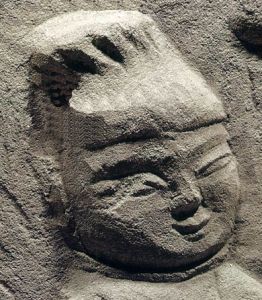
Top left: Stone carving in xiao and Yulu's tomb - 1.000 AC.
Top right: Liao apsaras - a kind of Buddhist angels.
Bottom left: A Liao spirit.
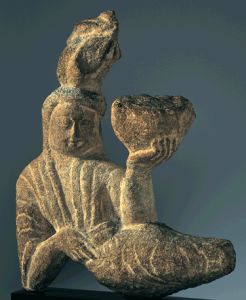
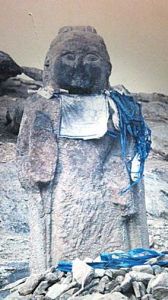
Bottom right: Sculpture of a Qi Dan woman - Inget Tolgoi - Bulgan.
No doubt there were different types. Immediately, judging by the sculptures, some of them seems to have been some fairly broad types with large round faces with small or narrow eyes.
|
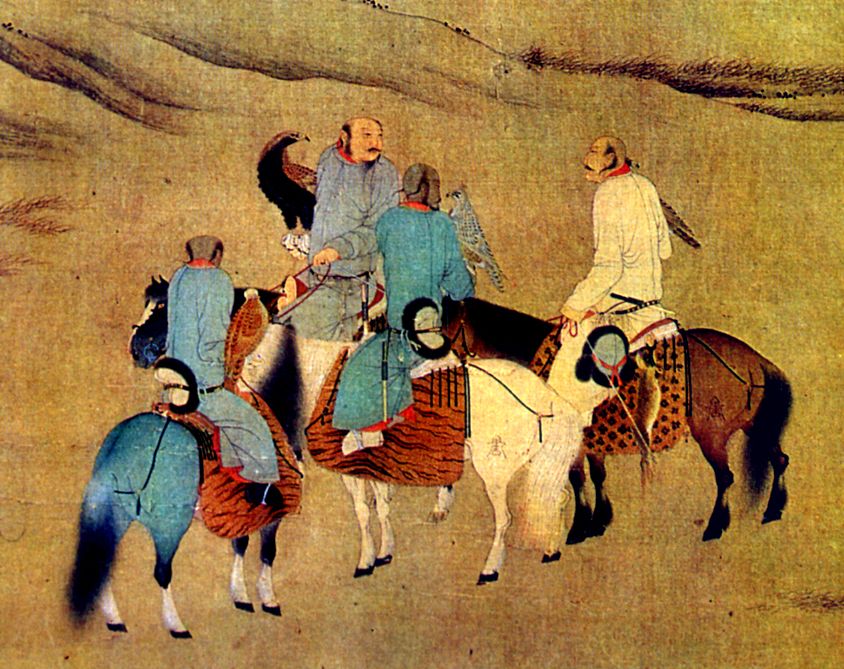
The Chinese writer Hu Gui wrote that Qi Dan used eagles for hunting. Painting owned by the National Palace Museum of Taiwan, purchased and donated by Kosi Gramatikoff.
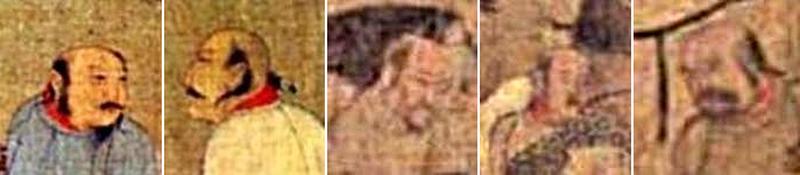
It is striking that a general type is men with black or brown hair, with a tendency to become prematurely bald and with well-groomed mustache or beard.
|
Qi Dan types. There were probably several different types. But one type comes to mind. Men who get bald early with well-groomed mustaches or full beards.
The first two from left are from the painting in the National Palace Museum of Taiwan and the last three from Chinese drawing of unknown origin. The two in the painting from Taiwan look more modern Asian than the three in the Chinese drawing of unknown origin.
The royal family and the leading generals are described in the novel with golden or brown hair and green eyes. According to Qi Dan's own tradition, they descended from Xianbei's Tuoba genus. Tuoba must have been the royal family over all: several hundred years after their kingdom, Northern Wei, disintegrated, they again emerged as kings of Qi Dan and Dan Xiang (Tangut). They were truly "kings who returned," like Tolkien wrote about. Precisely Xianbei and their Tuoba royal family were known to have "yellow heads".
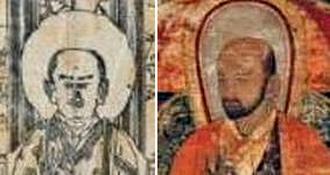
Two Dan Xiang types for comparison.
Left: From Illustration in Buddhist Sutra, showing Emperor Hui (1068 AC to 1085 AC) of Great Xia, presiding over a Buddhist sutra translation.
Right: A Buddhist monk from Xi Xia found by Kozlov in Kara Khoto. Exhibited at the Hermitage in Sct. Petersburg.
It is seen that Qi Dan and Dan Xiang are similar. They are both represented by men who become bald early, with well-groomed beards
It seems likely that the royal family has, to a greater extent than their subjects, avoided the on-going race mix and retained their original Indo-European appearance.
A Liao nobleman, Yelu Dashi, met with the fugitive King Yelu Yangxi during the attack of the Jurchen and Song Dynasty. But he judged apparently, that the war was lost.
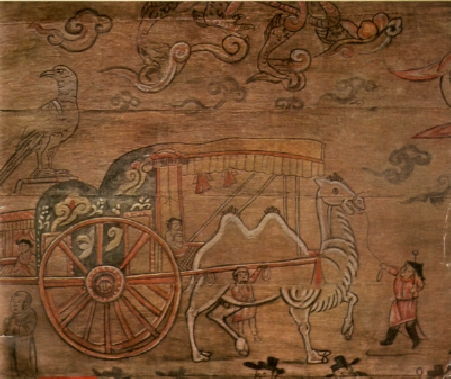
Qi Dan on travel - Chinese drawing of unknown origin
He gathered the defeated Qi Dan and led them to Kasgar in Tarim Basin. On the other side of the Tien Shan Mountains, they also established a capital in Balashagun in the resent Kyrgyzstan. Where th Wusun once lived and where the west-Turkish Khan received the Buddhist pilgrim, Xuanzang, in 645 AC.
Here in Central Asia King Yelu Dashi proclaimed in 1124 AC a new kingdom of Liao. It became also known as Kara Khitan, which means Black Khitan. Perhaps because of their Qi Dan black banner color. Chinese historians regard them among their forefathers and call it the kingdom of Western Liao.
Already by then the area was mainly inhabited by Muslim Turks.
With their usual determination Qi Dan immediately began to build up a kingdom as substitute for that which they had lost. They worked apparently with stunning ease. Soon Western Liao or Kara Khitan stretched from Mongolia to the Oxus River. Qi Dan built their Buddhist temples and Nestorian Churches everywhere. The Muslims Imans gnashed their teeth in impotent rage. It was one of the few times in history that Islam was rolled back from an area, which it had once conquered. The rumors reached the Crusaders in Palestine and gave them new courage.
Qi Dan also called themselves for "Gur Khan", it is Turkish and means "Masters of the World", rather ambitious, you have to say.
It is said that Kong Yelu Dashi was also known as King "David".
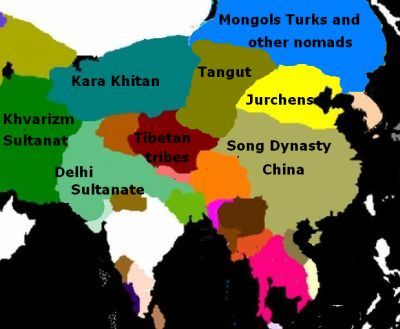
Central Asia around 1200 AC prior to the Mongol conquests.
During their expansion westward they clashed with the Seldjuk Turks, which had established a Sultanate in present Persia under Sultan Sanjar. In September 1141 AC the Qi Dans defeated the Turks in a battle at Qatawan, near Sarmakand. Qi Dan's army was led by King Kong Yelu Dashi with the Christian name "David".
The news about these victories over the Muslims reached the crusaders in the Kingdom of Jerusalem and fueled the myth of the Christian king, Prester John, who would come from East and defeat the Muslims forever.
In 1143 AC king Dashi was followed by Queen Xiao Tabuyan.
Her son, Yelu Yieli, succeeded her on the throne in 1150 AC. Kong Yieli was also known under the christian name "Elias", it is said.
In 1164 AC he was followed by his sister Queen Yelu Pusuwan.
Yelu Zhilugu ascended the throne in 1177 AC, and he should be the last ruler of the Western Liao. It is said that his Christian name was "Georgos".
Some reports says that Qi Dan arrested some leading Muslim imans in Kasgar and elsewhere. This brought them in further contradiction to the overwhelming Turkish Muslim population. It is fairly sure that the leading Muslims probably felt more loyalty to their fellow-muslims in the neighboring state to the west, the Muslim Sultanate Khwarizm, than against their own state, such as Muslims often do.
In 1211 AC a Mongol chieftain Kuculug, escaped to the Western Liao. He was fleeing from his rival and mortal enemy, Genghis Khan. Kuculug belonged to the Mongolian Naiman tribe, who were Nestorian Christians. Somehow he succeeded to put themselves on the throne in his new country. Kong Yelu Zhiligu ended his life in prison. In 1218 AC invaded Genghis Khan and his Turkish-Mongol armies, the Western Liao. They met little resistance and was welcomed as liberators by the Muslim population. Kuculug fled westward, but the Mongols overtook him and killed him.
Then the Western Liao had existed for 90 years.
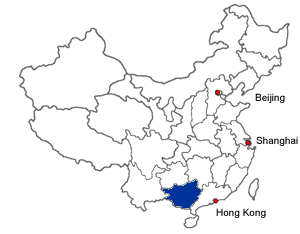
The modern provins of Guanxi.
It is said that the Mongols deported many surviving Qi Dans to the present Guanxi Province in South China, where they resisted the Ming emperors until well into their reign. One of our friends comes from Guanxi, and her grandmother had blue eyes, no one knows why, she says.
On the website Russia.com was a discussion about the Chinese's partial Caucasian origin. One topic was the relatively high frequency of blue eyes in Guanxi. A discussion participant from Guanxi told that his grandfather had told him that in the last years of Qing Dynasty the imperial soldiers came and wanted to kill all the children with blue eyes, as they could get hold of. Mothers of such children hid in the forests. The soldiers said that such children would otherwise grow up to be great leaders and come and rule over them.
Perhaps the grandfather or great-grandfather, that it probably could have been, remembered the time around 1900 AC, where Boxers and Qing Dynasty soldiers persecuted Chinese Christians, "Foreign devils" and perhaps also domestic devils, who had the same devilish apperance as the foreigners.
|
A thanks to the website "China History Forum" - which unfortunately is not among us anymore - for information and inspiration. "Outlaws of the Marsh" by Shi Nai'an and Luo Guanzhong - translated by Sidney Shaperio. Foreign Language Press Beijing China |
| To top |
