|
Home DH-Debate 3. The Indo-Europeans 5. The Dwarfs were from China |
It is so with the central parts of the world's continents, that they gradually become still more dry and desert-like.
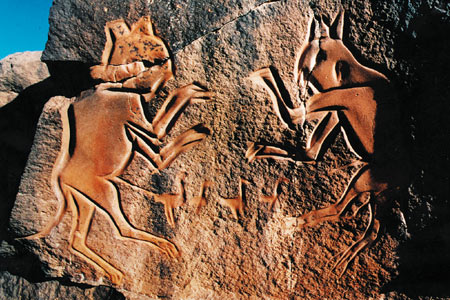
Thousands of years ago, there were lakes and rivers on locations in the Sahara desert, where no one can survive today. Rock Paintings show pictures of deer and humans. Each year, the desert is expanding to the south and north.
|
|
Left: Stone carving with fighting cats in the desert of Libya.
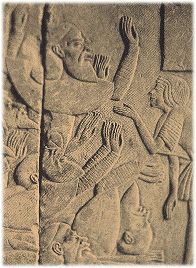
Right: The sea people attacked Egypt around 1200 BC - Egyptian stone carving.
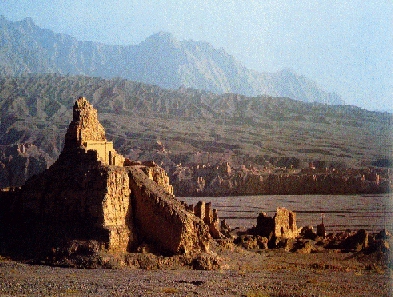
Central Asia was greener in the distant past than it is today. Ruins of the lost cities in the current Chinese province of Xin Jiang can today be found far out in the Taklamakan desert, where not a blade of green grass can be eyed for miles.
This climatic deterioration may have progressed mainly gradually, but also sometimes more dramatically.
Some years have brought drought disasters, which may have forced exposed people to leave their ancient land.
On the African continent, the Bantus migrated from their original homeland, around roughly the northern Cameroon, as the desert expanded. They populated most of Africa.
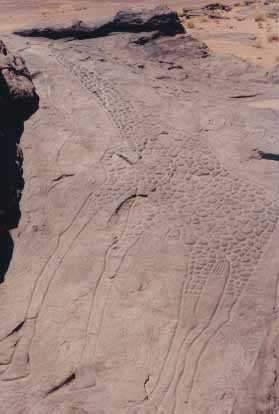
Left: Stone carving representing giraffe in the desert of Niger.
Right: Ruined city in the desert near Turfan in the Chinese province Xin Jiang.
On the Eurasian plains, many of the Indo-European peoples chose to go for a future elsewhere on the continent, as the climate deteriorated. One by one they arrived in Europe or China.
About 100 AC a people landed on the shores of the eastern coast of the Danish island of Funen. They were beaten in battle, probably by the local Goths, and their equipment and weapons were sacrificed to the victor's gods by being immersed in the holy lake, Vimose. It must have been such an Indo-European people among many from the heart of Eurasia, who had chosen to seek their fortune elsewhere.
Nobody knows the name of the defeated people, they may never have been registered in the history. After the defeat, the survivors possibly continued to Norway, here are made findings, which resemble those from Vimose.
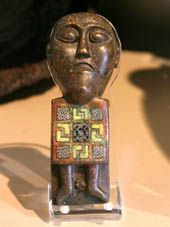
Among their equipment was a small comb using a cross with antique hooks, a symbol of Central Asia, a very old symbol, possibly a symbol of the sun. The ancient swastika still has a Buddhist significance in Asia, it symbolizes the eternal alternation between death and reborn. The picture shows a similar comb from Nydam.
In the Taklamakan Desert of the modern Chinese province Xin Jiang, swastika motifs also have been found that is assumed to be of Indo-European origin.



|
Left: Comb from the Nydam Boat 200 - 400 AC with a carved swastika.
Mid: The - Budha found in the Oseberg Ship in Norway 200 - 400 AC.
Right: Svastika motif found in the Taklamakan desert in Central Asia.
About 300 to 450 AC the climatic situation on great plains of Eurasia, for one reason or another, may have become particularly bad. The plains must have become almost uninhabitable. Refugees streamed across the border into North China and into the Roman Empire in Europe. A people named Sava in the present southern Afghanistan and Iran went to India.

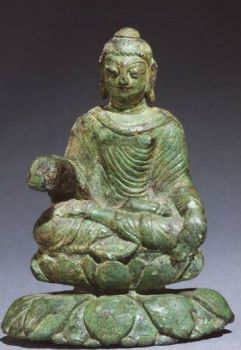
|
Left: Buddha in a temple in a Chinese village near the city of Dalian.
Right: Gandhara Buddha found in an iron age grave from Helgoe in Sweden.
Below: Myklebostad Buddha from Viking age found at Myklebostad in Norway.
H.H. Lamb writes in his "Climate History and the Modern World": "Through the centuries, in Roman times from about 150 BC to 300 AC or a few decades later, camel caravans traveled along the great Silk Road through Asia to trade in luxury goods from China. But from the fourth century AC, as we know from the changes in water levels in the Caspian Sea and studies of irregularities in rivers, lakes and abandoned cities in Sinkiang and Central Asia, drought developed to such an extent that it stopped the traffic on that route. Other serious stages of this drought occurred between 300 AC and 800 AC, and especially around these dates as it can be seen from the old coastlines and ancient port structures near the big lakes, which indicates very low water levels in the Caspian Sea around these times."(Page 159)
Just About 300 AC China had problems with refugees from the plains. "The five Hu" people from the north, Xiong Nu, Xianbei, Di, Qiang and Jie, sought refuge in the Middle Empire behind the Great Wall. The mandarins ordered them to return to their homelands, they answered back with force and created their own migration states.
This began the period in Chinese history known as "The Sixteen States". (About 300 AC to 400 AC)

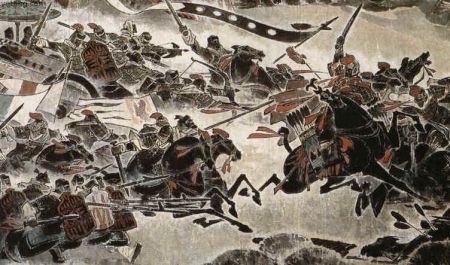
|
Left: In the year 410 AC king Alaric and his Western Goths sacked Rome.
Right: Xiong Nu - the Huns - attack China.
In the same way as the migration peoples of Europe admired the Roman Empire and the Emperor, so admired the newly arrived peoples in China the Emperor and the Chinese culture. They named their new states after famous dynasties from the past, the Kingdom of Han, the Kingdom of Qin, the Kingdom of Xia and so on. The newcomers quickly learned Chinese culture and language. Their noble and royal families married into Chinese families.
It is noted in the history that in the year of 317 AC millions of northern Chinese migrated to South China, allegedly because of the invasion from the plains. A new Jin Dynasty was proclaimed in Nanjing. Entire clans of northern Chinese fled to the south, along with 60 to 70 percent of the nobility. Complete Daoist monasteries moved to the south with all the monks and religious leaders.
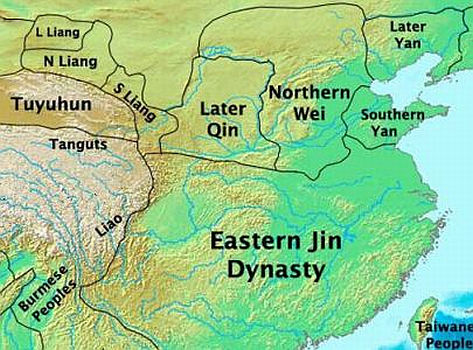
Peoples migration states in China about 400 AC.
In Europe, the Eastern and Western Goths left their old land on the Eurasian plains and aimed for a new land and a new life in Western Europe. The Vandals started the migration time by crossing the frozen river Rhine on New Year's Eve 406 AC.
Parts of the Xiong Nu people chose to find their way from Asia along the Silk Road to Europe. In Europe, they were called by what is supposed to be their real name, as they called themselves, "the Huns".
Also, Indo-Europeans peoples left their old land on the Eurasian plains and sought a new future in the west. They were among other names called "Alans".
Hepthalites, "the White Huns" invaded India.
Some of the Indo-European peoples on the steppe sought refuge in the east in China.
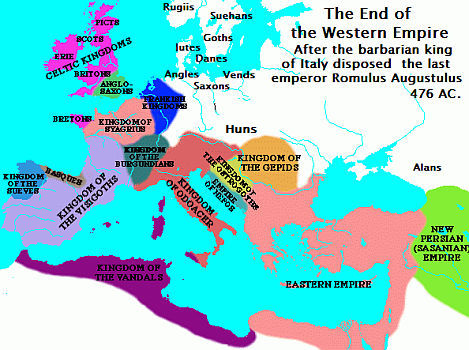
Peoples migration states in Europe in 476 AC.
H. H. Lamb writes in his "Climate History and the Modern World", page 150:
"These extreme winters are usually, as the progress in the disastrous
wet years in the 580's (AC) in Europe, considered as isolated events,
so therefore there is not considered development any significantly colder
climatic regime at any time during the millennium, we look at. Recent
studies in the Alps, especially by Ruthlisberger and Schneebeli from Geographical Institute at Zurich University and in Norway and northern Sweden by Vibjoern Karlen, suggest that this view needs revision. Carbon
14 analysis of the end moraines of the ancient glaciers in the bottom of the valley of Val de Bagneres in southwestern Switzerland, reveal the locations that were reached by the glaciers, as they came down from the heights before and after 600-700 AC and perhaps again as late as 850 AC, as it is recorded as the well known "Little Ice Age" period between 1550 and 1850 AC.
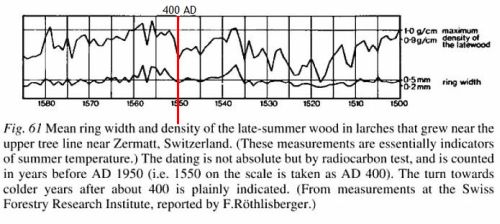
The density of growth rings in larch trees at Zermatt in the Alps - from Climate History and the Modern World by H. H. Lamb.
"These glaciers cut clearly an ancient Roman route across the mountains from Italy, which passes down through this valley. Further," Lamb continues, "studies of growth rings on larch trees that grew near the upper tree line near Zermatt indicate, what appears to be a gradual building up heat in the century of 300 (AC) followed by a fairly sharp variation between 400 and 415 AC and a significant cold period thereafter. Therefore, if this dating is dependable, the Roman administration was facing further difficulties in addition to the growing threat from the barbaric migrations at the time, when the Western empire collapsed."
The very fact that the Vandals crossed the frozen Rhine in 406 AC, suggests that it has been a very cold period. I do not recall, that the Rhine has been frozen in recent years. Perhaps the problem on the Plains was as in Mongolia and Sirbirien in the winter of 2001, large amounts of snow, and freezing temperatures down to minus 40 or more. It was too cold for the cattle, which died in large numbers.
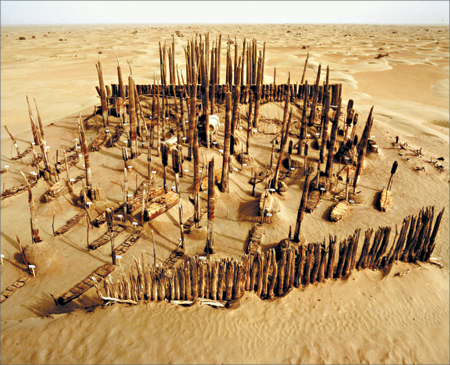
Ruins of the kingdom of Loulan at the shore of the now vanished salty lake Lop Nor in the Taklamakan desert of Chinese Xin Jiang.
The Asian ancestors of the modern Danes were also such an Indo-European people among many, who at the beginning of the first millennium chose to seek new land in Europe.
The Scandinavian ancient poem, "Ragnarok", says: "Tell about Ragnarok - about that great news are to bring up. The first is, that the Fimbul Winter is coming. Then the snow will be drifting from all sides. There will be a lot of frost and biting winds. The sun does not work. There will be three such winters after each other without summers in between." It sounds as if our ancestors had experience of that such thing can happen.
The Indo-Europeans were not driven away from the great plains by new and tougher peoples. The Mongols, the Turks, the Kirgiz' and the Manchus first showed up from the big Siberian freezer more than hundred years after the beginning of the time of the big migrations. At that time the climate there again had eased, and the Eurasian plains were green, empty and inviting.
When the Turkish peoples took possession of the practically uninhabited plains in the years of 500-600 AC, they were met with very little resistance, and therefore they could populate the plains in a very short span of years.


Left: Ellsworth Huntington - 1876-1947.
Right: Growth rings in a tree trunk.
Ellsworth Huntington (1876 - 1947) was a professor in geography in the American Yale University. He took part in several expeditions to Central Asia and Palestine.
His main work is the book "The Pulse of Asia", where he wrote: "The relapse of Europe in the Dark Ages - was apparently due to a rapid change of climate in Asia and probably all over the world, - a change which caused vast areas which were habitable at the time of Christ to become uninhabitable a few centuries later. The barbarian inhabitants were forced to migrate, and their migrations were the dominant factor in the history of the known world for centuries."
"The data, which I obtained in Central Asia," Huntington continues, "confirm the surmise of the historians. There is a strong reason to believe that during the last two thousand years there has been a widespread and pronounced tendency toward aridity."
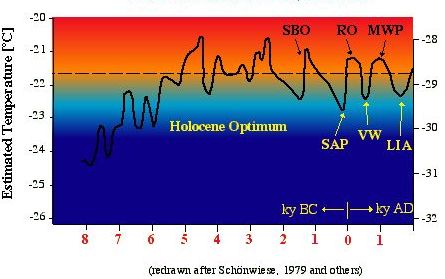
The result of ice-core drilling from the Greenland ice cap - Camp Century.
"In dryer regions the extent of land available for pasturage and cultivation has been seriously curtailed; and the habitability of the country has decreased," says Huntington. "After a period of rapidly decreasing rainfall and rising temperature during the early centuries of the Christian era, there is evidence of a slight reversal, and of a tendency toward more abundant rainfall and lower temperature during the Middle Ages."
"In relatively dry regions increasing aridity is a dire calamity, giving rise to famine and distress. These, in turn, are causes of wars and migrations, which engender the fall of dynasties and empires, the rise of new nations, and the growth of new civilizations."
Ellsworth Huntington measured growth-rings on the big old trees in the
U.S. national parks to find evidence for his theory of cyclical
climate changes as key drivers of history.
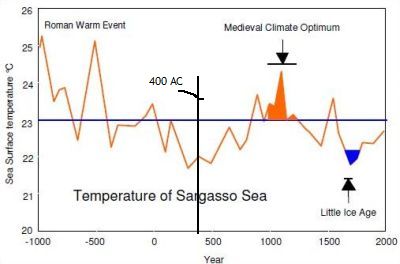
Graph showing the temperature in the Sargasso Sea as function of time.
Unfortunately, his results were not convincing related to the Migration Age and the Germanic peoples' invasion of the Roman Empire around 400 AC.
However, Greenland ice-core drillings seem to show a temperature minimum in the fifth century.
Also, the temperature in the Sargasso Sea was very low in the years 400 to 500 AC.
A group of scientists has concluded that the surface temperature of the
Farewell Lake, in Alaska during the Roman Warm Period (0-300 AC) was
as high as today, but that it nevertheless fell steadily by a total of 3.5 degrees and reached a minimum in 600 AC.

Cross section of a stalactite from the Soreq Cave near Jerusalem.
Geologists from the University of Wisconsin have analyzed a stalactit from the Soreq Cave near Jerusalem and concluded that the climate was drier in the Eastern Mediterranean area between 100 AC and 700 AC, with marked decreases in rainfall around 100 AC and 400 AC.
However, the Indo-European emigration from the steppe has undoubtedly occurred over a considerable period of time and cannot be attributed to a single apocalyptic event. It must have taken place - if not gradually then seen in waves, pulses as Huntington says.
|
Klimaskifte - Fimbulvetr - den store vinter Aar 536 e.Kr. - Asernes Aet Verasir Flemming Rickfors Pulse of Asia -Canadian Libraries Ellsworth Huntington. The Genetic Link of the Viking - Era Norse to Central Asia David K. Faux The Tassili n'Ajjer: birthplace of ancient Egypt? af Philip Coppens. The Tassili Prehistoric Rock Paintings - Charles Emile van Santen |
| To top |
