|
Home DH-Debate 5. Rorschach's Inkblot Test 7. TAT and Test of Ambition Level |
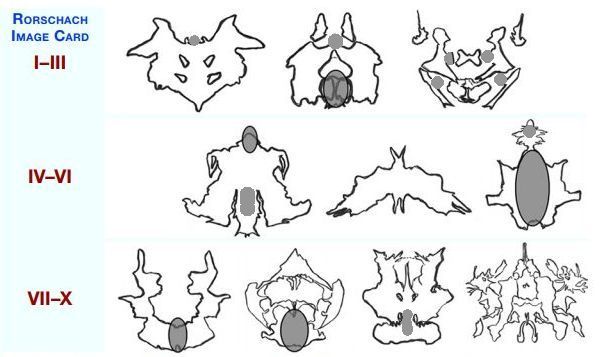
Almost all the blots have some features that can invite sexual interpretations, but it is wise to limit them. Some interpretation manuals indicate that more than four sexual responses out from the ten cards will indicate schizophrenia.
|
|
The 10 Rorschach cards with the most obvious options for sexual responses shown shaded. Photo Yonago Acta Medica.
Some psychologists believe that sexual feelings and interpretations are unconsciously present all time (Freud). Therefore it is wise to say something positive about blots, resembling a penis, vagina or breasts. For example, a red blob can resemble the female genitals, but one does not want to say wishing not to over-score the sexual responses. In this case, it is better to say that it resembles a butterfly than to say it looks like a crab, as butterfly are a more positive response. A not positive response to such potentially sexual motives may indicate some problems with the relationship with the opposite sex.
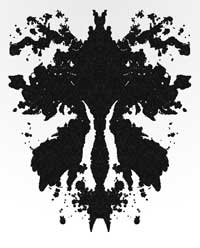
Left: An ink blot reminiscent of a female genitalia, orchid or microscopic aquatic animal.
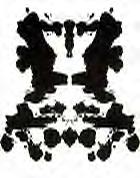
Right: An inkblot reminiscent of two seahorses kissing each other.
If the test person has too few sexual responses, it may indicate sexual frustration.
Traditionally, there are five response details that have often been associated with homosexuality. Namely that the test taker tells that he sees: 1) buttocks and anus, 2) feminine clothes, 3) male and female genitals, 4) human figures without male or female features, 5) human figures with both male and female features.
A large number of sexual responses will indicate schizophrenia. However, a total absence of sexual interpretations will also be unusual, at least if the applicant is a man. It is said that men think about sex up to 50 times every day.
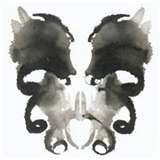
Typical symmetrical inkblot - This is not an original Rorschach card.
Rorschach folded all the cards over a central axis in a wet state so that they are all symmetrical, and it is tempting to turn them ninety degrees and interpret them as something that is reflected in water. However, that is not wise. Exner's Rorschach interpretation perceives such mirroring responses as the result of a "self-reflective and thoughtful personality".
Only one mirroring response of this kind will lead to that the test person will be designated as "egocentric" with a "pronounced tendency to overestimate his personal value." "Drifting Clouds", "bog wife's brew" and similar responses will be equated with reflections in water.
Mirroring responses are fairly obvious, but they are dangerous. For criminal offenders, mirroring responses are used to distinguish psychopaths from non-psychopaths, and "are consistent with pathological narcissism and omnipotence as noted in Antisocial Personality Disorder" (Gacono & Meloy, 1992, p. 401; see also Gacono & Meloy, 1994).
If the test subject interprets just one of the inkblots as food, then the Exner's interpretation manual says: "This individual is expected to exhibit more addictive behavior than usually expected."
If the test person takes an general overview of an image, it will, according to the Exner scoring system, be interpreted as intellectual potential and leadership qualities. It would, therefore, be wise to take a view of the whole image before saying anything.
Some test subjects will try to put the various elements of the image into a context, they try, so to speak, to connect the details by setting up a hypothesis or theory. Rorschach psychologists say that whole response indicates abstract thinking and ambitions.
This is especially true of cards, which contain many elements, such as VIII, IX and X. For example, one might say that VIII is a coat of arms or a torso for medical instruction.
If the response given by the test subject includes the whole ink blot, it is called a "W-response" (W for whole). (All types of responses have such a letter designation.)
Adults test subjects score an average of 38% as "W-responses". They are usually in the range of 29% - 46%. The opposite is "D-responses" (D for detail), where the test person interprets only parts of the ink blot.
High "W" percentage also indicates creativity, while low "W" percentage indicates depression.
A breakdown of an image into modules and sub-regions will reflect common sense. For example, one can subdivide card X into three areas of different colors.
An attention to details can be interpreted as impulsivity or alertness, the ability to see what others are overlooking. However, if one looks at too many details, it will indicate a fascination with the mundane, rigid compulsive thinking and sometimes paranoia.
|
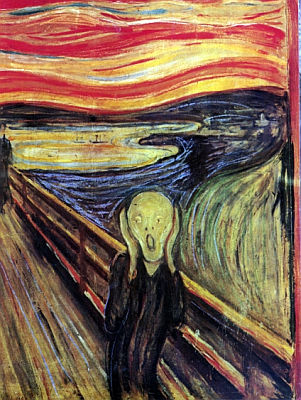
Left: The famous painting The Scream by the Norwegian painter Edvard Munch - It contains a scary detail in the center of the image.
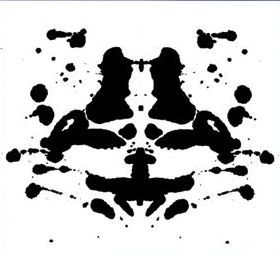
Right: It may be difficult to detach from the face in the middle, but the outline may look like a rococo fountain. Interest in the detail in the middle will score on anxiety.
It is best to tear oneself away from possible scary or erotic detail in the blot's center and try to interpret the silhouette and the whole. An inkblot can, for example, contain a miniature face or similar in the middle, reminiscent of the Norwegian painting "the scream". It's not good giving response to such details as a start; it may score on anxiety.
An interest in the outline of a blot will indicate rational abilities. For example, one could say that the silhouette of card VI resembles a kind of flatfish that swims over the bottom of the sea.
Interest in outlines reminds about the "whole responses" approach, as mentioned above. However, a whole approach also includes elements within the outline and may also describe the whole situation.
Rorschach psychologists believe that seeing movement in an immobile Rorschach card will be an expression of imagination. Therefore, it may be wise to describe what one sees as something that walks, runs, dances, flies, swims, falls and so on.
Some manuals prescribe that a movement response must be the test subject's first idea, otherwise it does not count as an indication of imagination.
Psychologists believe that when a test person sees people moving, it is a sign of mature thinking, intelligence and creativity - that is, as long as he can make the movement probable. The great merit of the Renaissance painters was, after all, that they were able to describe movement in a painting.
Seeing animals in motion indicates underlying needs and drives. Animals in motion can also indicate a dynamic way of solving problems.
But when a test-taker sees movement of inanimate things that should not move, it reveals stress and anxiety.
Responses which implies colours will indicate emotions. Note that five of the cards are black and white, and five contains colours. If, for example, one says that the two persons in card II are Christmas goblins, because they have red caps, then you have given a colour response.
Rorschach psychologists believe that colour responses indicate a tendency to be aware of - and able to express - emotions.
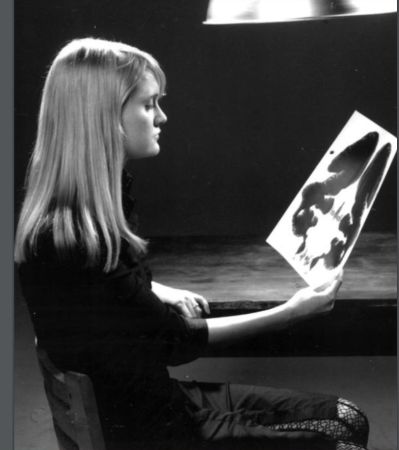
A test-taker studies a Rorshach card. Photo Twitter.
If a test person first talks about the shape of an ink blot and then mentions its colors, that's a good sign. He has a clear picture of reality in which he appropriately adds emotion. But if he first reacts to the colors and then mentions the form, or he talks about colors without mentioning the form at all, it will indicate that his emotions dominate rational thinking. If he does not mention the colors at all, it may be an expression that he is suppressing his emotions.
Test takers who hesitate before commenting on the colored cards - but not the black-and-white ones - Rorschach himself referred to as "pedants" or "ponderers". Colours represent emotions, and therefore he believed that such hesitation at the encounter with the first test card with colours indicated that they suppressed their emotions in a neurotic way.
They are called ink blots, but Herman Rorschach did not pour ink randomly over some piece of paper. He was a dazzling art-painter, who carefully painted ten pictures that we will never forget once we have seen them.
He used watercolors, which are very suitable for creating color shades, that is, gradual color transitions, mainly from light gray to gray, dark gray and on to black. He also painted color shades in the other colors.
Color shades in gray can be very expressive, we only need to think about black and white photographs. We call it shades of gray.
Interest in Colour shades will be interpreted as an expression of stress, anxiety, depression and the feeling of loss of control.
A particularly interesting type of colour shade response is surface-structure response. This is when the test subject considers an area of the ink blot and - based on color shades - imagines how this surface would feel, such as smooth, rough, sharp, hairy, or uneven.
Rorschach psychologists believe that such responses are characteristic of people, who feel the particular type of stress associated with loneliness and lack of human contact. People separated from their loved ones tend to give more surface-structure responses than others. Interest in surface structure indicates a need for emotional connection with others. Many surface structure responses will indicate the need for care.
Most test takers - in fact 88% of adult men and 89% of adult women - have at least one surface-structure response in their Rorschach report.

|
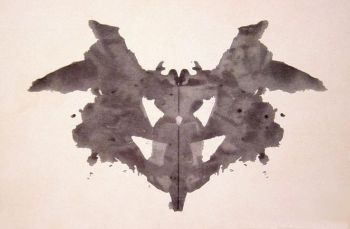
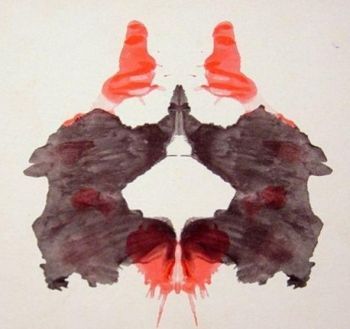
The first blot is easy, and you should be able to give an obvious answer quickly. The test person can probably see a bat, a butterfly, a moth, a mask, a hollowed pumpkin with light in. You could say that the central part of the blobs forms a female figure. One should avoid saying anything detrimental about it, such that the female figure has four breasts and no head. It's just a torso, as Venus from Miletus. Some interpretation manuals prescribe that the response, animal face, suggests paranoia.
The response "a dead bat" would be a clear negative response.
Some turn it 90 degrees and see a battleship, which plows its way through the water, with its reflection in the water. It has got a few bullet holes amidships. This may indicate that this person feels hurt, the person may feel vulnerable, but despite the injury continues she goes on with the life as she best can.
A warship is ultimately a weapon, a negative response, and therefore this response also indicates aggression and frustration.
The response battleship may also mean that the person feels threatened and feels anxiety. For example, a person may say: "I do not like this picture - it looks like a battleship."
The response "battleship" is a movement response, which also contains a mirror image - it indicates respectively imagination and egocentric self-overestimation.
Some interpret the card as an angel with stretched out wings. The interpretation "angel" always indicates innocence, goodness and purity. Maybe the person has been associated with morally unacceptable events but feels herself that she is innocent.
The response "A woman's body with outstretched arms and big breasts" - come to me - maybe an erotic response. It can also express a yearning for care. It can also be a woman's self-image - as erotically attractive.
Some see two people who attack a third in the middle. It would then indicate frustration and aggression or anxiety, depending on whom the test person identifies himself.
If the test subject say that it looks like two people or animals attacking a woman in the middle, it will indicate that he is not happy with his own body image.
A minor girl who had been sexually exploited saw two people raising their hands against each other, attacking each other. (movement response) She saw bloodstains.
A man gave the response: "A group of miners who drill deep down into the center of the Earth." This response represents a disregard of reality, because the card does not resemble miners at all following the psychologist's opinion - and therefore it indicates schizophrenia.
One can possibly see a vagina, where the head should be, but - as mentioned above - it is wise being cautious about giving sexual responses.
|
|
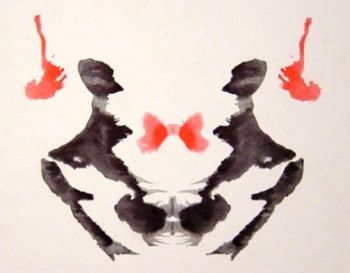
It is important to see that this looks like two human figures
facing each other, women or goblins. If you can not see this, it will indicate, that you have problems with your interpersonal relationships.
If you do not want to say that the red area at the figures' knees resembles a vagina, it is better to say that it resembles a butterfly, than it resembles a crab. Where the persons' hands meet, one can possibly see a penis. The area between the characters can be a cave entrance or a jet fighter seen from above.
A response may be "two fighting bears - blood everywhere", it will indicate a feeling of suppressed aggression, a defensive distance to a feeling of anger, an expectation of a personal confrontation or an expectation of to suffer damage.
It is almost superfluous to mention that the response "smashed insect on the windshield" will score on anger and frustration.
Some see a face of a cat or a bear with blood on the face and around the mouth. It would then be a negative response that scores on anger, anxiety and such.
The response "two clowns" can score on "Narcissistic reflection" - "my happiness depends on your reflection on my happiness". ("Contemporary Rorschach Interpretation" By J. Reid Meloy). At first glance, we would otherwise think that "clowns" is a quite innocent and obvious response.
A test subject gave the response: "It reminds me of violence." Card II is said to be the one most likely to produce responses associated with violence.
A minor girl, who had been sexually abused, saw a vagina in the slightly darker areas, the red was blood flowing from there.
One gave the response: "two black clouds meet. It's like it's going to rain when there's a storm." Exner perceives the response drifting clouds is associated with "egocentric" and a "distinct tendency to overestimate his personal value". As it further is storm clouds, it will also score as a negative response and thus on suppressed aggression, frustration and anger.
|
|
This card will indicate the test subject's sexual orientation. Most will see two human figures facing each other, surrounded by flowers, orchids and a butterfly.
Three-quarters of the test subjects say they see people in this card. If the test person does not see at least one human figure, it will be interpreted as an unusual reaction to social interaction.
Maybe they dance around a drum, bend over a table, pick something perhaps strawberries or mushrooms. They both seem to have breasts as well as penis. If the test subject does not say anything about the person's gender, the psychologist will insist that he makes a bid.
If the test subject hesitates too long to give a response to this image, some Rorschach psychologists will interpret it in the sense that he may be cautious, neurotic, or lack self-awareness in social situations.
If one sees the characters as men, it will imply heterosexuality, regardless if the test subject is women or man.
If one sees the characters as women, it will be a homosexual response, as the test person answering like this is assumed to recognize the characters' hermaphroditic nature.
Another possible response is "two dogs in a circus, balancing with something on their heads", which is a positive response.
A test person saw: "two women, who fought for something they both wanted to have"- a rare response suggesting that the test person is concerned with rivalizing contention in her life.
A man gave the response: "Two men who beat a woman's head." The two men are acceptable, but the "woman's head" represents a disregard of reality according to the psychologist's opinion, as it does not look like a woman's head and the response indicates therefore schizophrenia.
The response "two dancing girls standing on the shoulders of a man, who wears a butterfly" is a seemingly innocent activity, but it is nonetheless counted as a negative response, because the girls are much smaller than the man, and therefore the scenery is somewhat disabled and crippled.
|
|
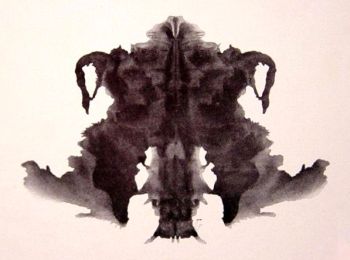
This is the "Father Card." Most people can after a few seconds imagine a giant seen in perspective from below. It is common to interpret it as a man in a big coat, an animal skin or a gorilla. It can be a dragon with big feet, who comes running towards the spectator, seen slightly from above, or a dragon, who sticks his head out of his cave. At the top, you can perhaps see a vagina.
The test person's response will be interpreted as his relations to his father, managers and other authorities. If the test-taker is a woman, it may show her relation to men.
The giant's third leg with a dragon head can recall a huge penis. If a test subject sees his father's sex so clearly, it will imply a strained relation to the father and to authorities in general; and this will make him less suited to a career in a large organization, a psychologist will think.
If you see a dragon's head, it must be a friendly dragon, since it is a potentially sexual motive.
The third leg can also be interpreted in a more neutral way as a sort of loin-cloth, which hangs down in front.
If one interprets the figure as an attacking dragon, bear, monster or gorilla, it will score on anger or anxiety.
It has also been interpreted as a tree with a somewhat odd appearance, maybe a Christmas tree.
One woman gave the response: "Ducks, who sticks their head out of a bush in opposite directions "- a protection-seeking imagining representing anger and alienation.
|
|
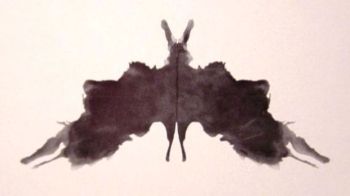
Rorshach himself believed that this was the easiest picture to interpret. It is a bat, a swallow or a butterfly. If you see crocodile heads in the tips of the wings, it's a sign of hostility. If you see the antennas or swallowtail as scissors, it suggests a castration complex.
It is easy to see a bat or a butterfly. But it is also true that this card will generally not cause as many responses as most others. In the literature are not so many responses on this card.
Therefore, some psychologists have concluded that if a person gives more interpretations of this picture than on the previous and the following ones, numbers IV and VI, it may be a sign of schizophrenia. They apparently believe that this card does not "contain" as many images and associations as the other cards, so if anyone thinks, he can see something else there, it must be a disregard of reality.
Some may see two animals that bang their heads together - which is a motif characterized by struggle and fighting, and therefore a negative response.
Gay men are more inclined to see creatures - half animal and half human - on this card.
Let us imagine a test person, who looks long at this card, turns it a bit and then says: "It was a tough one." He will surely score of depression because, firstly he is too long to respond, and second, this is the easiest card, and it should, therefore, be the easiest to give a quick response.
|
|
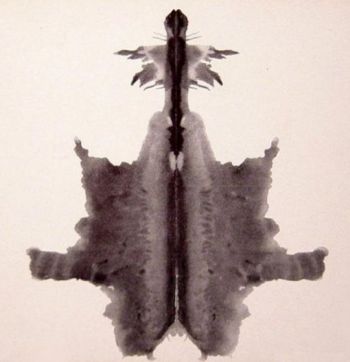
This ink blot is widely considered the most obvious sexual motive. It resembles the female genitals with the labia, clitoris and hair. Above can also be seen a penis including hair. The sexual interpretation is difficult to get around. If you can not see it, it's a sign that you have sexual problems.
It may also be two theater masks or faces with long noses and horns that look in opposite directions. You can flip the image 180 degrees and interpret it as an animal skins hanging on the wall, the tail hanging downwards. It maybe a seashell adorned with a flower. It maybe a ray that swimming over the bottom.
You can also rotate it 90 degrees and say that it resembles a ship or an U-boat on the surface of calm water with its mirror image. Then it will be a mirroring response that indicates egocentric self-overestimation. A U-boat is also a weapon, and it will symbolize a feeling of anger and aggression.
A woman gave the response "mountain", if this is in the meaning "difficult to climb", it may indicate anxiety. The response "island" suggests fear of being isolated or left alone.
The response "run over cat on a highway" or the like will generally indicate suppressed anger, frustration and aggression.
Some give the response "a jellyfish that eats an insect."
Japanese people often give the response "musical instrument" for this card.
|
|
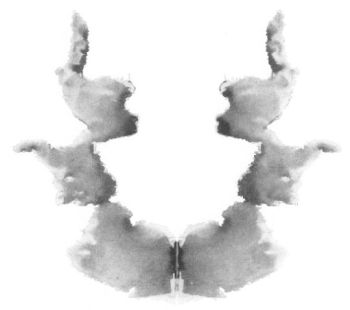
This is the "mother image". The picture may look like two women, who are very slim on the waist - with slightly unusual hairstyles.
The test person's response to this picture is supposed to show, what he really feels for his mother. If he interprets it as two witches, gossip bitches, fighting women or scheming women, it suggests a bad relationship with his mother.
A male patient interpreted it as two people "who looked at each other, stared at each other - like they had had an argument and no longer have the energy to say something."- such a statement indicates clearly some unresolved issues between the patient and his wife.
It is said that some test subjects can see thunderclouds, this will indicate anxiety. Some see the picture as two feathered Indians who stick their heads together to make plans on something.
If it turned 180 degrees, it can be a boulder stone bridge over a canyon.
The white area between the two girls can be seen as an oil lamp or the like. Some psychologists believe that only schizophrenics can see this.
A female test subject gave the response: "the female genitals opened, as it was pulled apart." This response is not particularly positive and represents a sense of injured femininity.
The response: "A little girl, who sees herself in a mirror", is a clear indication of egocentric narcissism.
|
|
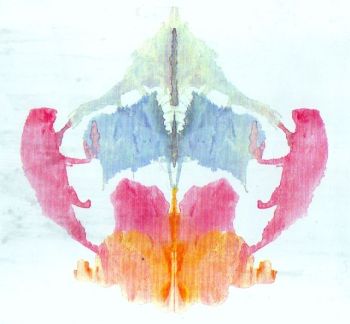
It is important that you see the two four-legged animals on each side of the figure. If you can not see them, it suggests a mental defect.
It is obvious to divide this map into sub-elements and sub-areas and thus score on common sense. For example, you can subdivide the map into areas of different colors.
The gray triangle on top can represent a tree. The blue area in the middle can be a flying dragon. The bottom orange area looks like a vagina, alternatively butterfly.
The card can be turned 90 degrees and become a panther on a piece of rock, the scenery reflected in a river. Since it is a reflection response, it will cause the interpretation "egocentric self-over-estimation."
The response: "Two animals fleeing for their lives to avoid the flames of Hell below" symbolizes the fear of life-threatening forces that the test-person can not control - perhaps the feeling of guilt for actions in the past that can not be changed.
If you respond that the entire image looks like a coat of arms, you have shown some sense of wholeness and indicated good organizational skills. It can also be seen like a plastic torso that demonstrates the internal human organs, lungs, liver, kidneys etc. with the spine in the middle. This response will be a "whole" response and also indicate good organizational skills and leadership.
|
|
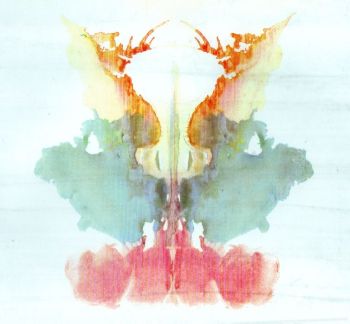
This can be interpreted as a rocket launching with the flames below, the black smoke higher up and the slender rocket in the middle. Or it can just imagine a fire with black and yellow smoke. It can be a many-colored flower.
When you turn it 90 degrees, you can see a face in both the pink areas at the bottom and in the blue areas.
It is said that paranoid persons will notice the bright green mushroom cloud, which is enclosed by the yellow in the center area above. It is not wise to imagine fighting men or monsters in the yellow area above. It will be a sign of social maladjustment.
One can score on common sense by subdividing the image into three areas by color.
It is wise to provide fewer interpretations to this picture than to the previous and the following picture in order to avoid suspicion of schizophrenia.
|
|
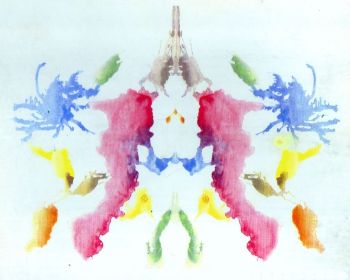
The purpose of this inkblot can be to test the person's organizational abilities. One can find blue crabs or spiders, grey crabs and shrimps, orange fruits, green caterpillars, red sea cucumbers and brown mice. The test subject is expected to mention all of this.
But he must also be able to see the whole picture. Meaning that the whole picture can resemble life on the bottom of the ocean or a glance at amoebas through a microscope.
If you see the grey mice or shrimps in the top center as two animals eating a stick, it will indicate castration anxiety, since the grey stick is assumed to symbolize a penis, even if the test subject does not say so.
Some test persons see after prolonged response time something that disintegrates, collapses, falls down or explodes, or they watch a volcano eruption. This may indicate the following:
- 1. The test person may have obsessive thoughts that he is about to be degraded physically or mentally, or on the verge of degrading.
- 2. The test person is depressed and preoccupied with aging or loss of functions - especially for older persons.
- 3. Loss of self-control and risk of destructive and inappropriate behavior.
|
LISTVERSE De ti Rorschach kort. The Rorschach Test - ParentingPlan.net De 10 kort og respons-forslag. The Inkblot.com - Rorschach Test Online Online multiple choice Rorschach test with ink blots as shadows, ie outlines. Rorschach Test Wikipedia. The Rorschach Inkblot Method - Science or Pseudoscience? Great Plains Sceptic. "Principles of Rorschach Interpretation" af Irving B. Weiner. "Contemporary Rorschach Interpretation" af J. Reid Meloy. "Rapid Psychological Assessment" af Jason T. Olin, Carolyn Keatinge. |
| To top |
