|
Home DH-Debate 10. Tarim Basin II 12. Place-names in Asia and Scandinavia |
| 1. Da Yuezhi | 2. Xiao Yuezhi |
| 3. Three Kingdoms | 4. Journey to the West |
| 5. The Western Mountains | 6. Literature |
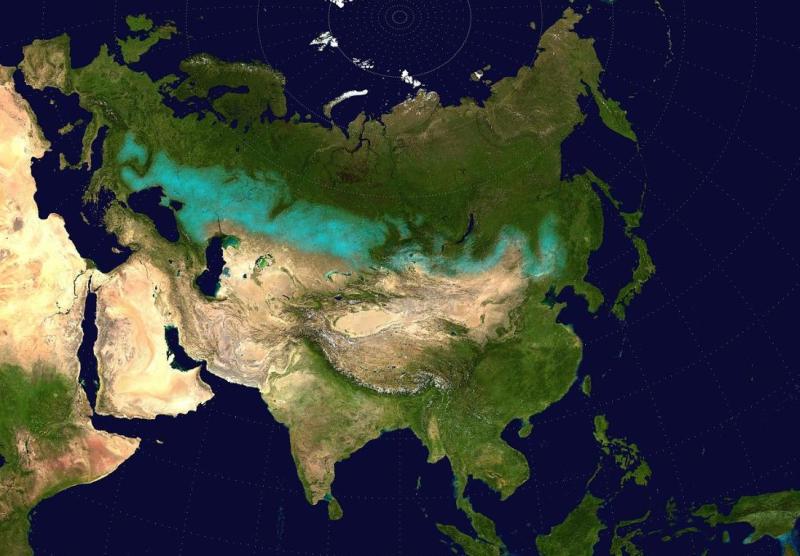
The Eurasian steppe stretches from the Hungarian Pusta to eastern Mongolia and the plain along the Yalu River between China and Korea. Horses and riding were an absolutely necessary condition for living on the steppe.
|
|
The Eurasian steppe extends from the Hungarian Pusta to the Yalu River between China and Korea. Oploaded by Mdf derivative work: Shattered Gnome (talk) Wikipedia.
For many thousands of years after the end of the ice age, it lay, presumably virtually empty of people. However, about 6,000 years ago, some Indo-European tribes were the first to tame the horse, and then the steppe lay open to them. Thereafter, the Indo-Europeans dominated it for thousands of years and were only displaced by Arabs and Mongols around the year 600-1200 AD. However, the Mongols were very few, and the net result of their conquests became a Turkish and Muslim Central Asia, as we know it today.
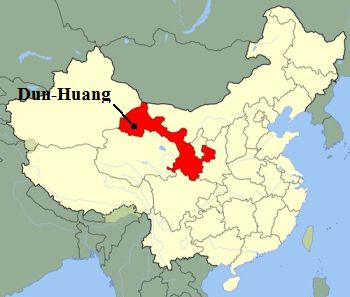
The town of Dun-Huang is located in the north of Gansu Province.
In the area where the modern city of Dun-Huang is now located in the northern part of the modern Chinese province of Gansu, the Yuezhi people lived for over two thousand years.
The famous Han Dynasty historian Sima Qian - who wrote almost a hundred years after the Qin Dynasty's demise - reported in "Shi Ji" that Yuezhi was armed with spears, swords and bows, they used chain mail. They cut their hair at their shoulders, except the king, who wore long hair, tied up with a ribbon. They practiced arable farming, cattle breeding and breeding horses. They burned their dead. They liked to eat fried peacocks, and they dependent to excessive beer drinking. What amazed the Chinese most was that Yuezhi had so much hair on their body and face.
|
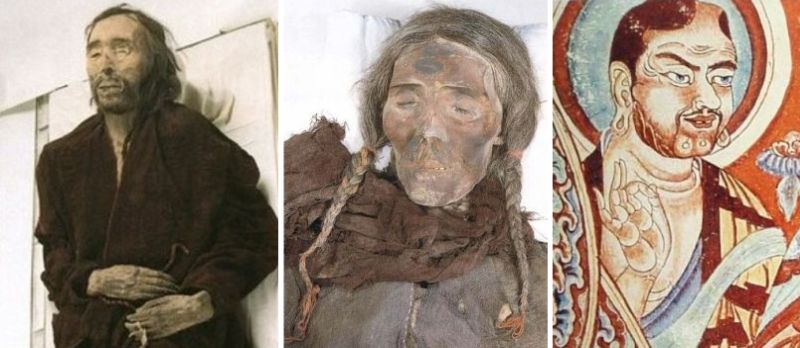
Caucasian types from Tarim Basin.
From left to right: The Cherchen man from about 1.000 BC, a female mummy also from Cherchen and a Buddhist monk from the Bezeklik caves near Turfan.
In the nearby Tarim Basin many mummies of distinct Caucasian origin have been found, among other things characterized by hair color and beard growth, also many cave paintings in the area that clearly show Caucasian types. At the same time, a number of ancient documents have been found in this area, written in the now extinct Indo-European language, Tocharian. As the ancient Chinese sources say that Yuezhi had white skin, one can conclude that they were also an Indo-European people, who probably spoke a language closely related to Tocharian. This is made even more likely by the coins issued by Yuezhi when they later emigrated to the Bactria further west, showing portraits of their kings with distinct Caucasian features.
In the 5th century AC, scholar, translator and monk Kumarajiva, while translating texts into Chinese, used the Chinese character for Yuezhi to represent Tochar.
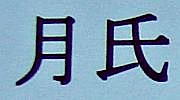
These are the Chinese characters for Yuezhi. The first character means "moon". The second sign means "zhi", which means something like "member of" or "supporter of". In the old days, the daughters of a Chinese family often did not get a name; after all, they were only girls, they had to satisfy with a number. When a girl then was married to another family, such for example with the name "Wang", then this character was used and the girl came to be called "Wang Zhi". So, to understanding the characters take the characters literally according to their denomination, the Yuezhi people worshiped the moon. However, it is also possible that the characters were used as a kind of alphabet, so to be understand that the words for these characters sounded like Yuezhi's name, which they called themselves. Chinese characters are alphabetized in different ways. "Yuezhi" is alphabetized with the modern pinyin system, while in the slightly older "Wade-Giles" system, it is written "Yüeh-Chih". In Professor Daniel C. Waugh's "Selections from the Han Narrative Histories," they are called "Yue-te," and since we know that a leading "Y" in many languages, including Danish, corresponds to "J", it can also be written "Jue-te".
A later Chinese traveler, Wan Zhen, visited Yuezhi's descendants a few hundred years later, when they were living in Bactria. He writes that their skin color was reddish white, making it likely that they were Indo-Europeans related to Tocharians in the nearby Tarim Basin, who also had white skin as shown on their cave paintings. Wan Zhen wrote about Yuezhi in Bacteria: "There are so many riding horses in the country that the number often reaches hundreds of thousands. Town lay-out and palaces pretty much resemble those of Daqin (the Roman Empire). The people's skin is reddish white. They are skilled in archery from horseback."
Dun-Huang is not a standard Chinese city name, such as something with -zhou or -jing. It is a name, where the elements cannot be recognized from other cities. Several of the early explorers have offered their opinion what they think the name means. Sir Aurel Stein believed that the name Dun-Huang meant something like "blazing beacons", that is a signal that the enemy is coming. This does not sound likely. A city must have a good name; which merchant would choose to settle in a city with such a name, with the prospect that the Barbarians would come every second years and steal his gold, burn his stock, and expose him to which was worse.
|
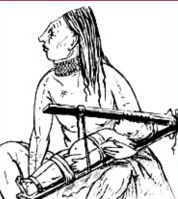
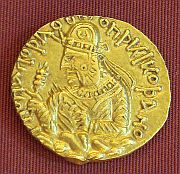
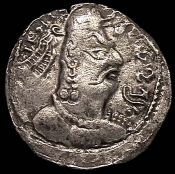
Like Goths, Huns and several other migrantion peoples, Yuezhi used artificial skull deformation of selected baby-boys.
Left: A Chinook Indian from the American West Coast with a baby in a wooden squeeze.
Mid: The portrait on the coin represents the Kushan king Vhishka with deformed skull - notice his royal ponytail hairstyle.
Right: The portrait on the last coin represents the king of Hepthalites, The White Huns. They used also artificial skull deformation. Now-a-days many think that Hepthalites was a people closely related to Yuezhi. They originally lived on the Dzungaria plain north of the Tien Shan Mountains.
Place names are very persevering. Dun-Huang is probably an ancient name, given the city by those who lived there before the Huns and the Chinese came, as is often the case with place names.
Danu is an ancient Indo-European word for river. We find it in the river names Danube, Dnieper, (originally called Danapris, Danastro or Danaper), Dniester, (Danastius, Danaprum or Danaster), Don (Tanais), Rhone (Rodanus), Po (Eridanos), and not least in the name of the Kingdom of Denmark.
Therefore, a people or area that calls itself Dan, probably must have an Indo-European origin in a near or distant past, as the name is denoting a people who lived at a river.
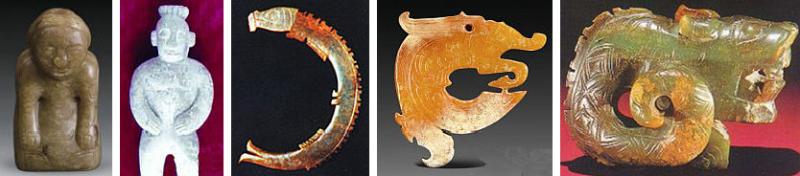
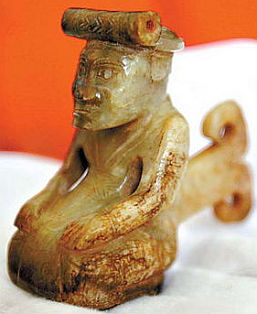
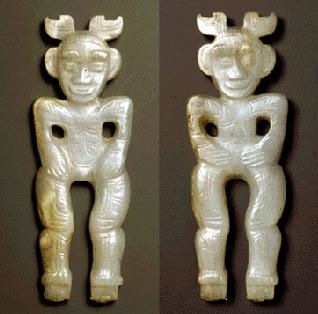
It has been shown that almost all jade in China came from the Tarim Basin. All jade pieces excavated in King Fuhao's tomb from the Shang dynasty (1.600 BC-1.046 BC) were from Khotan in the Tarim Basin. It was more than 750 pieces.
The figures show jade from the Chinese Shang Dynasty (bronze age) - about 1.000 BC.
From left to right: kneeling man or woman with wide nose and big eyes, a man also with big eyes and wide nose, a snake with a kind of fish tail, a small fat snake, another snake with a real snake tail.
It seems that the Shang Dynasty Chinese had big eyes and wide noses; and they had a keen interest in snakes.
The first part of the city name Dun-Huang, that is Dun, represents very likely the Indo-European Danu, that is river. If we are to describe the pronunciation of the second part -huang, with English letters, it will be something like "hwang". The word "vang" is found in medieval Danish in the meaning of pasture. Danish is an ancient Indo-European language, and one can believe that vang can be found in other Indo-European languages with a similar meaning. Dun-Huang will thus mean the River-Pasture, or the Pasture by the River, which name a horse-loving people could very likely give their land.
The Han Dynasty document, "Hou Han Shu" tells, that when the Yuezhi arrived in their new home in the West, they divided themselves into five groups. The name of one of the groups was "Guise Huang." This group later won power over the other four groups, it is said, and in the West, they became known as "Kushans"
It is said that the name "Kushans" has been derived from "Guise-Huang." Then we can conclude that the ending "-huang" must have had some tradition for the Yuezhi People. Which makes it even more likely, that the name "Dun-Huang" origins from Yuezhi.
Yuezhi was the first to trade along the areas that should become known as the Silk Road. They sold horses to the Chinese and bought silk instead, which they sold in Khotan in the Tarim Basin, where they instead bought raw jade stones that they brought to China. Unlike their northern neighbours, Xiong-nu, Yuezhi never embarked on a war against the Chinese Empire. They preferred to increase their wealth by trade rather than by looting.
The great traveler Zhang Qian later tells of their descendants and related people in the West: "They are skilled in trading and will haggle over a fraction of a penny. Women are held in great respect and the men make decisions on the advice of their women."
|
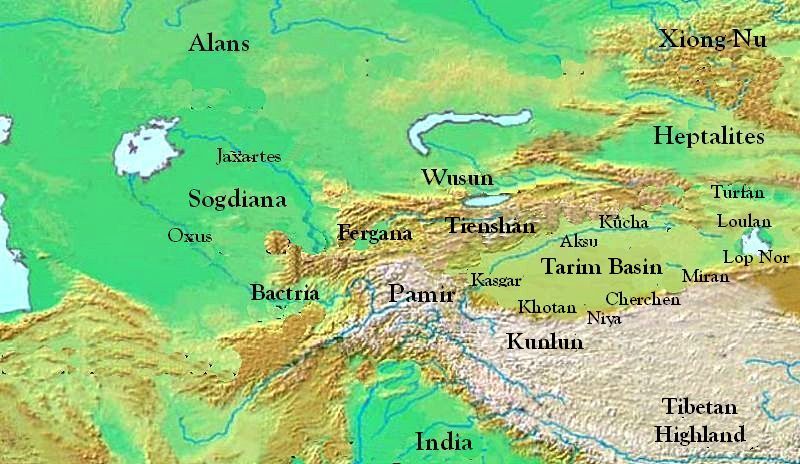
People and place names in connection with Da Yuezhi's migration to the west.
The Alans were Indo-European tribes, who had lived on the Eurasian steppe for millennia.
Xiong-Nu had lived on the north-eastern steppe "always", there is not much to suggest that they were Indo-Europeans, perhaps they were the ancestors of the Turks.
Wusun was a short-skulled Caucasian people, who lived on the Ili Plain north of the Tienshan Mountains at the lake, now bearing the Turkish name Issyk Kul.
Heptalites was also called "The White Huns". They later made their mark in India; they are said to have been closely related to Yuezhi. Heptalites used a kind of runes to scratch messages on wooden sticks.
Bactria was founded by Alexander the Great during his great conquest of the Persian Empire. The Chinese call it Da-Xia (Big Xia?)
The Fergana valley was also among Alexander's conquests.
Between the rivers Jaxartes and Oxus (now called Syr Darja and Amu Darja) was Transoxania where Da Yuezhi settled and founded the Sogdian cities of Sarmakand, Bukhara and others in the area, which we call
Sogdiana.
Tarim Basin is bounded to the north by the Tienshan mountains - high as the Alps, to the south by the Kunlun mountains leading to the Tibetan Highland, to the West by the towering Pamir mountains. On the access road to Tarim Basin from the east lay the now dried-up salt lake Lop Nor. In the middle of the basin was also at that time the dreaded desert Taklamakan.
In the Tarim Basin were a big number of ancient independent cities and small states, Han dynasty Chinese said the number was 40-50. The kingdom of Loulan lay on the banks of Lop Nor. Near the famous Khotan one can still find raw jade stones.
Ancient Chinese sources describe the existence of "white people with long hair" beyond the northwest border (the Bai people of the "Shan Hai Jing"). Shan Hai Jing is a Chinese classic text that is at least 2,200 years old. It is largely a adventurous account of mythology, geography and culture in and around China from the pre-Qin Dynasty.
|
Left: Jade figure from Shang Dynasty China about 1000 BC - a kneeling man - he seems to have big eyes and a broad nose and a kind of fishtail or snake tail.
Right: Jade figures from Shang dynasty found together in Henan representing a man and a woman - they have protruding eyelids as modern Asian and broad noses.
Representatives for the Yuezhi people arrived at the Shang court in King Tang's era (about 1000 BC) and also in a list of tribute bearers from the Beidi (or northern minorities) in Yi Zhoushu (Lost Book of Zhou 400- 300 BC) during Zhou Dynasty. A Guan Zi noted in the third century BC that a politician named Guan Zhong put forward a suggestion that "(we) should accept the jade of the Yuzhi from the North." Obviously, they made a living by trading with jade from the Tarim Basin to China. All jade which has been found in China from the Shang and Zhou dynasties origin from Tarim Basin; and the raw material have most likely been supplied by Yuezhi traders.
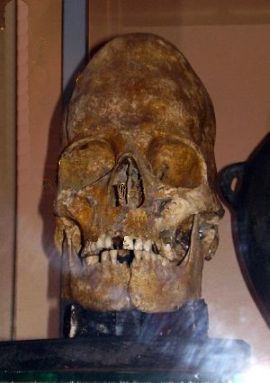
From the Stavropol Museum in southern Russia - a typical artificial deformed skull, probably from a Goth, Hun or Alan.
"Book of Han" from 111 AC tells: "Da Yuezhi (Great Yuezhi) was a nomadic people. They moved around after their cattle and had the same customs as Xiong-Nu. As their soldiers numbered more than a hundred thousand, they were strong and despised Xiong-Nu. Previously, they lived in the area between Dunhuang and Qilian".
Yuezhi used the head shell deformation of selected baby boys. It was a widespread custom in Central Asia at this time and probably had been for millennia. It was done by clamping the head of newborn boy children between two pieces of wood or tie it up tight. The skull of newborns is very soft and can easily be deformed. Huns, Sava, Alans and Goths also used it
|
Tocha-
rian A |
Danish
|
English
|
|
sas
|
et
|
one
|
|
wu
|
to
|
two
|
|
tre
|
tre
|
three
|
|
stwar
|
fire
|
four
|
|
paen
|
fem
|
five
|
|
saek
|
seks
|
six
|
|
spaet
|
syv
|
seven
|
|
okaet
|
otte
|
eight
|
|
nu
|
ni
|
nine
|
|
saek
|
ti
|
ten
|
|
kaent
|
hun-
drede |
hun-
dred |
|
pacer
|
fader
|
father
|
|
macer
|
moder
|
mother
|
|
pracar
|
broder
|
brother
|
|
ser
|
soester
|
sister
|
|
yuk
|
hest
|
horse
|
|
ko
|
ko
|
cow
|
|
vak
|
stemme
|
voice
|
|
nom
|
navn
|
name
|
|
malk
|
(at) malke
|
(to) milk
|
|
sam
|
samme
|
same (as)
|
|
taem
|
dem
|
them
|
|
nu
|
nu
|
now
|
|
se
|
soen
|
son
|
It is believed that Yuezhi spoke a language, related to the extinct Indo-European language Tocharin, found on the documents of Dun-Huang, which the explorers brought back in the early twentieth century. The documents were mostly Buddhist sutras, which are also known from other languages, that is why Tocharin was fairly easy to explore.
The language Tocharian A has some words in common with Danish, such as "ko" (cow), "malke" (to milk), "nu" (now) and "samme" (same). "Son" is called "se" in Tocharian A, it recalls the "suffix" in traditional Danish surnames, Han-sen, Niel-sen, Mad-sen and so on. The final "n" can be a grammatical inflection ending, they are many in Indo-European languages. (in Danish we ad -n or -en to make a noun definite, then "-sen" can mean "the son"). The word "se" (son) also recalls the widely used Chinese suffix "-zi" - pronounced something like "ze'e", which also is the basic Chinese words for "son".
Yuezhi made a truce with their despised neighbours to the East, the Xiongnu, who supplied a hostage, a Xiongnu prince named Modun. The Xiongnu king broke the truce and attacked the Yuezhi. They wanted to kill their hostage, but Modun stole a good horse and escaped to the East.
Modun killed his father and became king of the Xiongnu, and it was the start of their heydays. He waged war against the Yuezhi, killed their king and made a drinking cup of his skull, and drove them away from their ancient land in 170 BC.
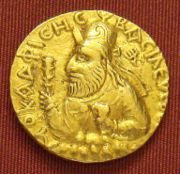
A coin showing the Kushan king Vima Kadphises - he had artificial deformed skull - and royal ponytail. The Kushans thought about themselves as descendants of the Yuezhi as many others did.
Most Yuezhi traveled west and tried first to settle on the plain at the Ili River, where they, however, were defeated by the Wusun People. Then they settled in the Fergana Valley, some years later in Sogdiana, where they founded Samarkand and Bukhara. They went on to Bactria and after a few hundred years they created the Kushan Empire in present-day Afghanistan, Pakistan and northern India.
Those, who traveled west were by the Chinese called "Da Yuezhi" which means "Great Yuezhi". The remaining withdrew higher up into the Qilian and Kunlun mountains. They were by the Chinese called "Xiao Yuezhi", which means "Little Yuezhi".
The Han Dynasty document, "Hou Han Shu", says that when Yuezhi arrived at their new home in the West, they divided themselves into five groups. The name of one of the groups was "Guis Huang". This group later seized power over the other four groups, it is said, and then they became known in the West by the name "Kushans".
The name "Kushans" should thus be derived from "Guis-Huang". In doing so, we can see that the last part of the name "-huang" must have had some tradition at Yuezhi. Which makes it even more likely that the name "Dun-Huang" comes from Yuezhi.
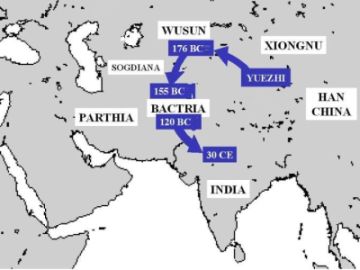
Yuezhi's migration from Gansu over the Ili plain, Fergana Valley, Bactria to the present Afghanistan, Pakistan and northern India.
The great traveler Zhang Qian, on behalf of Emperor Wudi, visited Yuezhi in their new home in Fergana and sought to persuade them to support the Han Dynasty in the fight against Xiong-Nu. But they were not interested, they had found "a valley, rich and fertile, and rarely disturbed by invasions." After several years of travel, Zhang Qian returned to the emperor with the message that his mission had failed . But among the things that the had brought back, were some very special horses, "the Celestial Horses," which could run farther and faster than the bad quality horses that the Chinese cavalry had to satisfy with. The emperor and his advisers decided that a supply of these horses was necessary to defeat Xiong-Nu, which was a plague along the borders of the empire.
The emperor sent many delegations and two armies to Yuezhi in Feragana to persuade or force them to sell horses to China, and he really managed to motivate Yuezhi to sell some thousands of these amazing horses to the Chinese army, which then - after some year - defeated Xiong-Nu.
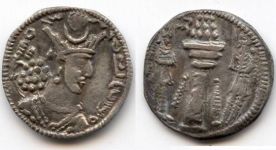
A coin with a portrait of a Sogdish king with crown.
Also the Sogdians considered themselves descendants of Yuezhi. According to the classic source "Xin Tang Shu", there were from the beginning nine groups of Sogdians. It was Kang (Samarkand), An (Bukhara), Cao, Shi2 (Tashkent), Mi, He, Huoxun, Wudi and Shi4 (Kesh). Shi2 and Shi4 represent different pronunciation of the same character. The King of Kang (Samarkand) claimed that he descended from Yuezhi and that his ancestors had lived in the city of Zhaowu in Gansu north of the Qilian Mountains. The other eight groups were created by princes from Kang.
The name "Kang" can still be recognized in the last part of the name of the city of Sarmakand.
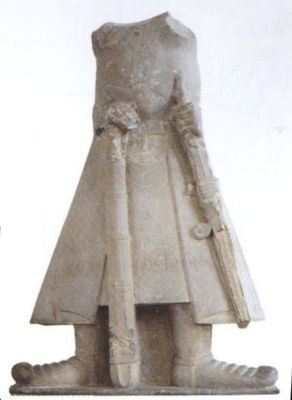
Statue of the Kushan king Kanisha 100-146 AC with sword and mace; it is a statue from India. Notice his sturdy boots, it must have been hot in the Indian climate. Perhaps Yuezhi was a conservative people who held on to their original customs from their homeland. The Kushans considered themselves descendants of Yuezhi.
The Sogdians lived in present-day Uzbekistan around Sarmakand. Sogdiana never became a united nation, it remained a loose association of rival cities. They were overcome by newly converted Muslims from the Middle East in 705 AD.
With the support of the Sogdian ruler of Balkh, who had allready converted to Islam, the newly-converted Arabs initiated the conquest of Sogdiana. Flexible, as always, many leading Sogdians let themselves convert - probably in the hope of getting peace to continue their trade. But after the conquest, the Arabs issued a new law saying that proof of circumcision and the ability to read the Koran in Arabic was necessary for new converts, and therefore they were no longer exempted from the tax on non-Muslims, the jizya.
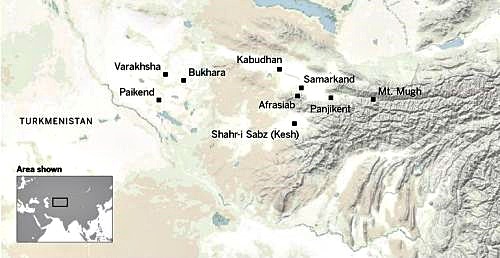
Map of Sogdian cities and settlements. Sogdiana included parts of the modern states of Uzbekistan, Tajikistan, Kazakhstan and Kyrgyzstan. The main cities were Samarkand and Bukhara. It was a form of association of rivaling city states. Map from "Who were the Sogdians".
Only then did the Sogdian nobles revolt against the conquerors, but too late, the entire Sogdian nobility was wiped out.
Furthermore, in 1220 AC, a most of the population was killed by Genghis Khan's Mongol-Turkish armies.
Never the less, the Japanese-Chinese Silk Road Expedition in the early 1980's managed to find an old man in Tajikistan, who still spoke Sogdian.
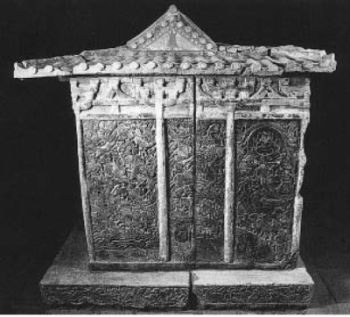
The east wall of the Sogdian's Wirkaks sarcophagus in Xian.
A total of three Sogdian tombs have been found in Xian, some say four.
Furthermore, in 1999, the richly decorated Yu Hong's Tomb was found in a southern suburb of Taiyuan in Shanxi. The most famous tomb is in Xian and belongs to Wirkak and his wife Wiyusi. His Chinese name was Shi Jun. The tomb is a sarcophagus designed as a house, richly decorated with reliefs on all sides. The east wall contains the most interesting motif, which is reminds of of the Scandinavian tale of Hermod's passage over the Gjallar Bridge on his way to the underworld to retrieve Balder from the dead.
Wirkak and his wife died very in a very old age after a long life filled with peaceful deeds, merchant voyages and important negotiations. On his sarcophagus is no hint of struggle and strife. And this is why; they came to Paradise, one can suppose.
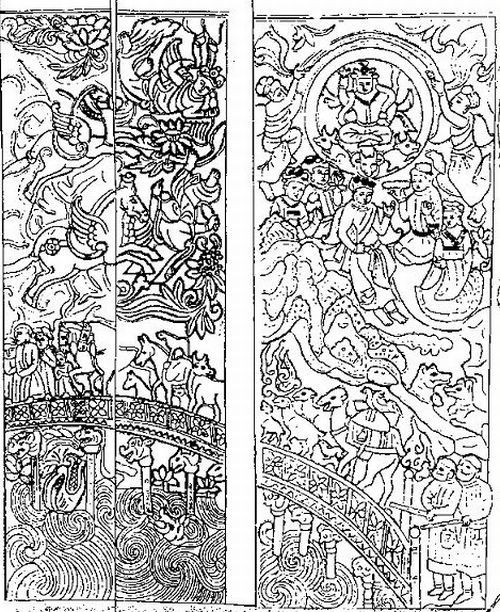
Drawing of the east wall of the Sogdian Wirkak's Sarcophagus in Xian. Wirkak and his wife are on their way over the Cinvat Bridge to the Sogdian Paradise. Top right Wirkak and his wife can be seen feasting in Paradise, over them is the Sogdian God, Wesparkar, who welcomes the deceased.
Upper left the sun god, Mithra, is hovering over the World together with some "apsaras", which are a kind of angels and winged horses. A sinner seemed to be in free fall down towards the water. Under the bridge, monsters are lurking for the sinners, who will be rejected by the guardians of the bridge. On the bridge, the deceased are assumed to meet a fair young woman, who will be the personification of their life's merits.
Scandinavian mythology has a completely similar motive, but as it was reversed.
After Balder's death, Hermod undertook to ride to "Hel", the Underworld, to get him back into the world of the living. Hermod came to the Gjallar Bridge, which the deceased must pass to get to the Underworld. Here Modgun, a young woman, the guardian of the bridge, stopped him. Hermod negotiated the agreement, that if everyone and everything in the whole world would cry because of Balder's death, then he would be released from the Underworld.
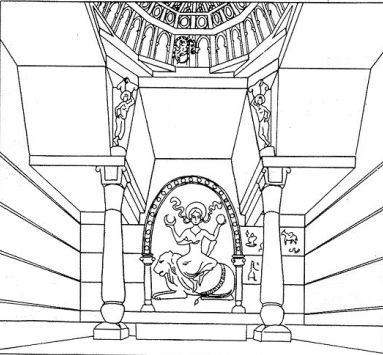
The four-armed godness Nana with the sun in one hand and the moon in the other - sitting on a lion. Drawing from excavation in Uzbekistan.
For the Sogdians, Nana was a very important goddess. Among the Scandinavian Gods, she had a more withdrawn role as Balder's wife.
In the Scandinavian mythology, the World of the deaths on the other side the bridge is a dark and sinister shadow-world. Only men, who die in their beds of illness and disease, will come there. Men who die by weapons will come to Valhalla, a cheerful and wonderful place, where they every day will sit benched at Odin's table along with other heroes.
It looks like, that Aesirs once in tthe past had worshipped the same Arian religion as the Sogdians. But they have dismissed it as a soft and sloppy superstition. They have downgraded the Sogdian Paradise to a dark and sinister underworld. Maybe they changed belief, forced by the harsh necessity of the changing time.
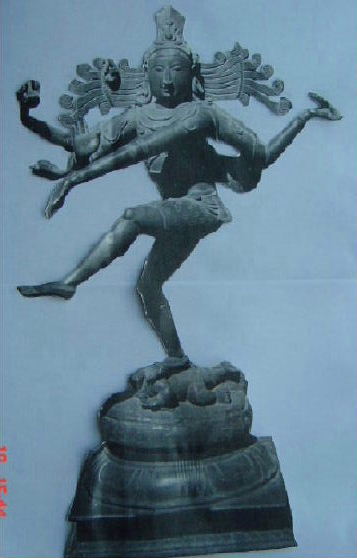
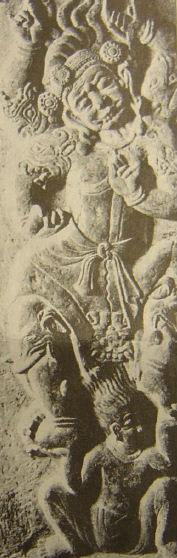
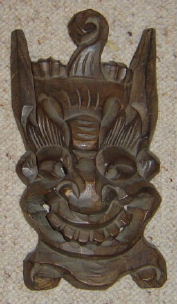
|
Left: An Indian figure from the 1700's who depicts the god Shiva's cosmic dance. Notice the poor man whom the god Shiva is stamping on.
Mid: A stone carving of a dancing god Sogdian god found in Xian on Wirkak's sarcophagus performing the cosmic dance. The God's four arms are radiating from the head and seem to form a swastika-like figure, as we know it from history. The little man below seems to hold up the God.
Right: A traditional Chinese monkey king mask. The dancing Sogdian god's face looks like the very traditional Chinese "Monkey King" mask. It is ugly, and with his teeth standing right out of the mouth.
It is interesting that the Sogdiske findings from China are richer than the findings from Sogdiana itself. One gets the impression that the center of the Sogdiske culture was in China, and Sogdiana was a satellite area.
In the mid-700's, the Tang Dynasty of China was shaken by the An Lushan Revolution, which cost millions of lives and extensive destructions. The majority of Sogdian merchants in China had bad luck in supporting General An Lushan and his proclaimed Yan Dynasty, which after seven years of war ended up as the losing party. We must assume that it cost them their lives and wealth. There were still Sogdians left in China after the civil war, but they most likely did not want to profile themselves and have probably become integrated into the general Chinese population.
The Roman historian Pliny had knowledge of a people called "Ta-gora", who had crossed the river Danais from east to west, together with "other Scythians". (Pliny VI, 22) Yuezhi was by some historians called Tochari, so it can have been them.
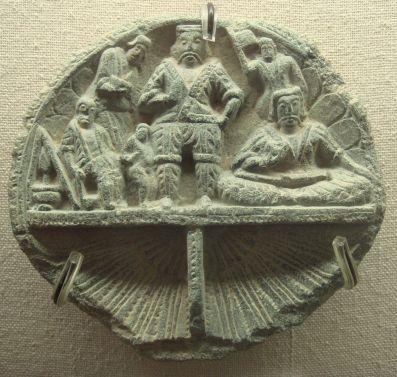
Figure found in India which is believed to represent Yuezhi. They are well dressed according to Indian conditions. Maybe they have been a conservative people - who stuck to their old customs.
In ancient time, two rivers were called Danais, namely the river Don and Jaxartes. It must have happened about 100 AC with a good margin.
In Justin's Prologue of Pompeius Trogus' book XLII we can read: "Reges Tocharorum Asiani interitusque Saraucarum", which means "The Asiani became kings of the Tochari and annihilated the Saka king (in Bactria)". Which must mean that Yuezhi conquered Bacteria from the Greeks. They learned themselves Greek culture, and based on Bacteria, they created their Kushan Empire in present-day Afghanistan, Pakistan and India.
This is the first time we hear about the Aesirs.
When Yuezhi was defeated by the Xioung-Nu king, Modun, the majority of Yuezhi migrated west. This group the Chinese called Da Yuezhi - meaning Great Yuezhi. But a smaller group chose to remain close to their ancestors' land and retreated into the Nanshan Mountains - which is also called Qilian - at the salt lake of Koko Nor. The Chinese called this group Xiao Yuezhi - meaning Little Yuezhi.
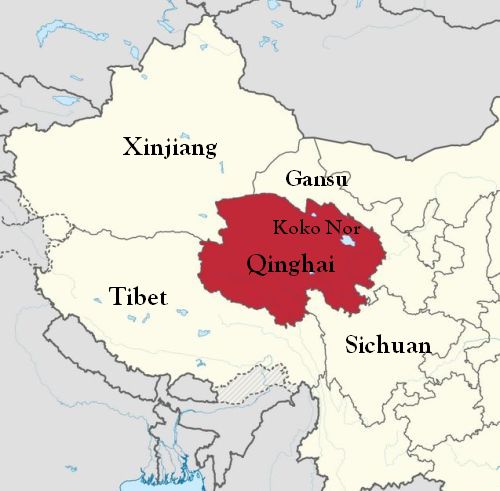
The modern Chinese province of Qinghai with the lake of the ancient name Koko Nor. Today, the Chinese government has chosen to call it Qinghai Lake. The provinces of Qinghai, Tibet and parts of Sichuan and Xinjiang make up the Tibetan highlands. The Nanshan Mountains are located north and west of the lake at the city of Xining.
The Greek geographer Ptolemy (Ptolemy), who lived in Egypt, knew a country called "Tha-gouroi", located in the Nanshan Mountains south of Koko Nor ("The Cambridge History" page 152). Ptolemy lived 90 - 168 AD and the Xianbei tribe Tuyuhun first established their kingdom at Koko Nor in 329 AD Therefore, we can believe that this Tha-gouroi was a Little Yuezhi area.
The Australian SinologistJohn E. Hill believes that the Greek "Tha-gouroi" is a Chinese word "Ta'guo", that is a "Tan-gaard", which has been "Hellenized".
It is well seen by John Hill that the word contains a "-guo" or "-gaard". However, it is not necessary to take the detour over Chinese, because it is an Indo-European name, which it was quite natural for Yuezhi to call their homeland. Chinese is not an Indo-European language, but in the language some words can be identified which are due to Indo-European influence far back in history.

Tan-gaard written in Greek letters.
The Sinologist Rafe de Crespigny writes that "At the end of the Han Dynasty, they could apparently muster about nine thousand armed men in the area, their main centers being the Xi-Ning Valley and the Lianju area" and further "and in Wuwei, with a few groups in northern Zhanggye". Lianju, Wuwei and Zhanggye are areas of northern Gansu.
Another sinologist, Beckwith, confirms that Little Yuezhi lived at Koko Nor. He mentions that the Han Dynasty sent an expedition to the area around Koko Nor in 217 AD to fight the Little Yuezhi tribe that lived there: "Hsia-hou's lieutenant, Chang Ho, crossed Huang-ho (a river in Gansu) and reached Little Huang-Chung's area east of Koko-Nor, home of the Yueh-chih tribe who had been leading the rebellion."
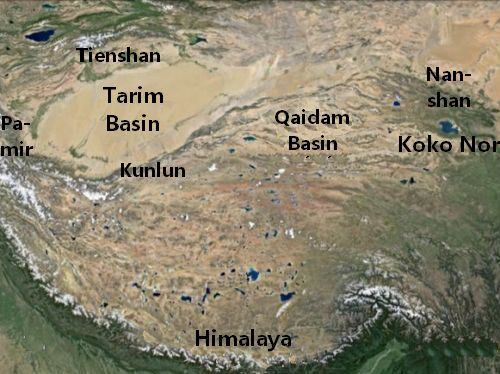
Satellite photo of the Tibetan High Plains with Koko Nor, Qaidam Basin, Tarim Basin and the mountain ranges Himalayan, Pamir, Tienshan, Kunlun and Nanshan, the latter being the mountains east and north of Koko Nor around the city of Xining, which is also located at Koko Nor. Nanshan Mountains is also called Qilian Mountains or is part of this. Foto Pinterest.
However, it is also known that in 329 AD the Tuyuhun Xianbei people created a kingdom centered around the salt lake of Koko Nor and the Qaidam lowlands in the northeastern part of the modern Chinese province of Qinghai.
What happened to the Little Yuezhi people and how the land was taken over by Tuyuhun, I do not know.
Perhaps they had already left the plateau and sought new land to the west, as so many other peoples of the time of the migration did. Perhaps Little Yuezhi was displaced by the invading enemies, or they found some form of coexistence with Tuyuhun. Maybe they were integrated into Tuyuhun; nobody knows.
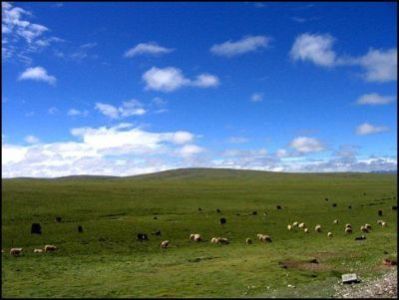
The Tibetan Highlands of Qinghai. Cold and without trees, it can resemble Iceland.
By appearance, Tuyuhun and Yuezhi were most likely not that different. The appearance of the Xianbei tribes was commented by the learned Yan Shigu, who worked at the court of the first Tang ruler, Li Shimi. He wrote in a commentary in Sima Qin's historical work Shi Ji: "Nowadays, these "Hu" people have green eyes, red beards, their appearance is like bearded monkeys, and they are originally of this kind." Since Xianbei, in Yan Shigu's time, was the dominant steppe barbarians, it must have been those he talked about.
We can say very little about Tuyuhun's language, but unfortunately nothing about Little Yuezhy's, except that we think it was a kind of Tocharian.
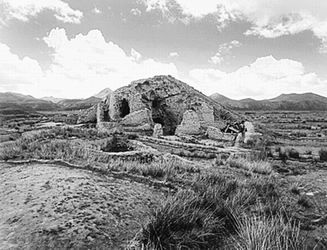
Ancient burial mounds in the Qaidam lowland in Qinghai.
A branch of the Silk Road passed through the Qaidam Basin and it seems to have made the Tuyuhun people quite wealthy. Persian and East Roman coins and hundreds of remains of silk have been found.
Around Koko Nor and in Qaidam the lowland in northeastern Qinghai is found in hundreds of traces of ancient burial mounds, which are believed to originate from Tuyuhun.
Sinologist John E. Hill believes that Tuyuhun was identical to the tribe, Zilu - mentioned in the document, Weilu. He writes: "They gradually grew into a powerful state centered around Koko Nor. They were later known by the Chinese as Tuyuhun, and by the Tibetans as' A-zha. After many years of war, they were finally defeated by the Tibetans in 663 AC and never regained their independence. Some of them fled to the Chinese, others remained and were gradually absorbed among the Tibetans."
This is partially confirmed by Alex Mcay in his book "The History of Tibet" (page 46) where he writes that it was the royal family who called themselves "A-chai", (found in Tibetan Literature as "A-sha" ) while the people were called "Tu-Yu-Hun", Tibetan "Thogon" or "Tho-Yu-Gon".
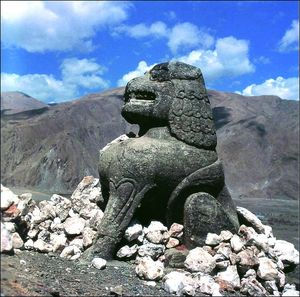
Stone lion in Qinghai perhaps erected by the Tuyuhun people.
In some of the old documents, which Stein and Pelliot brought back from Dun-Huang, it is said that an "Aza" people still had a foothold around Koko Nor about 800 to 900 AC. They made raids into the Chinese Dun-Huang area, where they abducted children and young people as slaves. In modern Tibetan, slaves are still called "tralpas", which reminds of the Scandinavian "thrall".
The nationwide Chinese CCTV 1 Television Channel in cooperation with The Japanese TV brought an excellent series about the Silk Road. Among was an episode about Qinghai, which make up the western part of the Tibetan plateau, where the Little Yuezhi, Tuyuhun and Aza once lived.
The broadcasting showed the Qinghai plateau, which has an altitude of around 3000 m. The landscape reminds about parts of Iceland, as far as I could see. Completely without trees, cold, even in the summertime there can fall snow.
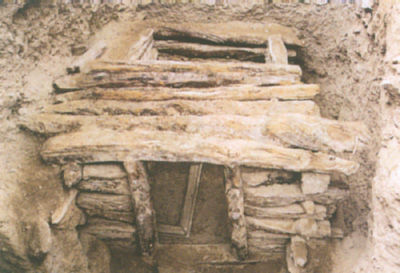
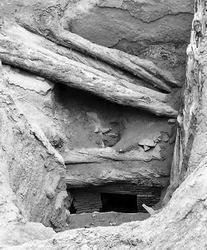
On the plain are a multitude of burial mounds, all robbed once in the past. They are dug up and everything is removed. Large constructions of wood were used for the construction of these mounds. They are build up of layers of logs and soil.
|
Logs of cypress used in Tuyuhun burial mounds.
Then, much of this part of Qinghai has apparently been covered by cypress forests in the past. It can be shown that more big logs were used for the older graves than for the younger graves. It suggests that large trees became increasingly difficult to find. It fits that cypresses grow extremely slowly. Today, the area is completely treeless.
Some Tuyuhun tombs from the Tang Dynasty era are very similar to the tombs of China's northern plain.
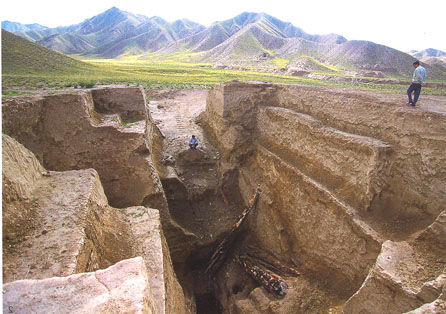
Tuyuhun tomb from the Tang Dynasty period in the Qaidam Basin on the Tibetan plateau.
Despite the tombs being robbed, however, some things have been found in Qinghai.
Most interesting are a silk carpets made with the same technique used in the West and in the Middle East. The reconstructed silk rug motifs showed an apparently dark-haired people with European appearence, big noses, eyes, etc. living an active and cheerful life, they go hunting, drinking and eating some good dinners. Somewhere, someone is vomiting, as if he has had too much to eat and drink. Many other findings indicate that they had good relations with the West and the Greeks in Bactria.
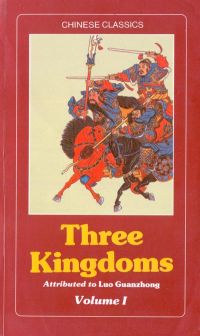
First volume of the Classical Chinese Novel - Three Kingdoms.
In the classic Chinese novel "Three Kingdoms" are also here and there narrated about possible Indo-European peoples in the western mountains and plateaus.
The classical Chinese novels must have the same truth-value as the Icelandic sagas. Person descriptions and details of individuals deeds are certainly fiction, while descriptions of the underlying society and environment are most likely fetched from reality. The details of the underlying environment are the "infinitely small", which may suggest us to believe, that the main characters and the intrigue are also true.
One should know that historical Chinese writers were not very analytical about other peoples living near China. During the Han Dynasty, all western tribes and people were mostly called Xiong Nu. During the "Three Kingdoms" period, the people of the western area were mostly referred to as Qiang. During the Jin Dynasty period, it was common to call people on the plain for Xianbei.
The classic Chinese novel, "Three Kingdoms" gives a very detailed description of the strategy and tactics of the political intrigues and warfare in China during the historical period of the same name, approx. 220 AD to 300 AD. That was in the wake of the collapse of Han Dynasty. The novel was written during the late Yuan Dynasty time, under the domination of the Mongols in 1320 AD, many years after the events it describes. However, using the historical basis given in "The Annals of the Three Kingdoms" written about 300 AD during the Jin Dynasty, which immediately followed the Three Kingdom period.
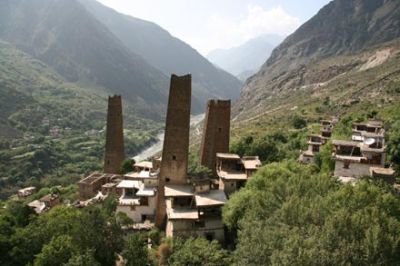
Qiang defense towers in Danba in Sichuan.
"Three Kingdoms" was Mao-Zhe-Dongs favourite reading. Here he got a lot of inspiration about, how he could overcome his enemies with sly means, mainly something with: "let the one enemy's hand beat the other enemy."
King Cheliji of Western Qiang and his minister, Ya Dan, had been persuaded by the King of Wei to take part in the war in China. The king sent thousands of Qiang fighters led by the general, Yu Eji, against the kingdom of Shu. They were armed with bow and arrows, crossbows, spears and swords, iron scepters with spikes and flying hammers.
"Flying hammers" were intended to throw in the face of the unprepared enemy at close range.
They had provision wagons clad with iron plates, pulled by camels or mules. When they camped for the night, they drove the armoured wagons together in a ring and chained them together.
Initially, the Shu troops were defeated: "Suddenly opened the Qiang rows, and their iron wagons came roaring as a tide, and their crossbow shooters filled the air with nails." Their leader stepped forward armed with a steel hammer in his hand and shouted: "I am Marshal Yu Eji, don't go forward any longer little general".
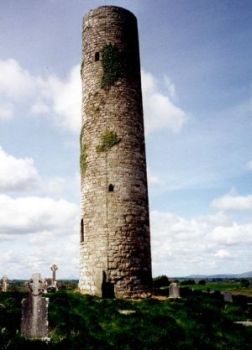
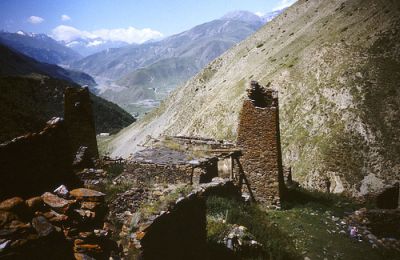
|
Left: Irish defense towers from Meelick.
Right: Defense towers in North Ossetia in the Caucasus Mountains.
"Qiang bases their warfare on raw strength and courage alone. How do they care about intelligent tactics?", said one of the Shu generals.
Ultimately the civilized Chinese defeated the natives with a cunning plan.
Flying hammers like "Mjoelner", Thor's hammer, had a tradition in China. In the "Creation of the Gods", a classic novel about the transition from the Shang to the Zhou Dynasty, is told, that a famous Chinese warrior from the Shang Dynasty had a small but deadly "stringed" hammer, which he used as a throwing weapon. The string made it possible for him to recover the hammer after the throw. Thor's Hammer also had the ability to return to his hand after a throw.
The Qiang king, Ma Teng, was the son of a Qiang father and a Chinese mother. He was "8 span tall with a heroic physics and striking features." (One "span" is a little less than ten inches, which is about 0.24 m, thus the king was close to 1.9 m. tall) ("Three Kingdoms" II page 998 and I page 545).
Ma Teng was lured into an ambush and killed by the King of Wei.
|
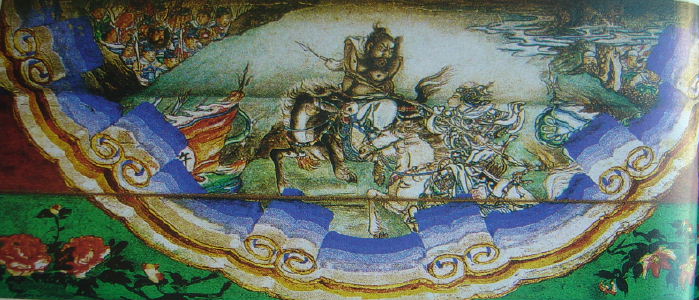
Xu Chu fights against Ma Chao. Picture from the long corridor in the Summer Palace at Beijing.
His son Ma Chao attacked the Kingdom of Wei to avenge his father. The king of Wei describes Ma Chao: "He was bright and white, as he was covered with powder, lips as red as if they were covered by Vermillion, broad-shouldered, narrow around his waist, with a powerful voice and agile physics, dressed in a white armour and helmet." (Three Kingdoms II page 1001). Ma Chao had a lion emblem in his helmet. (Three Kingdoms III page 1173).
In the notes to the "Three Kingdoms" it can be read, that Qiang had a religious relation to white horses, which they sacrificed to their god. ("Three Kingdoms" in the notes page 547, 551).
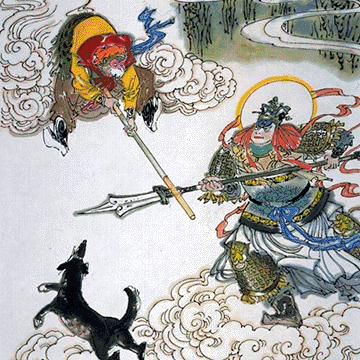
Brother Monkey in battle against one of the West's red-haired devils. A theme from the classic novel Journey to the West.
Another classic Chinese novel is "Journey to the West." It was inspired by the Buddhist monk Xuan Zang's journey to India to fetch holy scriptures. Xuanzang had through several generations purified himself by living a virtuous life. He is exceedingly good, totally unworldly and impractical and was therefore continually in trouble. One monster after another wants to get him and eat him because if they eat his precious purified meat, they will have an eternal life. However, Xuanzang is accompanied by his more earth-bound and practical disciples, who every time save him from being eaten. The various incidents on the road to the west are totally adventurous and have no direct historical relevance. The disciples are Brother Monkey, Brother Pig and Brother Sand. The novel has been developed by professional story-tellers up through Ming and Qing Dynasty, and it must to some extent reflect the common popular ideas of the time about the West and its inhabitants.
During Xuanzang and his disciples travel along the Qilian Mountains or the Nanshan Mountain Range, they are held up by robbers. A poem describes how the robbers look like:
"One's blue face and prominent canine teeth were worse than an evil god's.
The other's outstanding eyes were like death stars.
The red hair at their temples appeared to be in flames.
Their brown (body-) hair was sharp as needles
etc".
("Journey to the West" page 1277)
This must be the professional story-tellers' dramatic notion of what kind of robbers, one would expect to meet at the Nanshan and Kunlun Mountains along the Silk Road near the border of present Qinghai province.
Nobody knows what became of the Yuezhi and Xianbei peoples who lived in the mountains West of China. We can only guess.
I think, they lost their ethnic and national identity and their language and became mixed up with all the other Chinese - those who were not in the past persecuted and exterminated as devils. We must consider that a very large part of the descriptions of the devils in the classic novel "Journey to the West" includes red hair, big eyes and big nose, which - compared to Chinese - are typical Caucasian features.
The fight against the devils is an old and central theme in Chinese culture, and it can not have been completely taken out of thin air.
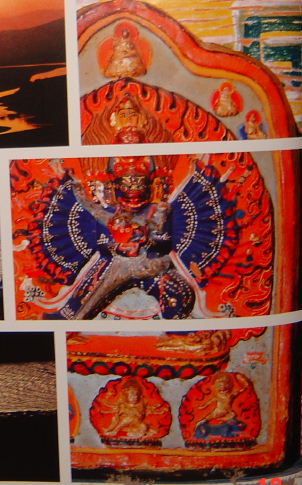
An old Taoist picture board was shown in a flight magazine from Southern China, "Blue Sky Aviation" in connection with a tourism promotion of Sichuan scenic mountains. It was brought without any special comments.
|
Left: A Taoist picture board from Aba county in Sichuan, which depicts a typical devil with red hair, big nose and eyes, surrounded by little devils.
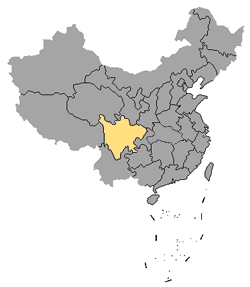
Right: The modern province Sichuan.
Note the head just above the main diabolical figure. It has yellow hair. Note also the little demons bottom right, who has brown hair.
It is from Aba County near the Sichuan border of Qinghai and Gansu, which today is Qiang area.
Today, one cannot find persons in this area with light or brown hair, they are all dark-haired. People which were genetically disposed for light or brown hair seem to have had a very high mortality rate during the history. Only the Chinese-Japanese Silk Road Expedition in the eighties could show a little blond girl from a nomadic people high up in the Qilian mountains.
In modern times, the Chinese provinces of Qinghai and Gansu are mainly inhabited by the Turkish Muslim Hui nationality.
|
Who were the SogdiansThe Freer Gallery of Art and Arthur M. Sackler Gallery, Smithsonian Institution. Tocharian Online - Todd B. Krause and Jonathan Slocum Linguistics Research Center Glossary Tocharian Mithraism - David Fingrut on Bill Thayer's Web Site Mithra's Contributions - Iinnvista Absolute Astronomy - Yuezhi. Notes on the Yuezhi - Kushan Relationship and Kushan Chronology (pdf) om Yuezhi's vandringer. Selections from the Han Narrative Histories Daniel C. Waugh Sogdia Wikipedia Weilu The Peoples of the West John E. Hill Heavenly horses, the four-footed legends of the Silk Road China Watch "Journey to the West" by Wu Cheng'en Foreign Language Press "Three Kingdoms" Foreign Language Press A thank to the homepage "China History Forum" - which unfortunately is not among us anymore - for information and inspiration. |
| To top |
